Opinion
Zambia’s Uranium Find Is a Test for African Industrialization
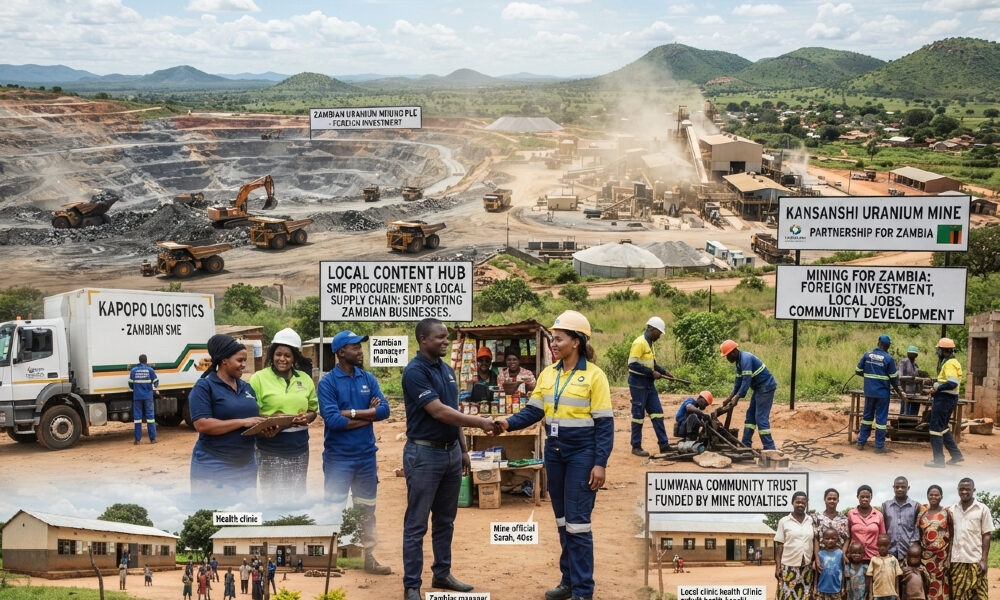
The latest geological triumph in Zambia’s mining sector presents a familiar crossroads. The true test of this discovery will not be measured in tons extracted, but in the economic ecosystem it builds above the soil.


By Martin Mpukani
Geologists are, by temperament, optimists. Give them a drill rig and a radiometric anomaly, and they will find reasons to believe. In Zambia’s Kariba Valley, they now have several. Atomic Eagle, an Australian-listed company, reports that drilling continues to push out the boundaries of uranium mineralization at its wholly owned Muntanga project. The project sits in the Siavonga and Chirundu districts, roughly 200 kilometers (124 miles) south of Lusaka. The company’s combined resource estimate now stands at 58.8 million pounds of U₃O₈ (triuranium octoxide). It has also secured an option on a second prospect, Sitwe, in the Luangwa Valley.
For shareholders in Perth, this is a good story. For Lusaka, Kitwe and Siavonga, the question is harder: what, exactly, is Zambia buying?
African Mining’s Oldest Question
Africa has run this experiment many times. A discovery is announced. Ministers cut ribbons. Investors celebrate. Then the ore leaves by rail or road, the revenue is booked offshore, the catering contract goes to a multinational, and the nearest village is left with a dusty road and a grievance.
Economists have a name for this: enclave economics. A mine becomes a sealed box. Capital goes in, minerals come out, and almost nothing passes through the wider economy on the way. The country is rich in rock and poor in linkages.
Uranium sharpens the problem. It is not copper, with its centuries of Zambian mining know-how and deep pool of experienced contractors. Nuclear fuel is a specialized, tightly regulated product sold into a market driven by geopolitics and long-term utility contracts. A weak government negotiating with a strong buyer has little leverage unless it builds some at home.
Foreign Capital Isn’t the Enemy
Let us be clear about what this argument is not. Zambia needs foreign investment. Exploration is a gamble that most domestic investors cannot afford, and Atomic Eagle’s willingness to fund drilling at its own risk is exactly what a capital-scarce economy should welcome. Developing a uranium mine also requires technical expertise that Zambia cannot yet supply alone. The metallurgy matters, too: test work on the newly discovered Muntanga East deposit achieved uranium recoveries of 81 percent to 86 percent. That is the kind of result that turns a prospect into a project.
The mistake is to treat investment as the destination. Investment is a means. The measure of success is not how many dollars arrive, but how many Zambian businesses, careers and communities are strengthened by them.
Can Zambia Enforce Its Own Rules?
To its credit, Zambia has not left this to chance. Since January 1, 2026, the Local Content Regulations (Statutory Instrument No. 68 of 2025) have applied to all mining and mining-related companies operating in the country. They require companies to dedicate at least 20 percent of annual procurement spending to local Zambian firms supplying core mining goods and services, with that threshold set to rise to 25 percent after two years. Certain non-core goods and services that are critical to operations are reserved exclusively for local companies. There is even a sensible provision allowing mining companies to split large contracts into smaller lots, so that small Zambian suppliers can compete for work.
On paper, this is the right instinct. But rules are only as good as their implementation, and three risks deserve scrutiny.
First, the definition of “local.” The regulations define a local company as a citizen-empowered or citizen-owned company. That sounds robust until you see how businesses respond. Law-firm commentary notes that large suppliers with foreign shareholders are already weighing ways to qualify for local status. Some will do so by genuinely bringing in Zambian partners. Others will do so by renting a Zambian name to a foreign balance sheet. Economists call this “fronting.” A quota met by shell arrangements is a statistic, not development.
Second, the capability gap. A reserved contract is worthless to a firm that cannot win it, finance it or deliver it. Most Zambian SMEs lack the working capital to carry a mining contractor’s payment terms, the certifications to meet safety standards, or the scale to serve a project of this kind. Setting aside work for them without building their capacity is a promise with no delivery vehicle. Zambia’s rules are explicit that they shift procurement from a cost-and-quality exercise to a compliance exercise. Compliance without capability simply raises costs.
Third, the uranium-specific burden. Handling radioactive material is governed by the Ionising Radiation Protection Act of 2005. That means demanding standards of training, monitoring and community safety. If local workers and firms are to participate, they need access to the certifications that make participation safe, not merely a place on a vendor list.
What a Serious Zambian Strategy Measures
Politicians love to announce discoveries. They should be forced to publish outcomes. A credible uranium strategy would track, publicly and annually, a short list of indicators:
- Procurement: the share and value of spending flowing to verified, genuinely Zambian-owned firms, not just registered ones.
- Employment: skilled jobs held by Zambians, including technical and supervisory roles, not only unskilled labor.
- Technology transfer: how many local engineers, geologists and technicians are trained to run, not merely service, the operation.
- Community benefit: what happens in the Kariba Valley itself, in schools, clinics, water and roads, in the years after construction crews depart.
- Fiscal return: the revenue the state actually collects, set against the headline value of the ore.
Each of these can be measured. Each can be missed. That is why they matter.
The Project Is Real – So Are the Milestones
Atomic Eagle is not a speculator’s vapor. Zambia’s environmental regulator approved the project’s environmental and social impact assessment on June 4, 2026, and the company has reported a probable ore reserve of 28 million pounds of triuranium octoxide. The project holds four mining licenses and two exploration licenses along a 146-kilometer (91-mile) strike length. A project at this stage is exactly when a government has the most bargaining power, before construction locks in contracts and habits. Once procurement patterns are set, they are difficult to change.
Beyond the Deposit: Owning the Value Chain
There is a tempting narrative in which Africa’s critical minerals will lift the continent simply by being in demand. They will not. Demand creates opportunity, not outcomes. The outcomes depend on whether African governments, firms and workers are positioned to capture what is created above the ground: the contracts, the skills, the suppliers, the industries that grow in a mine’s shadow.
Zambia has the legal framework to try. The test now is execution: enforcing the rules honestly, closing the fronting loopholes, financing the SMEs that must compete, and holding both government and investors to account for results.
The uranium beneath the Kariba Valley has waited for millions of years. It can wait a little longer for Zambia to get the terms right. The prize is not the ore. It is an economy in which a farmer’s son becomes a technician, a local fabricator becomes a supplier, and a community’s wealth outlives the mine.
That, not the drill results, is the discovery worth waiting for.
Martin Mpukani is a serial entrepreneur and the Founder & CEO of The Business Place Network, as well as the founder of AfriLeap Capital, a hybrid early-stage venture pipeline builder and impact finance partner focused on informal and climate ventures across Africa. He is dedicated to supporting entrepreneurs in low-income communities, empowering young people with limited opportunities, and driving scalable ventures that foster economic growth and social impact.