Opinion
Zambia’s Data Refusal Is a Warning Shot to Washington


By Charles F.V. Chitekwe
Across Africa, a quiet but consequential revolt against conditional aid is gathering momentum – and the United States should pay close attention.
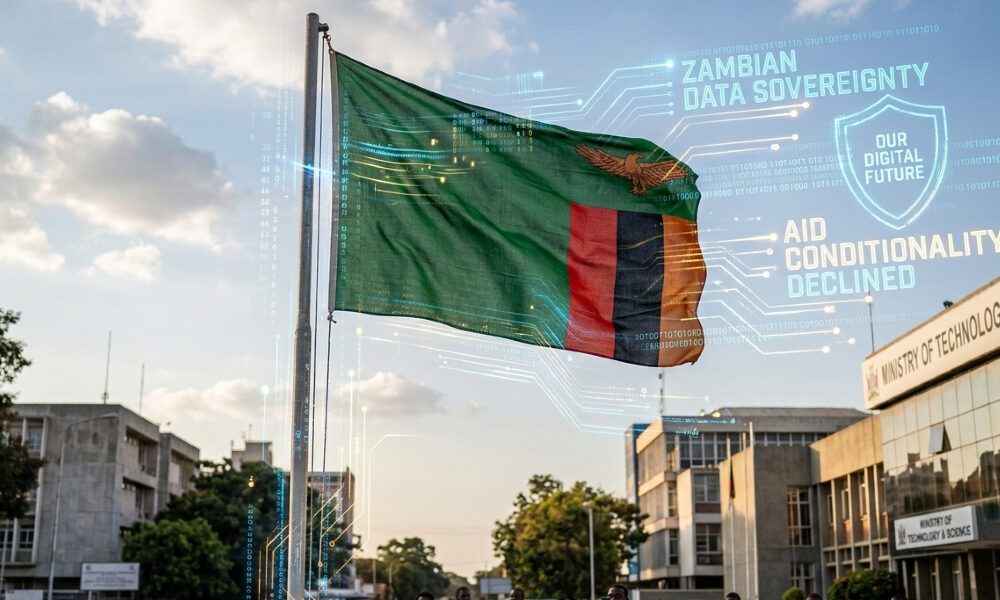
When Zambia declined a U.S. health funding package earlier this year, the decision barely registered in Western headlines. It should have.
According to reporting by TRT Afrika, the offer – extended under the Trump administration – was contingent on granting American officials access to sensitive categories of Zambian health and demographic data. Lusaka said no. In doing so, it joined a growing cohort of African governments that are beginning to treat data not as an administrative afterthought, but as a sovereign asset worth protecting.
The decision was not anti-American. It was, in a deeper sense, pro-Zambian.
The New Geopolitics of Data
To understand why Zambia’s refusal matters, one must first understand what was actually on the table. Health records, biometric registries, digital identity frameworks, and population datasets are no longer merely bureaucratic tools.
In an era defined by artificial intelligence, predictive analytics, and digital infrastructure competition, access to citizen data carries profound economic, political, and national security implications. Whoever controls that data – whether to model disease spread, map population demographics, or train machine-learning systems – holds meaningful leverage.
This is precisely why the terms embedded in the proposed funding package alarmed Zambian officials. The concerns raised were not abstract: data sovereignty, privacy rights, and national security are categories that any government, in any region, would be right to scrutinize.
The fact that the offer was tied to a health package – an area of acute need for many developing nations – only sharpens the ethical edge of the arrangement.
Aid With Strings Is Not New. The Response Is.
Conditional financing has, of course, a long history in international development. From structural adjustment programs administered by the International Monetary Fund in the 1980s to contemporary grant frameworks stipulating governance benchmarks, donor nations and multilateral institutions have routinely attached conditions to capital flows.
African governments have, historically, had limited leverage to push back.
That calculus is shifting. Across the continent, a generation of technocrats, policymakers, and civil society leaders has become far more sophisticated in assessing what agreements actually cost – not merely in fiscal terms, but in terms of regulatory autonomy, digital infrastructure control, and long-run strategic positioning.
Zambia’s decision reflects this maturation. It was not a rejection of partnership with the United States. It was a renegotiation of its terms.
The Broader Continental Shift
Zambia is not alone. From debates over Chinese-built telecommunications infrastructure in Nigeria and Kenya to legislative efforts to localize data storage in South Africa and Rwanda, African governments are actively constructing frameworks to govern how citizen data is collected, shared, and monetized.
The African Union’s Data Policy Framework, adopted in 2022, signals a coordinated continental intent to assert digital sovereignty at scale.
What is emerging, in effect, is a new set of ground rules for external engagement – one in which foreign actors, whether governments or corporations, can no longer assume that development funding automatically purchases access to sensitive national systems. The era of frictionless data extraction in exchange for aid dollars is ending.
A Challenge Washington Must Reckon With
None of this should be read as hostility toward American engagement in African health and development. U.S. investment through programs such as PEPFAR has saved millions of lives and built genuine goodwill across the continent.
That legacy is worth preserving. But preserving it requires recognizing that the world in which PEPFAR was designed has changed.
Attaching data-access provisions to health funding does not merely risk individual agreements falling apart – it risks poisoning the well of American soft power at a moment when Washington is competing for influence with Beijing, Brussels, and an increasingly assertive Gulf. If the United States wants to be a trusted partner in Africa’s development, it must structure its engagements in ways that respect the sovereignty of the nations it claims to support.
The question confronting American policymakers is not whether to engage with Africa. It is whether they can build partnerships that deliver genuine impact without treating recipient governments as subordinates.
Zambia, for its part, has offered a clear answer to what it will and will not accept. Africa is no longer waiting to be written into someone else’s strategy. It is writing its own.
Charles F.V. Chitekwe is a diplomat and global relations specialist at the Alpha Sirius Foundation, where he advises heads of state, senior policymakers, and international delegations on Africa-focused diplomacy, trade, and development strategy. He advocates for a unified African position in global negotiations, promoting innovation-driven growth, investment, and economic self-reliance over aid dependency. He writes on African development, pan-African finance, diaspora investment, and the role of AI and technology in accelerating the continent’s economic transformation.