A Diaspora View of Africa
Women’s roles in African and Diaspora societies


By Gregory Simpkins
In recent decades, women throughout the African Diaspora and the rest of the world have struggled to attain some level of equity in their societies. Ironically, that is where African societies started before the colonizers arrived.
According to the Oxford Research Encyclopedia, in precolonial Africa, relations between women and men were varied, changing, and culturally specific, yet there were some common themes. Most African societies attempted to attain forms of heterarchy, i.e., they often created several centers of authority and aspired to establish communities where gender relations between women and men were equitable.
Additionally, throughout history most Africans determined status by the amount of labor a group or individual could control, and in a historically underpopulated continent, this meant that motherhood and giving birth to children was especially important. The result is that women, as both biological and social mothers and as grandmothers, were highly respected throughout the history of the continent. The earliest ancestors of modern humans originated in Africa, and so the history of women starts earlier in Africa than anywhere else, probably around 200,000 BCE.
The encyclopedia cited anthropologists of early humanity as having proposed that the most successful human families in the earliest eras were based on family units that situated grandmothers at the center, a family structure found in many parts of the Diaspora in the early 21st century. Around 5,500 years ago, a small group of Bantu-speaking people migrated from West Africa and over time populated large portions of Africa below the Sahara Desert.
Heterarchy and gender equity were features of most Bantu-speaking societies. Their worldviews were manifested in the matrilineal social structure that most Bantu societies preferred until recent history. Even the earliest empires in Africa, Nubia and Egypt, were organized matrilineally.
The West African Sahel empires from 700 BCE were also matrilineal, and there is a long history of Muslim African female rulers. Such social structures are familiar in the Diaspora. In America, “Big Mama,” the elder woman in a family, has long been considered the authority on tradition and has often been the center of the larger family unit. This evidently is a holdover from ancient Africa and not just a fallback due to the increasing absence of males in families.
Colonial distortion
However, with the creation of empires and more centralized societies, hierarchy among some societies replaced heterarchy. This change motivated a shift in gender relations: Women from elite lineages maintained their status, while other women tended to lose their traditional positions of authority as mothers and elders within their clans, and the struggle for general equity has continued.
Colonization in sub-Saharan Africa brought Western notions of appropriate gender roles and skewed the political system towards male representation by only allowing men in government administration, despite the history of women’s political leadership and comparative gender equality in the region, stated the Center for Global Development (CGD) in a recent study.
While there was not a similar tradition of women’s leadership in Latin America and the Caribbean (LAC) prior to colonization the study cited, the much earlier advent of independence created space for the emergence of women’s rights advocates, leading the fight for women’s political equality in regional and international fora.
The hangover from the European concept of gender roles has not been eliminated, and there remains a conflict between men and women on the basic social level.
The Atlantic slave trade worsened heterarchical social relations and threatened women’s authority and status in West Africa further. Another element of this period is the transference of African gender relations to the Americas.
During the 19th century, as Europeans arrived in greater numbers, they imposed new gender ideologies as they began to structure how the rest of the world viewed Africans. From the so-called White Man’s Burden to Social Darwinism, new definitions of the Other placed African women at the bottom of this new social order.
While women played key roles in the long-term history of Africa, the Western analysis of African gender dynamics began to inform colonial policies, dominate world opinion, and shape academic research, according to CGD. The Global Gender Gap Index report published in 2018, predicted it would take 135 years to close the gender gap in sub-Saharan Africa and nearly 153 years in North Africa.
Progress seen in gender roles
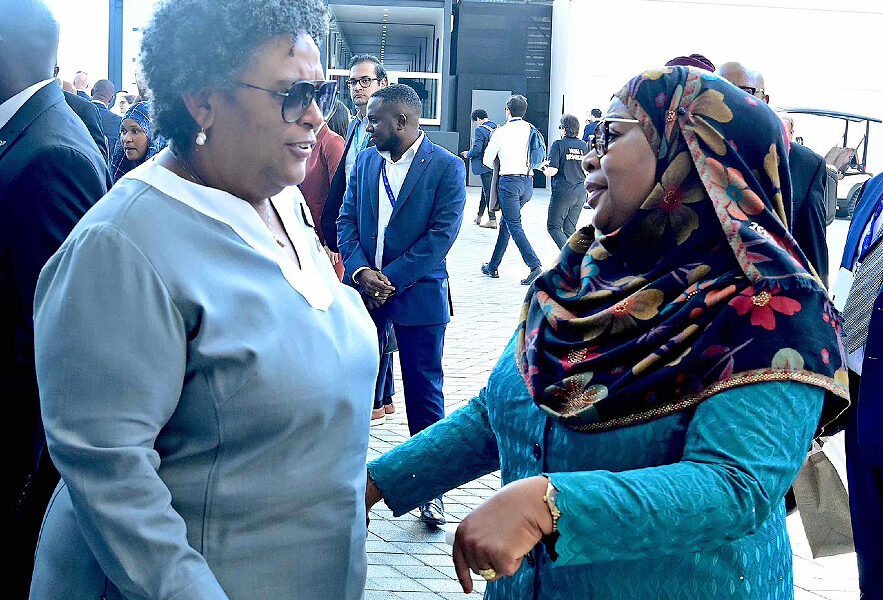
That period may pertain to societies as a whole, but women in Africa and the Diaspora have risen to the forefront in the last decade. Females have achieved presidencies in Liberia (Ellen Johnson Sirleaf), Malawi (Joyce Hilla Banda), Mauritius (Ameenah Gurib-Fakim), Tanzania (Samia Suluhu-Hassan) and Ethiopia (Sahle-Work Zewde). In the Caribbean, female Prime Ministers include Mia Mottley (Barbados), Portia Simpson-Miller (Jamaica), Michèle Pierre-Louis (Haiti) and Dame Mary Eugenia Charles (Dominica).
For the first time in U.S. history, one of the two major political parties – the Democrats – have nominated a woman of color as its presidential nominee. Black women reportedly are much more enthusiastic about this development than black men.
In addition to the highest-ranking offices, women in Africa and the Diaspora have become legislators, governors, mayors and have held other offices. This has been the result of various factors. Of course, persistent political efforts have achieved much of this progress, but there are other means by which females have assumed political office.
In countries such as Kenya and Uganda, and in the Caribbean, there have been political set-asides for women officeholders. In war-torn countries such as Rwanda, where some communities were up to 80 percent female, the shortage of men have accelerated female political participation at ever higher levels.
Women in Africa and the Diaspora have become business and community leaders as well, but what about the general roles for women in society? The hangover from the European concept of gender roles has not been eliminated, and there remains a conflict between men and women on the basic social level. This hangover has caused resentment among some African and Diaspora males who have had to adjust to the current circumstances.
The Gender Gap report states that while gaps in educational attainment and health and survival are relatively similar across geographic regions, gaps in political empowerment and economic participation vary widely. For example, sub-Saharan Africa has among the lowest gender gaps in economic activity (which includes labor force participation and estimated income earned), while LAC and European countries score around the same level, despite having much smaller gaps in political empowerment. Paradoxically, having high levels of women’s political representation does not seem to make much difference for levels of women’s economic participation.
It has taken more than a century to overcome the residual impact of colonialism and slavery. We are not yet there, but we’re getting there.
Gregory Simpkins, a longtime specialist in African policy development, is the Principal of 21st Century Solutions. He consults with organizations on African policy issues generally, especially in relating to the U.S. Government. He further acts as a consultant to the African Merchants Association, where he advises the Association in its efforts to stimulate an increase in trade between several hundred African Diaspora small and medium enterprises and their African partners.