A Diaspora View of Africa
Will Western Sahara’s Conflict Reignite?


By Gregory Simpkins
Western Sahara, a territory the size of the American state of Colorado is designated by the United Nations as a non-self-governing territory, making it the largest disputed territory in the world.
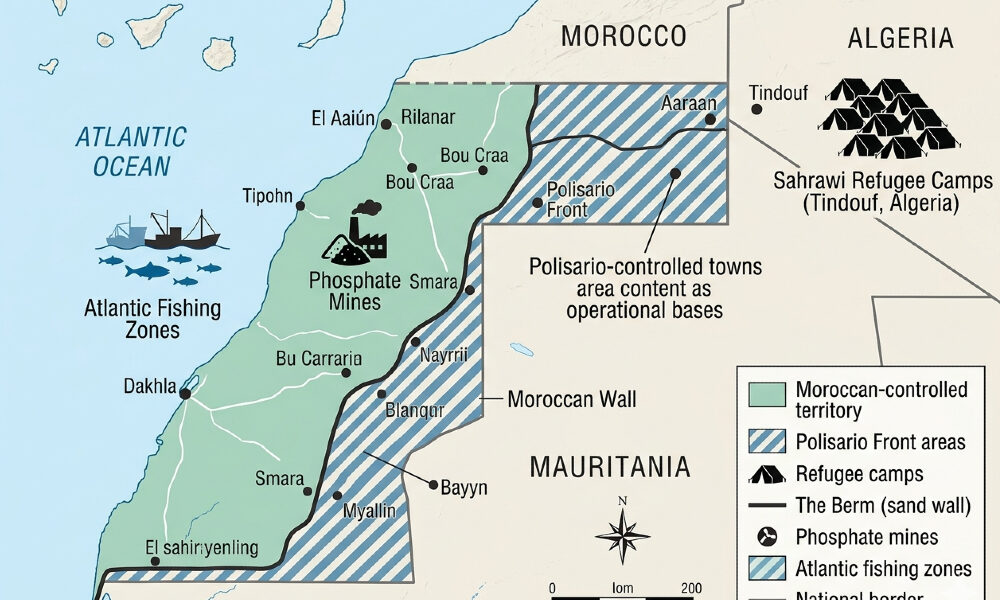
Western Sahara borders Algeria, Mauritania and Morocco, with the latter controlling about 80 percent of the territory. The eastern area is controlled by the Polisario Front, a nationalist military group consisting of members of the Sahrawi ethnic group, who are native to the region.
In a April 3 article in Business Insider, the territory was described as holding political significance for its phosphate rock reserves, offshore fishing and location on the Atlantic coast. While Morocco claims Western Sahara as its own, the Polisario Front proclaims the territory to belong to the Sahrawi Arab Democratic Republic (SADR).
Many Sahrawi people reside in refugee camps on the Algerian border.
A Territory’s Path to Conflict
Western Sahara was a Spanish colony from 1884, with Spain merging the territories of Saguia el-Hamra and Río de Oro to form the province of Spanish Sahara in 1958. The Sahrawi people, a nomadic group, began to settle in the region in the 1960s, and a nationalist movement emerged, particularly among Sahrawi students at Muhammad V University in Morocco.
The Polisario Front was formed in 1973 with Algerian assistance to battle Spanish occupation. After Spain announced plans to hold a referendum, Morocco and Mauritania claimed the territory, leading to the Green March in 1975, where 350,000 Moroccans crossed into Western Sahara to settle there.
Spain withdrew in 1976, and Morocco and Mauritania divided the territory. The Polisario Front proclaimed the SADR and waged a 16-year war for independence against Morocco and Mauritania.
Mauritania withdrew in 1979 and became a Polisario ally, and Morocco annexed the territory.
Meanwhile, Sahrawi refugees fled to Algeria, where they live in five camps in Algeria’s Tindouf Province that are mostly named after the cities from which their inhabitants fled: El Aaiun, Awserd, Smara, Dakhla and Cape Bojador (also known as the Daira of Bojador). The camps sit near the Algeria-Western Sahara border and are managed by the Polisario Front.
Polisario officials affirm Laayoune (which they call El Aaiun) as its official capital, but governance is carried out in other controlled cities and outposts, as well as in the refugee camps in Tindouf.
The SADR is only recognized by 47 countries globally, a number dwindling amid the growing support for Morocco’s autonomy proposal, according to the US Committee for Refugees and Immigrants. However, Morocco withdrew from the Organization of African Unity (OAU) – the precursor to African Union (AU) in 1984 due to the admission of the SADR as a member state.
Morocco rejoined the African Union on January 30 2017, after a 33-year absence, with 39 out of 54 member states voting in favor of its readmission. The SADR remains a member of the AU, and Morocco’s return does not affect its membership.
The Western Sahara conflict remains unresolved, and Morocco’s return to the AU has raised questions about the country’s stance on the SADR’s independence claims.
The UN has attempted to mediate the conflict, but progress has been limited largely because of geopolitical considerations.
Division, Displacement and Ongoing Repression
After asserting control over the territory, Morocco began building a huge 2,700-km-long (1,678-mile-long) sand-berm dividing the territory longitudinally into two regions. The western side is occupied by Morocco, while the eastern side, the so-called “free zone,” is controlled by the Polisario Front.
It is estimated that between 30,000 to 40,000 inhabitants live in this landlocked swath of desert next to Algeria and Mauritania, mostly in refugee camps or as nomads. The territory has never seen the referendum on independence promised for the native Sahrawis.
As a result, many activists dub the territory “Africa’s last colony.”
In October 2010, Sahrawi demonstrators erected a camp near Laayoune in protest of alleged human rights abuses. Violence ensued after Moroccan forces clashed with protesters, resulting in 13 deaths, Amnesty International reported, though Moroccan officials and the Polisario Front each claim higher death counts.
The fighting between Morocco and the Polisario Front resumed after protesters blocked an important road in the territory, leading Moroccan forces to launch an operation to clear the barricade. The Polisario Front then declared the ceasefire to be over.
Amnesty International reported that authorities in the Moroccan-controlled parts of Western Sahara have repressed dissent and peaceful assembly of Sahrawi people, such as an incident in January 2024 where police “subjected protesters to beatings,” the organization said.
Morocco Benefits Economically from the Territory
At the large Bou Craa mine, rocks of phosphate are placed on the world’s longest conveyor belt, and transported to the El Aaiún harbor, 100 kilometers (60 miles) to the west. From there, cargo vessels transport the phosphates from the occupied part of Western Sahara to importers overseas for fertilizer production.
The industry has been providing Morocco with huge revenues since the start of the occupation.
Morocco is the sole beneficiary of phosphate mining in Western Sahara. Critics say the mining violates international law, citing a UN legal counsel’s 2002 opinion that the extraction of mineral resources would be illegal if they were carried out “without respect to the interests and wishes of the people of Western Sahara.”
While fishing off the Western Sahara coastline is lucrative, the practice has been marked by controversy in recent years. For more than 15 years, a Moroccan fishing agreement with the European Union allowed European member states to participate in offshore fishing.
The agreement expired in 2023. In 2024, the EU’s top court ruled that the trade deals were carried out and concluded without the consent of the Western Saharan people.
There is also speculation that there may be off-shore oil and natural gas fields. According to leaked United States diplomatic cables, by Wikileaks, the region might actually be an economic burden for Morocco.
Extracts from the leaked cable:
Existing infrastructure is good and cash flow is buoyed by a large military presence, tax breaks for businesses, subsidies on fuel, and a five-year, US$800 million investment package from the Government of Morocco (GOM). Still, the territory faces serious economic challenges: unemployment over 20 percent, a rapidly expanding urban population, scarce water resources, and threatened fishing grounds – source of employment for 70 percent of the region’s workers. The Western Sahara’s much-touted phosphate reserves are relatively unimportant, representing less than two percent of national holdings.
The cable concluded that the territory is unlikely to ever be of any economic benefit for Morocco even if offshore oil fields were to be discovered and exploited.
Geopolitics Affects Western Sahara’s Prospects
In 2020, the United States recognized Morocco’s sovereignty over Western Sahara in exchange for Morocco normalizing relations with Israel. The US government during the George W. Bush administration, had tried to negotiate a way forward for Sahrawi independence in the territory, but Moroccan intransigence forestalled progress, and needing Muslim support for Israel, the administration made the deal to gain something significant from their stalled independence efforts.
In recent years, a growing number of nations have supported Morocco’s autonomy plan, which proposes autonomy for Western Sahara but maintains Moroccan sovereignty. Morocco World News cites 120 countries that back the proposal, and countries across the world have increasingly opened consulates in Moroccan-controlled Western Sahara.
The support for Morocco’s plan is due in part to that country being seen as a moderate Muslim nation that has been an interlocutor in Middle East peace talks.
The UN has attempted to mediate the conflict, but progress has been limited largely because of geopolitical considerations. That doesn’t mean that success in negotiations is impossible, however.
When I worked for the Leon H. Sullivan Foundation back in the early 2000s, we presented a version of the Sullivan Plan for South Africa tailored to the Western Sahara situation. Through several visits to the Tindouf camps while I worked for Congress and through talks with the Moroccan embassy officials in Washington, I had established contacts that allowed for at least discussion on a proposal that had something in it for both sides.
Unfortunately, nothing came of it before I left the Foundation, despite initially positive reactions on both sides.
I point this out merely to illustrate that there is a possibility for some lasting resolution to this long-running dispute because both parties recognize the fragility of the current situation. During my visits to the Tindouf camps and subsequent conversations with Polisario representatives, it became clear that the status quo is not sustainable.
Some young Sahrawis, frustrated by the long stalemate and the limits of refugee status, have either become radicalized by extremist elements or fallen in with regional criminal groups. Consequently, this is a situation that must not be ignored for much longer lest a sudden surprise outbreak of violence add to the ongoing conflicts on the African continent.
Gregory Simpkins, a longtime specialist in African policy development, is the Principal of 21st Century Solutions. He consults with organizations on African policy issues generally, especially in relating to the U.S. Government. He further acts as a consultant to the African Merchants Association, where he advises the Association in its efforts to stimulate an increase in trade between several hundred African Diaspora small and medium enterprises and their African partners.