Owusu on Africa
Why Xi Jinping Is Invoking History in His Talks with Zimbabwe


By Fidel Amakye Owusu
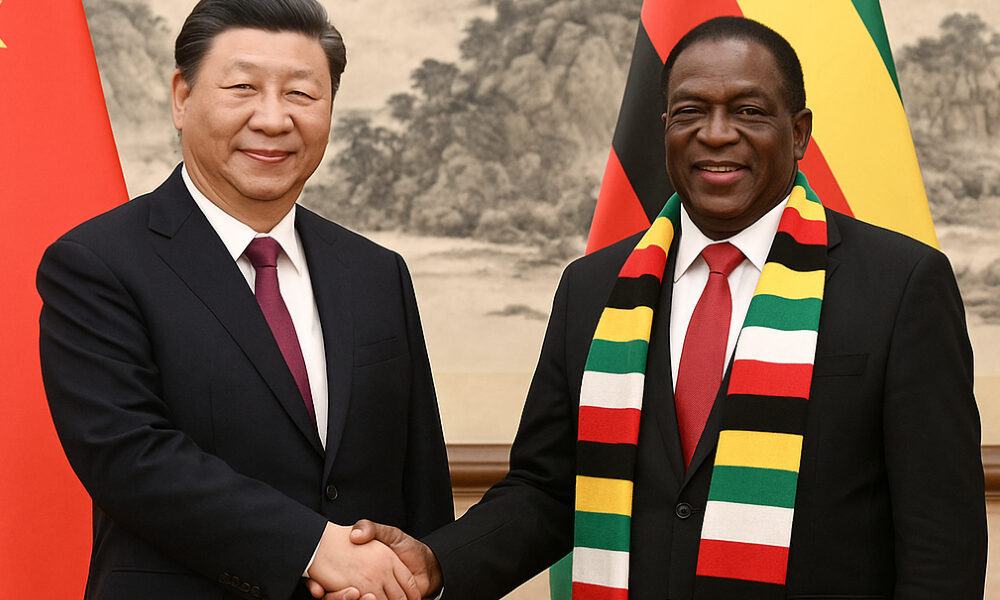
Last week, global attention turned to Beijing as China staged an elaborate commemoration marking the 80th anniversary of World War II. Among the delegations in attendance was Zimbabwe’s President, who, after the ceremonies, engaged in high-level talks with President Xi Jinping.
The meeting went beyond ceremonial courtesies. Xi called on both nations to “jointly remember history and firmly safeguard world peace,” while urging deeper bilateral cooperation.
At first glance, this may appear to be the standard language of diplomacy. Yet in China’s playbook, words are seldom careless.
Beijing’s leaders weigh rhetoric with precision, knowing language itself is a powerful foreign policy tool. Xi’s choice to frame the Zimbabwe talks in historical terms underscores how Beijing leverages shared struggles of the past as a foundation for advancing its strategic goals today.
A Legacy of Revolutionary Ties
For Zimbabwe, history means the liberation war against white minority rule that began in the 1960s. China played a pivotal role in supporting the independence struggle, backing Robert Mugabe’s faction until Zimbabwe finally achieved sovereignty in 1980.
Although both the Soviet Union and China aided liberation fighters, Beijing’s alignment with Mugabe cemented a relationship distinct from Moscow’s.
It is this revolutionary bond Xi seeks to revive in today’s context. By invoking shared sacrifices, China positions itself as Zimbabwe’s trusted partner – one that stood by the nation in its darkest hour and thus deserves priority in present-day cooperation.
Zimbabwe’s Strategic Importance Today
Zimbabwe’s natural resources are central to this renewed relationship. The country holds vast deposits of platinum group metals (PGMs), chromium, gold, and increasingly coveted lithium – critical for China’s industrial ambitions and energy transition strategy.
Beijing sees itself as entitled to preferential access, a perception strengthened by its non-colonial history in Africa. Unlike Western powers, China cannot be accused of having enslaved or colonized Zimbabwe.
And unlike the United States and Soviet Union, whose Cold War rivalries defined the region, Beijing claims relatively lighter historical baggage.
But history alone cannot mask the controversies surrounding China’s presence in Africa today. In recent years, Chinese-backed projects have generated resentment, fueled by concerns about unsustainable debt, environmental degradation, and labor disputes.
Just last week, revelations emerged that a Chinese mining operation in Zambia had polluted vital rivers with toxic chemicals – including arsenic and cyanide – threatening millions of people.
Other African governments, such as the Democratic Republic of Congo, have begun pushing to renegotiate mining contracts, reflecting a growing wave of resource nationalism. These disputes challenge China’s narrative of being a benign partner.
The Politics of Memory
This is why Xi leans so heavily on history. For Beijing, memory is less about nostalgia and more about strategy.
Invoking ties forged in the liberation era softens current tensions and provides moral cover for controversial economic engagements. It offers a narrative of friendship and loyalty that Beijing hopes will outweigh present misgivings.
The Road Ahead for Africa
Ultimately, the question is not how China frames its involvement, but how African states negotiate their own interests in this delicate balancing act. Historical solidarity may open doors, but the true measure of partnership lies in equitable terms and tangible benefits for African societies.
As Xi Jinping invokes the past, African leaders must remain firmly grounded in the present – leveraging partnerships, yes, but without surrendering sovereignty or the long-term interests of their people.
Fidel Amakye Owusu is an International Relations and Security Analyst. He is an Associate at the Conflict Research Consortium for Africa and has previously hosted an International Affairs program with the Ghana Broadcasting Corporation (GBC). He is passionate about Diplomacy and realizing Africa’s global potential and how the continent should be viewed as part of the global collective.