Owusu on Africa
Why Personal Bonds Between Military Commanders Matter for African Security
The African Land Forces Summit reveals an underappreciated truth: institutions alone cannot hold the continent’s security architecture together.


By Fidel Amakye Owusu
Africa’s security paradox is hiding in plain sight. With 54 sovereign states – more than any other continent – Africa has an extraordinary number of borders to manage, most of them porous, many of them cutting through the homelands of ethnic groups who predate the nations themselves.
The resulting complexity has defeated some of the most ambitious multilateral security frameworks the continent has attempted.
The G5 Sahel has unraveled. The Accra Initiative has gone dormant. The East African Community and Southern African Development Community missions in the Democratic Republic of Congo have both collapsed. The Multinational Joint Task Force of the Lake Chad Basin continues to struggle. Each of these frameworks has been undermined by a familiar set of pathologies: mutual suspicion born of proxy conflicts, diverging national security priorities, intelligence-sharing deficits, and the long shadow of historical grievances between neighboring states.
Yet at this year’s African Land Forces Summit (AFLS), something quieter – and perhaps more durable – was on display.
The Diplomacy That Doesn’t Make Headlines
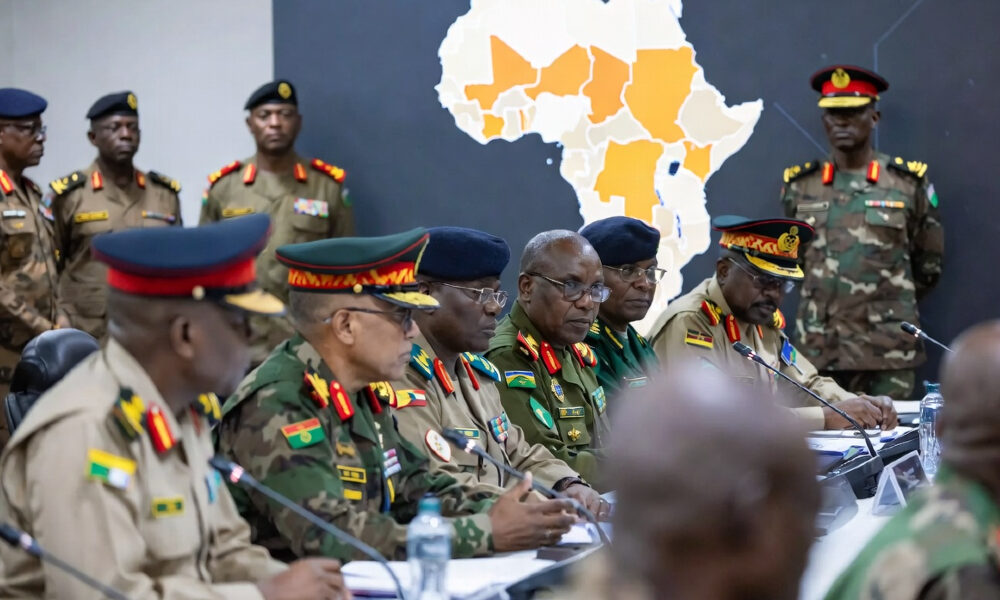
Between the formal sessions and structured panels, the summit’s most consequential moments may have been the informal ones: senior land force commanders from across the continent in direct, substantive conversation with one another, and with representatives from the private sector and international partner organizations. These were not the perfunctory exchanges of diplomatic protocol.
They were the kinds of deliberate, trust-building interactions that rarely appear in communiqués but often determine whether cooperation survives contact with political reality.
For civilian officials, a productive sideline conversation is a useful networking opportunity. For military commanders, it can be something more – a foundation for operational coordination when formal structures are absent, paralyzed, or politically compromised.
When Institutions Falter, People Fill the Gap
Those who conduct individual-level security analysis understand this dynamic well. Institutional frameworks set the parameters for cooperation, but it is interpersonal relationships – the chemistry between specific commanders, the accumulated credibility of prior engagements – that determine whether those frameworks function under pressure, or at all.
This is not a novel insight in security studies, but it is a persistently underweighted one. When a regional security mechanism stalls over a sovereignty dispute or a funding shortfall, it is often a prior personal relationship – a shared training exercise, a frank conversation at a summit, a direct line between two officers – that keeps some degree of coordination alive at the operational level.
Forums like the AFLS serve precisely this function. They create the conditions for relationships that can outlast the particular institutions of the moment, surviving the retirement of individual commanders and the realignment of regional politics.
In a continent where security architectures are in constant flux, that kind of resilience is not a soft benefit. It is a strategic asset.
The Long Game
None of this is an argument against investing in formal regional security institutions – quite the opposite. Robust multilateral frameworks remain the goal. But the persistent failure of those frameworks to achieve their potential should prompt a more serious reckoning with the human architecture that underpins them.
Africa’s security challenges are structural. Their solutions will require structural responses. But structures are built and sustained by people, and people cooperate most effectively when they know, respect, and trust one another. Great things have often emerged from words exchanged between individuals – and in the realm of continental security, that observation deserves to be taken seriously.
The African Land Forces Summit may not resolve the deep tensions that have undermined regional cooperation. But if it produces a generation of commanders who have looked each other in the eye and found common ground, it will have accomplished something that no treaty text alone can guarantee.
Fidel Amakye Owusu is an International Relations and Security Analyst. He is an Associate at the Conflict Research Consortium for Africa and has previously hosted an International Affairs program with the Ghana Broadcasting Corporation (GBC). He is passionate about Diplomacy and realizing Africa’s global potential and how the continent should be viewed as part of the global collective.