Opinion
Why Africa’s “Cheap Labor” Advantage Is a Dangerous Myth


By Dishant Shah
The unit economics of manufacturing reveal that low wages mean little without productivity to match.
The conventional wisdom about African manufacturing rests on a seductive simplicity: labor costs US$3 per hour in Ethiopia versus US$8 in Vietnam, therefore Ethiopia wins. This logic has guided countless investment decisions and development strategies.
It is also fundamentally wrong.
Labor that costs US$3 per hour isn’t cheap if it produces US$2 per hour of value. The critical metric isn’t what you pay workers – it’s what you pay per unit of output.
When measured against this standard, Africa’s presumed wage advantage dissolves into a mirage.
The productivity gap that erases the wage gap
Consider two garment workers, one in Dhaka and one in Addis Ababa, each earning roughly the same hourly wage. The Bangladeshi worker completes twelve units per hour.
Her Ethiopian counterpart completes five. The cost per garment has just tripled, even though the wage remained constant.
The cheaper worker has become the more expensive producer.
This productivity disparity doesn’t reflect individual capability or work ethic. It reflects everything surrounding the worker: the systems, processes, and infrastructure that either enable or constrain output.
The Bangladeshi factory operates with fifteen years of accumulated refinement. Managers have scaled production repeatedly. Maintenance teams preempt equipment failures.
Supply chains deliver materials on predictable schedules. Workers execute standardized processes that have been optimized through thousands of iterations.
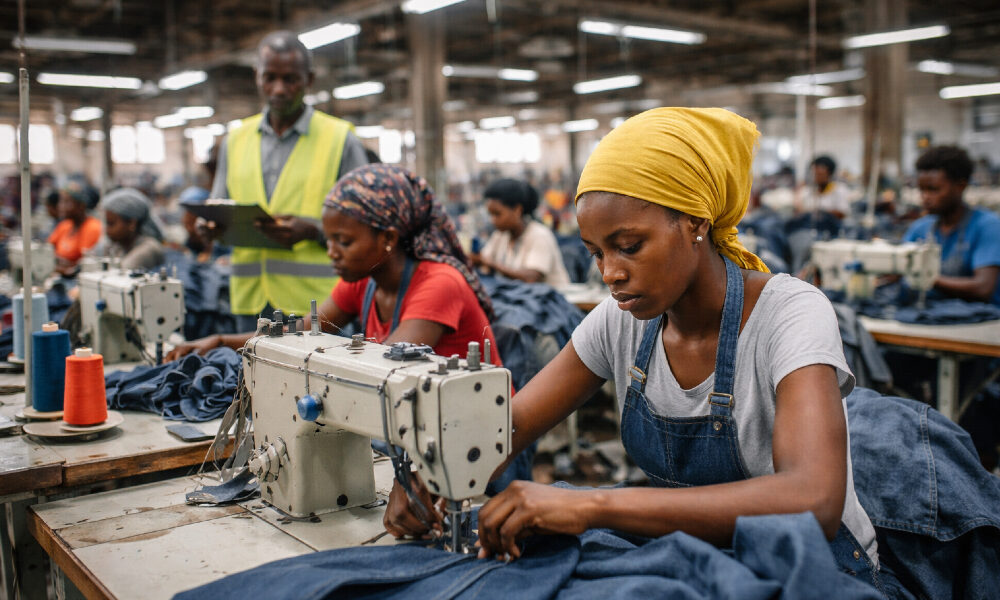
The Ethiopian factory, by contrast, is learning these lessons in real time while competing against mature operations that have already paid the tuition. Training takes months.
Efficiency accumulates gradually. Process knowledge builds through trial and error. During this learning curve, the wage advantage that existed on paper evaporates when confronted with actual unit economics.
Infrastructure as the invisible multiplier
Then there’s the compounding effect of infrastructure deficits. Power outages don’t merely pause production – they create cascading costs. Workers must be paid during downtime.
Fixed costs continue accruing without corresponding revenue. Quality suffers when climate control fails. Port delays mean raw materials arrive late and finished goods ship slowly, disrupting just-in-time manufacturing and eroding customer confidence.
Each infrastructure failure extracts a tax that never appears in wage comparisons but dominates total cost calculations. A factory paying US$4 per hour with 99 percent uptime outcompetes one paying US$3 per hour with 85 percent uptime. The arithmetic is unforgiving.
The ecosystem advantage that actually matters
Bangladesh didn’t capture global garment production through wages alone. The country won by building an ecosystem: clustered suppliers that reduce logistics costs, trained supervisors who can scale quality, established compliance systems that satisfy international buyers, reliable infrastructure that meets delivery commitments, and a reputation that reduces perceived risk for global brands.
This ecosystem creates network effects that new entrants cannot easily replicate. When a factory in Dhaka needs specialized buttons, a dozen suppliers compete for the order within a twenty-kilometer radius.
When quality issues emerge, managers can hire supervisors who have solved identical problems elsewhere. When buyers place orders, they trust that ports will function and deadlines will be met.
These capabilities took decades to develop. They cannot be conjured through policy declarations or wage subsidies.
Why the cheap labor narrative undermines development
Here’s the paradox: the “cheap labor” story actively undermines sustainable development. It attracts investors seeking minimum wages rather than optimal production environments.
These investors pursue arbitrage, not partnership. They leave the moment wages rise slightly – before any meaningful ecosystem develops, before workers acquire valuable skills, before local suppliers mature.
The countries that built durable manufacturing sectors – Taiwan, South Korea, Vietnam – never competed purely on cheap labor. They competed on reliability, then quality improvement, then design capability, climbing the value chain before wages eroded their initial position.
They invested in education, infrastructure, and supplier development even when these investments exceeded short-term returns. They understood that sustainable advantage requires creating value, not just capturing it.
Africa’s actual comparative advantages
Africa’s genuine economic opportunities lie elsewhere. Geographic proximity to European markets offers logistics advantages for time-sensitive goods.
Rapidly growing domestic consumption creates opportunities in sectors where local knowledge matters. Vast agricultural resources remain underprocessed, with value addition happening offshore.
Abundant renewable energy resources in specific regions could power energy-intensive industries as global production decarbonizes.
Chasing the “cheap labor” positioning means competing in a race that others have already won, on terms that were never decisive anyway. It means attracting investors who will depart at the first wage increase, leaving behind little institutional knowledge or capability.
The alternative requires harder work: building infrastructure, developing skills, creating supplier networks, establishing quality systems, and climbing toward higher-value production. This path offers no shortcuts.
But it’s the only one that leads somewhere worth reaching.
Rethinking Africa’s industrial strategy
Economic development demands clear-eyed assessment of comparative advantage – actual advantage, not the mythical kind that sounds good in investment pitches. Africa has real strengths.
Low wages, when unaccompanied by productivity, aren’t among them.
The sooner policymakers and investors abandon the cheap labor illusion, the sooner they can pursue strategies grounded in Africa’s genuine opportunities. Manufacturing success requires building the systems that make workers productive, not simply finding workers who accept low pay.
That distinction determines whether Africa’s industrial future will be sustainable or fleeting.
Dishant Shah is a partner at Legion Exim, a company specializing in facilitating the export of high-quality engineering products directly sourced from manufacturers in India to Africa. His areas of expertise include new business development and business management.