Opinion
Why Africa Continues to Miss Out on the True Benefits of Global Trade


By Farouk Mark Mukiibi
Africa accounts for less than 3 percent of global trade – a figure so persistently low it defies mere coincidence. Conventional wisdom blames crumbling infrastructure, undercapitalized enterprises, or inconsistent policymaking.
But these diagnoses, however accurate, miss a deeper, more uncomfortable truth: Africa’s real deficit in global commerce is not logistical – it’s existential, rooted in how we perceive and price our own worth.
No transformation begins with finger-pointing. It begins with self-awareness.
And the central question Africa must confront is this: What version of value do we believe in – and who gets to define it?
Africa is not absent from global trade. It is deeply embedded within it – yet rendered invisible in its rewards.
We move goods, supply raw materials, and accept the terms set by others. But we rarely move the goalposts.
We participate, but we do not preside. And therein lies the paradox: the more Africa trades, the less it seems to accumulate.
The Illusion of Inclusion in a System Built for Extraction
This is not a flaw in the system – it is the system working exactly as designed. Global trade does not reward mere presence; it rewards control.
And control lies not in shipping containers, but in the power to set prices, shape standards, and author the story behind the product.
For too long, Africa has mistaken endurance for evolution – and applause for advancement. We celebrate invitations to global markets as signs of progress, forgetting that inclusion is not the same as influence.
Endurance keeps us visible; definition makes us powerful. Being allowed to sit at the table does not mean you get to write the menu.
The real barrier to Africa’s trade prosperity is what we might call structural subtraction: an architecture that extracts presence without granting power, harvests participation while denying proportional profit, and commodifies resources without honoring the civilizations that steward them.
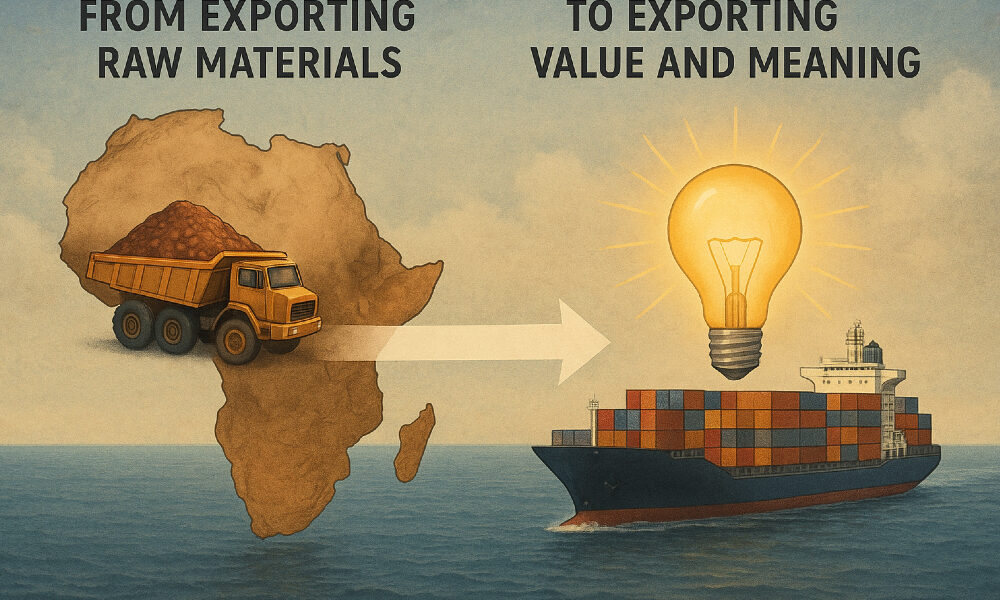
Consider this: when a barrel of crude leaves Nigeria or a cobalt shipment departs the Democratic Republic of Congo, the physical commodity travels – but the value narrative stays behind, crafted in boardrooms thousands of miles away. Africa exports materials, not meaning.
And in today’s knowledge-driven global economy, meaning is where the margins are.
From Materials to Meaning: Redefining Africa’s Trade Identity
True trade advantage comes not from what we make, but from what we mean. Economies that command respect – whether in Germany, South Korea, or China – first mastered the art of defining their own identity, then built trade systems that reflected it.
Trade follows narrative. Narrative follows identity. And identity follows self-definition.
That sequence is what determines whether a nation becomes a price taker or a price setter.
Africa’s deepest deficit is not financial; it is psychological. Even when exports rise, value leaks through invisible channels – transfer pricing, intellectual property regimes, branding monopolies – that siphon wealth before it reaches African shores.
We trade in a system that measures volume, not sovereignty. But lasting prosperity resides not in volume, but in ownership – of ideas, of standards, of stories.
The path forward demands more than better roads or bigger loans. It requires a continental reawakening to the power of value sovereignty.
Africa must shift from being a supplier of inputs to a shaper of outcomes. From exporter of raw materials to exporter of meaning – of design, of innovation, of cultural and technological frameworks that the world seeks, not just consumes.
The day the world looks to Africa not just for what it has, but for what it defines, is the day trade becomes true benefit. Until then, every boom risks ending not with dividends, but with a thank-you note.
Africa is not missing from global trade. But unless it claims the right to define its role within it, it will remain present – yet perpetually diminished.
Farouk Mark Mukiibi is the author of The African Startups Playbook and creator of the Minimum Viable Relationships (MVR) business framework. He is also a marketing consultant based in Uganda, East Africa, where he helps international brands and ventures navigate the realities of East Africa’s evolving middle class and consumer economies.