Opinion
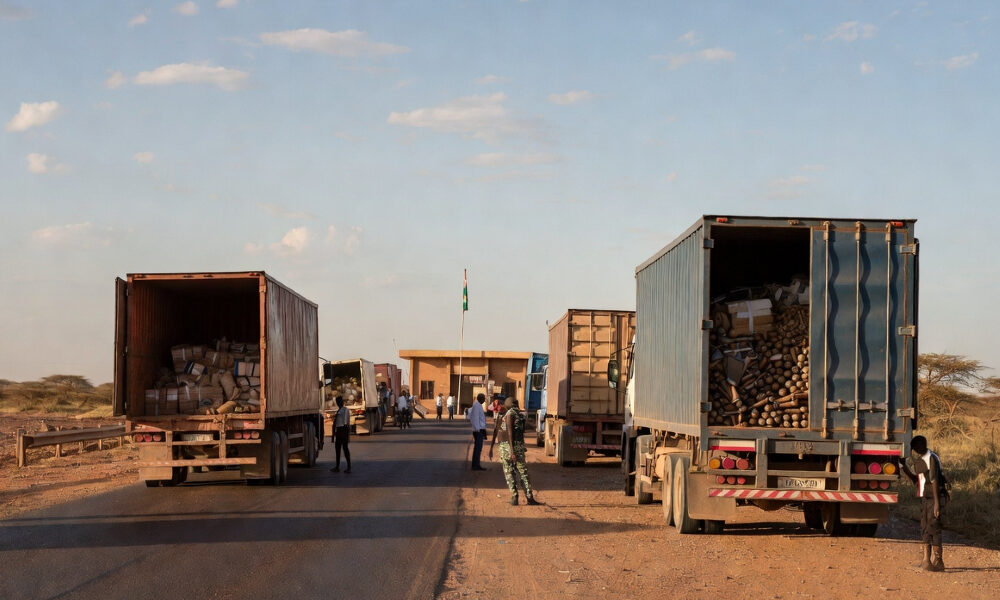
Where Growth is Won: Africa’s Border Challenge


By Ziad Hamoui
Africa is projected to be the world’s fastest-growing region in 2026, expanding at 4.0–4.3 percent according to the United Nations World Economic Situation and Prospects 2026 report by UN Trade and Development (UNCTAD). West Africa is expected to lead at 4.4 percent, with Benin and Niger forecast around 6.7 percent and Côte d’Ivoire (Ivory Coast) at 6.4 percent.
But these projections only hold if goods actually cross borders.
The report identifies the risks: high debt burdens, limited fiscal space, slow implementation of regional integration commitments. What it misses is the operational reality on the ground.
Growth projections depend on soft infrastructure that never makes headlines – digital customs systems, harmonized transit procedures, and the institutional capacity to reduce border delays from 72 hours to single digits.
The Infrastructure Paradox
We invest billions in roads, ports, and railways. Yet we allocate a fraction of that to the border cooperation frameworks that determine whether those assets operate at 30 percent or 80 percent of capacity.
The imbalance is striking.
The World Trade Organization’s Trade Facilitation Agreement (TFA) implementation addresses this gap directly. Africa’s TFA implementation rate has reached approximately 73.7 percent, with 2025–2026 marking the deadline for many Category C measures requiring technical assistance.
Article 11 on transit coordination is specifically designed for landlocked country facilitation. When we project growth for Niger or Burkina Faso, we implicitly assume that transit routes to Tema, Lomé, and Abidjan function efficiently.
Without Article 11 implementation, landlocked countries pay logistics costs 50 percent above global averages.
When Systems Fail, Infrastructure Idles
In my work with the National Trade Facilitation Committee (NTFC) in Ghana, I have seen how these provisions translate into operational improvements when properly resourced. Countries with functioning NTFCs and advanced TFA implementation systematically outperform growth projections.
Those without functional coordination mechanisms underperform despite infrastructure investment.
Early last year, I visited the Akanu-Noepe Joint Border Post at the Ghana-Togo border. The facility was modern in design but struggling operationally because institutional workflows had not kept pace with physical construction.
Trust deficits between agencies and procedural bottlenecks were holding things back just as much as dilapidated infrastructure elsewhere. The systems that make infrastructure work matter as much as the infrastructure itself.
The Fiscal Imperative
The International Monetary Fund notes that 40 percent of African countries are in or at high risk of debt distress, with interest payments absorbing 15 percent of public revenue. Countries with constrained fiscal space cannot afford infrastructure that sits idle because border procedures remain unaddressed.
Development partners and finance ministries are finalizing 2026 allocations now. I would urge them to fund border cooperation, NTFC capacity building, and customs digitalization with the same urgency as corridor construction.
The border is where growth is won or lost.
Ziad Hamoui is the Co-Founder and Past President of the Borderless Alliance, a leading private-sector advocacy group promoting economic integration and removing trade and transport barriers in West Africa. With extensive experience in Ghana’s road transport, logistics, and shipping sectors, he currently serves as Executive Director of Tarzan Enterprise Ltd., a long-established family business. He is a former Co-Chair of the Africa Food Trade Coalition, Co-Founder of the Trade Facilitation Coalition for Ghana, and serves on multiple high-level advisory committees on trade, transport, agriculture, and security. A Chartered Fellow of the Chartered Institute of Logistics and Transport (CILT) Ghana, he is also a former member of its Governing Council.