Zina’s Youth View on Africa
When Power Refuses to Retire: Biya, Ouattara, and Africa’s Succession Dilemma


By Godfred Zina
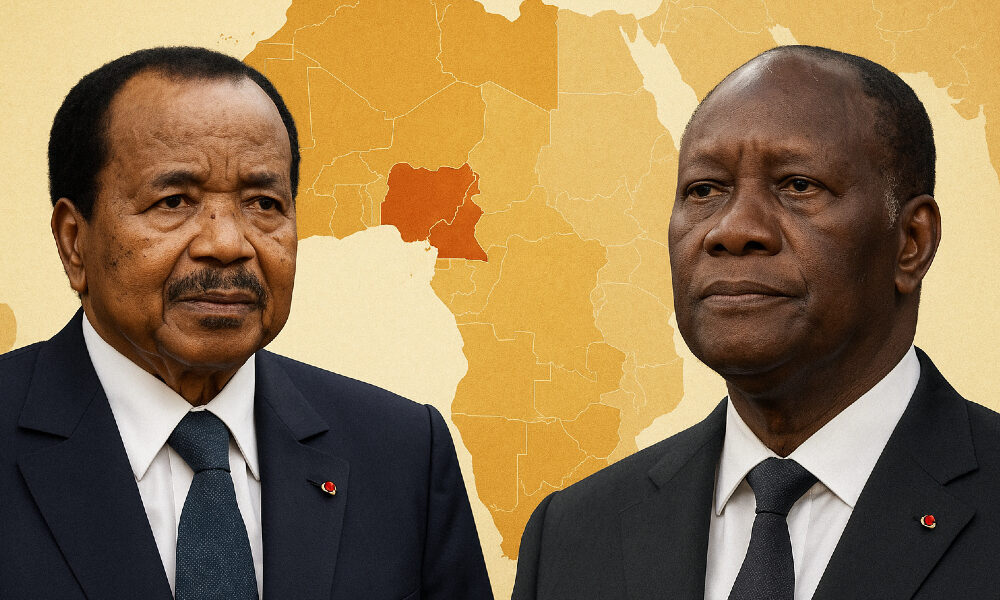
In October 2025, two of Africa’s longest-serving leaders – Cameroon’s 92-year-old Paul Biya and Ivory Coast’s 83-year-old Alassane Ouattara – secured yet another mandate.
Biya claimed his eighth term with 53.66 percent of the vote, while Ouattara won a fourth term with a staggering 89.7 percent. On the surface, these results project continuity.
Beneath the veneer, however, they expose a continent-wide crisis: the dangerous entrenchment of aging autocrats and the systemic failure to plan for political succession.
These elections are not anomalies – they are symptoms of a deeper malaise afflicting West and Central Africa, where leadership is increasingly personalized, institutions weakened, and generational renewal stifled. The result? A paradox of short-term stability masking long-term volatility.
Cameroon: Eroding Legitimacy, Rising Fragility
Paul Biya’s latest victory marks a sharp decline from his 71.28 percent win in 2018 – a drop that speaks volumes about waning public confidence and fractures within his ruling Cameroon People’s Democratic Movement (CPDM). With opposition leader Maurice Kamto barred from running and the Anglophone crisis simmering in the background, Biya’s reduced mandate reflects not triumph, but fragility.
The absence of a credible succession plan has turned Cameroon’s political system into a house of cards. Elite rivalries within the CPDM are intensifying, while the Anglophone regions remain volatile tinderboxes.
Without inclusive dialogue, constitutional reform, and a transparent roadmap for leadership transition, Cameroon risks descending into deeper instability – precisely when regional security threats, from Boko Haram to transnational crime, demand resilient governance.
Ivory Coast: Stability Built on Sand
Alassane Ouattara’s electoral dominance – 83.66 percent in 2015, 94.27 percent in 2020, and 89.7 percent in 2025 – may appear impressive. But it is a dominance sustained by a constricted political space, not genuine consensus.
Voter turnout hovered around just 50 percent, and credible challengers were either excluded or marginalized. The Ivorian model of “stability” is increasingly reliant on the suppression of pluralism rather than the strength of institutions.
More troubling is the vacuum left in the wake of Félix Houphouët-Boigny’s legacy. Decades later, Ivory Coast still lacks a clear, democratically viable successor to Ouattara.
With over 60 percent of the population under 25, rising youth disillusionment threatens to undermine the very cohesion Ouattara claims to protect. Electoral reforms, civic inclusion, and intergenerational dialogue are not optional – they are existential.
A Regional Pattern, A Continental Risk
From Yaoundé to Abidjan, a troubling pattern emerges: leaders prioritizing personal continuity over institutional resilience. Elections become rituals of reaffirmation rather than mechanisms of accountability.
Political parties morph into personality cults. And young Africans – bearing the brunt of unemployment, climate shocks, and digital repression – are left with little stake in the status quo.
This leadership stagnation has real consequences. It weakens judicial independence, entrenches corruption, deters investment, and creates fertile ground for extremism and organized crime.
In fragile states already grappling with security threats – from the Sahel to the Gulf of Guinea – delayed succession is not just a political issue; it is a security imperative.
The Way Forward: Institutions Over Individuals
The solution lies not in regime change imposed from outside, but in homegrown institutional renewal. Regional bodies – ECOWAS, ECCAS, and the African Union – must move beyond rhetorical commitments to democratic norms.
They should establish early-warning systems for leadership transitions, support independent electoral commissions, and condition regional integration benefits on demonstrable progress in succession planning.
Domestically, both Cameroon and Ivory Coast must empower judicial, anti-corruption, and electoral bodies with genuine autonomy and capacity. Constitutional term limits – where they exist – must be respected, not circumvented.
And most critically, political space must be opened to the next generation of leaders, thinkers, and reformers.
Africa’s future cannot be mortgaged to the longevity of its current leaders. True stability is not the absence of change – it is the presence of resilient, inclusive, and forward-looking institutions.
Without them, the calm of today may well give way to the chaos of tomorrow.
Godfred Zina is a freelance journalist and an associate at DefSEC Analytics Africa, a consultancy specializing in data and risk assessments on security, politics, investment, and trade across Africa. He also serves as a contributing analyst for Riley Risk, which supports international commercial and humanitarian operations in high-risk environments. He is based in Accra, Ghana.