A Diaspora View of Africa
What will BRICS+ do for Africa?
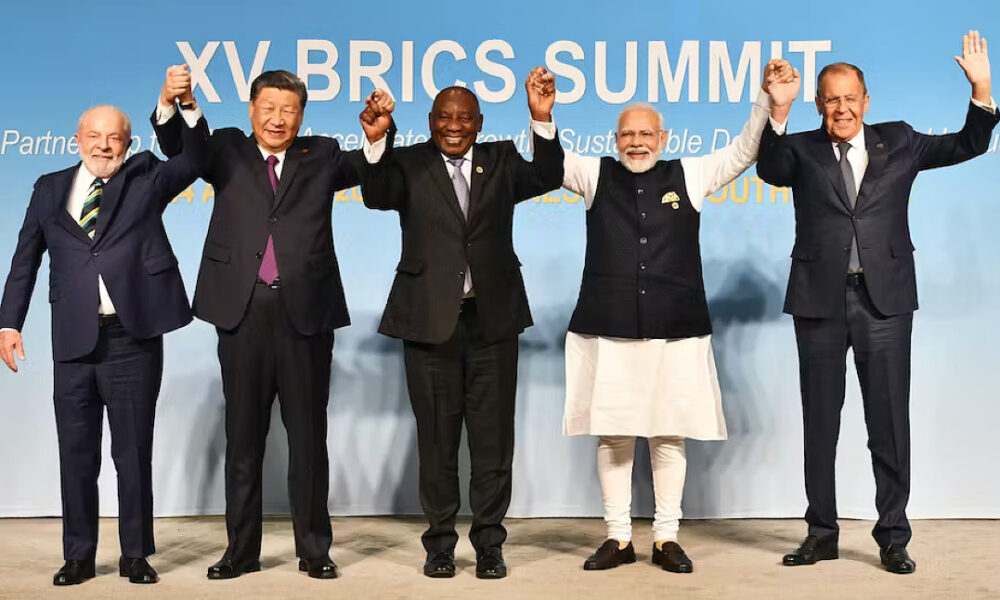


By Gregory Simpkins
One of the biggest stories in recent weeks has been the ongoing evolution of BRICS (Brazil, Russia, India, China and South Africa), this is a group of emerging economies comprising 41 percent of the world population, 24 percent of the GDP, and a more than 16 percent share of world trade. BRICS countries are considered to be the main engines of the global economy in the coming years.
Is BRICS a rival for the G20, the world’s top 20 economic and political powers?
Perhaps, but BRICS countries are participating in the G20, even as they are trying to insinuate themselves in other venues, such as the United Nations Security Council beyond Russia and China. Whatever venues they take part in, these nations play significant roles in the global economy already. In their closing statement after the August 22-24 summit, the BRICS group said its countries “produce one-third of the world’s food.” Of course, that percentage has been limited by the Russia-Ukraine war, diminishing the output due to the effects of the conflict in terms of embargoes and sanctions. Still, these nations cannot be underestimated.
With the addition in January 2024 of six new members – Saudi Arabia, Egypt, Ethiopia, Argentina, Iran and the United Arab Emirates – BRICS+ now adds members with significant natural resources and populations, as well as industrial output. Still, the additions to some extent only stir up rivalries that supersede the alliance. Sunni Saudia Arabia and Shiite Iran have made peace recently, but their religious divide is more than a millennium old. China and India are longtime rivals as well. And while Russia and China have bonded because of the struggle against Western sanctions over Russia’s invasion of Ukraine, both cannot take the lead. China is stronger now, and Russia has depended on China’s support since the war began, but China’s Xi Jinping would not likely be interested in a genuinely joint leadership role, nor would Russia’s Vladimir Putin be either in the long run. Both have grand ambitions on the world scene.
Dozens of governments expressed an interest in joining the BRICS alliance, but its leaders limited the number of new members. Undoubtedly, they saw how the increase in members in the European Union (EU) and the North Atlantic Treaty Organization (NATO) have been problematic. The new members they selected look to be strong additions (if controversial in the case of Iran). Certainly, they will be significant additions to the New Development Bank, the BRICS multilateral development bank established with the purpose of mobilizing resources for infrastructure and sustainable development projects in emerging markets and developing countries (EMDCs).
So how will BRICS+, with its three African members, benefit the continent? Clearly, the BRICS founders were selective in choosing who would join from the dozens of countries that expressed interest in joining the group. Only Singapore voluntarily withdrew its membership application, saying it wasn’t ready. Others, including African nations such as Zimbabwe, were judged to be not good selections at this point. But will this enhanced group significantly contribute to Africa’s development as it promises? Some African leaders have expressed doubts that BRICS+ will not live up to its promises.
Keeping its promises?
When you look at the pledges versus the realities of previous actions, you can see why there are doubts. For example, its closing declaration stated: “We commend continued collective efforts of the United Nations (UN), the African Union (AU) and sub-regional organizations, including in particular the cooperation between the United Nations Security Council and the African Union Peace and Security Council, to address regional challenges including maintaining peace and security, promoting peacebuilding, post-conflict reconstruction and development, and call for continued support by the international community to these endeavours using diplomatic means such as dialogue, negotiations, consultations, mediation, and good offices, to resolve international disputes and conflicts, settle them on the basis of mutual respect, compromise, and the balance of legitimate interests.”
Yet how does that square with the heavy emphasis by Russia on selling arms to African countries? It has not thus far seemed to expend much effort in resolving conflicts as opposed to providing the materials to initiate or expand conflicts. One of its African allies – Eritrea – has a history of conflict with its neighbors, and Russian arms supplies won’t make that country any less aggressive than it has historically been.
The declaration calls for ending corruption: “With the knowledge that the scourge of corruption knows no geographic boundaries, and respects no society or humanitarian cause, we have jointly put in place a strong foundation to combat corruption through capacity building, including, conducting training programmes and sharing of current best practices applied in each of our countries.”
As China and Russia have become more economically important on the continent, numerous reports state that they not only turn a blind eye to corruption in African countries but aid and abet it by providing bribes to get what they want. Transparency International, in a report written four years ago, said that institutions that are meant to control corruption remain weak, and citizens across the continent have to pay bribes to access the most basic services, like health care and education.
Several Chinese companies, including the China Energy Fund Committee, the telecommunications firm ZTE and the China Roads and Bridge Construction Company, have been accused of bribing senior government officials in Chad, Uganda, Zambia and Kenya.
“China’s rapid economic growth was referred to as a ‘miracle’ that would not have occurred without the high corruption. China poured billions of dollars into Africa and so in that sense has disseminated the same model of corruption to Africa,” Jianli Yang wrote in the Washington Times recently.
BRICS countries have been plagued by terrorism and have good reason to oppose it, as the declaration stated: “We express strong condemnation of terrorism in all its forms and manifestations whenever, wherever and by whomsoever committed. We recognize the threat emanating from terrorism, extremism conducive to terrorism and radicalization. We are committed to combating terrorism in all its forms and manifestations, including the cross-border movement of terrorists, and terrorism financing networks and safe havens.”
Unfortunately, Russia, for example, is alleged to have used its proxy in Africa, the Wagner Group, to help countries like Mali fight terrorism in the Sahel region. This group was considered to be more successful than French troops had been and justified the Bamako government’s decision to oust France. But their methods for combating terrorism have been terroristic itself.
Malian armed forces and foreign fighters apparently from the Russia-linked Wagner Group have summarily executed and forcibly disappeared several dozen civilians in Mali’s central region since December 2022, according to a report from Human Rights Watch. They are also responsible for alleged torture and destroying civilian property. HRW interviewed people for the report, who said armed forces committed abuses during operations against Islamist armed groups. In most operations, witnesses reported the involvement of foreign armed men who they described as “white,” “Russians,” or “Wagner.”
This doesn’t sound like the way to minimize conflict and certainly violates the rights of African citizens, many of whom may not have been involved in terrorist activities at all.
Boost trade with Africa
The Daily Maverick reported on August 22 that business leaders Patrice Motsepe (founder and chair of JSE-listed African Rainbow) and Stavros Nicolaou (an executive at Aspen Pharmacare) have called on the BRICS countries to boost their trading activity with each other and African countries. They believe that the formation of BRICS has benefitted all its member countries, especially South Africa, as the BRICS economies accounted for about 21.3 percent of South Africa’s total trade with the world in 2022, of which China accounted for 67.6 percent, India 26.5 percent, Brazil 4.2 percent and Russia 1.7 percent, according to data from the Industrial Development Corporation. South Africa’s overall trade with its BRICS partners increased by an average of 10 percent from 2017 to 2021.
Yet will this increased trade benefit other African countries beyond BRICS+ members? The declaration says it will: “We recognize the crucial role that Micro, Small and Medium-sized Enterprises (MSMEs) play in unlocking the full potential of BRICS economies and reaffirm the importance of their participation in production networks and value chains…Member states will facilitate exchange of business missions and promote sector specific Business to Business (B2B) meetings amongst the MSMEs, to enhance enterprise-to-enterprise cooperation and business alliances between the MSMEs of BRICS, with a particular focus on women-owned and youth-owned MSMEs.”
If one examines China’s history of labor and business development in African countries, though, their economic footprint is made mostly through Chinese workers and Chinese businesses. China exports labor, and after their initial project is completed on a road or stadium or other venture, these workers are supplied with discounted goods that enable them to become vendors and outcompete indigenous businesspeople.
Perhaps the Chinese have changed their operating procedures, but some years ago, I was told that participants in a Nigerian trade mission to China found that they had been invited not to sell their goods in China, but rather to buy goods to sell back in Nigeria. The main interest of China in purchasing African products has been in buying up African natural resources to take home to process and sell to Africa and the world, especially rare earths and other elements needed for the transition to renewable energy in the modern economy.
Many African governments are interested in ways to get out from under what they consider the overbearing domination of Western powers, but will the new BRICS+ benefit African governments and their people to the extent their words promise? Certainly, the BRICS coalition is warranted by its economic output and deserves to compete in the global economy, but it would be a mistake for African leaders to think that this new group of world powers will be their saviors – not unless they use their agency and leverage their human and natural resources to demand an equitable share of what they produce. BRICS countries are not forcing these leaders to do business with them; it’s up to the Africans to make deals that benefit their people in the long run and not just an elite in the short term.
Gregory Simpkins, a longtime specialist in African policy development, is the Principal of 21st Century Solutions. He consults with organizations on African policy issues generally, especially in relating to the U.S. Government. He also serves as Managing Director for the Morganthau Stirling consulting firm, where he oversees program development and implementation. He further acts as a consultant to the African Merchants Association, where he advises the Association in its efforts to stimulate an increase in trade between several hundred African Diaspora small and medium enterprises and their African partners.