Opinion
What the Heck is Going On?
By Dennis Matanda
Robbinsville, NJ | 8:58 p.m. | March 14, 2015
Over the past three weeks, our readers from across the Atlantic; in Europe, in the Caribbean and Africa have asked us the same question: What is happening in the United States? From this, we extrapolate that many people want to understand the issue between President Obama and the Republicans. Why do they hate him so much? Here, we really ought to touch on the complexity of things such as the November 2014 Republican take over of both houses in Congress; Binyamin Netanyahu’s address to a joint session of the U.S. Congress this early March 2015, and of recent, the letter that 47 Republican Senators sent to Iran’s ‘mullahs’ about the on-going negotiations to insert Iran back into the fold of world nations. Of course, subliminal questions about America’s long-term viability come up: After all, Russia is challenging the world’s only super power in Crimea and Ukraine; China is giving America a bloody nose in terms of investment and business, and the Islamic State (IS) is beheading people willy-nilly – those drones cannot do anything about IS even if they know who ‘Jihadi John’ is.
In response, we give two distinct answers: Our short response is, first and foremost, an overly optimistic and simplistic ‘relax!’ Seriously, people need to chill out about all that they are seeing or hearing in the United States. The union, like Obama said in his last State of the Union, is strong. In the same vein, the U.S. economy is doing so much better than any other nation on this planet.
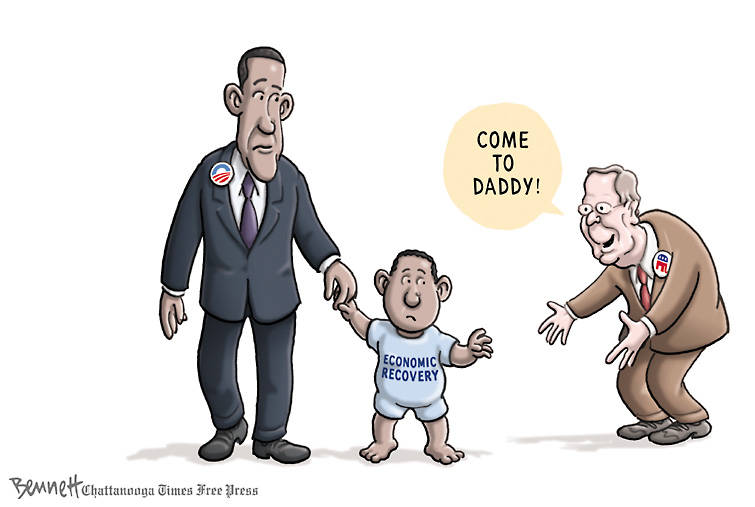
The longer response is more of an assertion: Because 2012 was the last plausible avenue for a Republican to win the White House for the foreseeable future, the Grand Old Party is employing the scorched earth policy on just about everything: on immigration reform, on America’s long-term debt issues, on America’s foreign policy, and on anything that could move the dial on Obama’s already sealed legacy. Again, short of something drastic happening – a disaster where both President Obama and Vice President Biden cannot perform their duties and so allow Republican Speaker John Boehner to constitutionally take over the Executive branch – there will not be a Republican president any time soon. Of course, Hillary Clinton could decide not to run for office in 2016. But with the way that things are going, this is an almost foregone conclusion and could be placed in the ‘disaster’ column were it to happen. Or, perhaps, she could run for office and win in 2016 – but mess up so badly that she loses a re-election in 2021. However, if George Bush could win a second term in 2004 – in the midst of wildly unpopular wars in Iraq and Afghanistan – we do not see why a Democratic Presidential candidate would not, handily, win a re-election contest especially since the Democrats have both the Electoral College and popular votes comfortably at their disposal.
A Republican Nation?
Now, we really ought to provide a historical background to our premise: The United States is more of a Republican nation than a Democratic one. Between 1861 and today, there have been 18 Republican presidents; with Theodore Roosevelt in 1901 and ending with George W. Bush in 2008. In the same period, only 8 Democratic presidents have had that privilege: Woodrow Wilson in 1912, Franklin Delano Roosevelt in 1932, his successor Harry Truman in 1945, John F. Kennedy in 1960, only to be replaced by Lyndon Johnson after his 1963 assassination; Jimmy Carter in 1976; Bill Clinton in 1992 and then Barack Obama in 2008. Although Democratic presidents are known to usher in good times of economic development, the pendulum has tended to swing back to the Republicans like it is a correction of sorts. But this time around, things may be very different: While much of American still lives off the nostalgia of Republican presidents like Ronald Reagan, George W. Bush managed to make a royal mess for the Republican philosophy during his 8 years in office. He went into Afghanistan and Iraq, and the United States led the world down an economic downturn on his watch. And these are some of the things that gave Obama the almost improbable opportunity he snatched to serve as commander in chief.
Sarah Palin? Really?
Much may have been said about America being a post racial society. But that could be more hyperbole and ideally selling the American dream, and American exceptionalism. It actually stands to be tested that 2008 presented an exceptional circumstance for the United States, and unlike the Republicans, Obama and the Democrats treated the whole thing a little more seriously. To this, it seems as though the graybeards in the Republican Party were, in allowing John McCain to bring Sarah Palin along as his running mate – simply not ‘aware’ that Obama was a worthy adversary. That they could unleash a woman as untested and as painfully unqualified as Ms. Palin was is evidence enough of this premise. No wonder they were and still are shocked about Obama. Essentially, this is what leads us to our second and almost sacrilegious assertion: The Republicans response to Obama has always been to wish him away and hope that he will, in the process, disappear. It really is as simple as that. They do not understand his appeal; do not understand why people listen to him, and scoff each time Obama has another positive response from an adoring public or world. Their overall hope is that they will wake up from this nightmare and find that someone has revealed the vacuous nature of this Wizard of Oz; that the Emperor, really, is just clothes and no substance.
A Firm Explanation
If some of you inexorably cannot accept this premise, neither can we. However, it is a viable theory especially when one looks at the state of American media, and the Republican opposition to Obama from his first time in office. After Obama won in 2008, a group of Republicans met and made the decision to oppose anything and everything that Obama suggested or even touched. Current Senate Majority Leader Mitch McConnell from Kentucky was, apparently the spear of this group. And so, just as Fox News was giving credence to the manufactured Tea Party phenomenon, the Republicans generated what became known as the Obama Derangement Syndrome (ODS) and opposed a stimulus package that was mostly made up of tax cuts and infrastructure funds to get the country back sooner from the brink of economic despair; they opposed a healthcare system that was framed by their own intellectuals and gave this simple market driven system the Obamacare moniker; they threatened the good credit rating of the United States in various ways – and they even opposed Obama’s hand at trying to rescue America’s auto industry. Each of these political decisions was made based on the need to erase Obama from memory, and of course, deny him a second term in office. That way, it would be easy to say that the Democratic President was as inconsequential as Jimmy Carter, and that he was a blight only meant to illustrate the Republican vs. Democratic swing of things. This could explain why people like Michele Bachmann thought they could beat Obama.
This is why Jon Huntsman quit his job as Obama’s man in China and came back to run for president. This is why the ‘starchy’ Rick Santorum was confident of himself. Even former Speaker Newt Gingrich thought that the Americans could ignore his baggage and actually elect him president. For the efforts, Mitt Romney – a most flawed candidate – was put against Obama. And on Election Night, Romney and the entire Republican establishment watched agape when Obama won Ohio, Virginia and even added insult to injury by winning Florida. The biggest mistake they had made, again, was in hoping to wish Obama away and never really treating him like he was an opponent to be reckoned with. In the process, they listened exclusively to their own consultants, their own media houses and pollsters. To this day, that Mitt Romney lost to Obama by over 5.9 million votes is almost inexplicable to the Republicans. Romney actually considered running for office again in 2016 – almost reassuring himself that the two times he lost were just a bad dream.
The Scorched Earth Policy
But perhaps, we ought to explain why the Republicans are employing some sort of scorched earth policy on Obama. This will be split between explaining the Electoral College and a concept known as ‘redistricting.’ Both are closely related to explaining why the Republicans are acting the way they are right now, and also contribute to the assertion that the Republicans may not hold the White House in the immediate, short and medium term.
The Electoral College System
For starters, the American presidency depends more on winning the Electoral College vote than on winning the popular one. And we would have had faith if Republicans had a chance at winning the Electoral College vote since they clearly do not have the numbers to win the popular one. But if the last presidential election is anything to go by, Republicans are, once again, toast. For example, when Obama triumphed over Romney, he had 332 Electoral College votes while his erstwhile rival had only 206. This so called ‘indirect election’ system has been criticized and may be reformed one of these days, but the combined votes of 538 electors (the nations 435 representatives, the 100 senators and 3 electors given to the District of Columbia) are said to ensure the rights of smaller states. In the same vein, a quick look at states that went Republican in the last election, Texas had 38, North Carolina had 15, Georgia had 16 – and the rest like North and South Dakota had a sputtering of 3 votes. This was not a good enough range. Invariably, Obama won states like California, Florida, New York, Illinois, Pennsylvania and Ohio, which have 55, 29, 29, 20, 20 and 18 Electoral College votes respectively. We do not foresee a scenario where Republicans win California, New York, Pennsylvania, Illinois, Michigan, Virginia, Oregon, New Jersey, Maryland, Massachusetts, Minnesota, Washington State, Wisconsin or New Mexico. Together, these, respectively, have 55 + 29 + 20 + 20 + 16 + 13 + 12 + 14 + 10 + 11 + 10 + 7 + 10 + 5 = 232. Under the circumstances, a Democratic would only need to win Florida’s 29 and Colorado’s 9 to make the magical 270 Electoral College votes to win the White House – and that is not even counting the 18 from Ohio. A Republican candidate cannot do this quite as easily with the 10 from Missouri, 9 from South Carolina, 8 from Louisiana or 11 from Arizona and 6 from Utah.
Interestingly, one may argue that Massachusetts, which is a reliably Democratic state currently, has a Republican governor. So do Ohio, Florida, Michigan and New Jersey. In fact, in the November 2014 elections, the Democrats lost reliable governorships in states like Maryland. Since these were statewide elections, one ought to wonder at these facts we provided. Well, it’s actually quite simple: In mid term elections – away from the Presidential Elections – it is the mostly white, older voters who go to the polls. Like results from the past 30 years have showed, these mid term voters are reliably Republican. During Presidential Elections, young people show up. So do the women and minorities – blacks, Latino and Asian American. These vote predominantly Democratic. Apparently, like the New York Times suggests, politicians are always able to make up for the numbers with the oversize influence of money and special interest groups like the anti-regulatory Wall Street crowd.
Alternatively, Sean Trende from Real Clear Politics tells us that in terms of the Electoral College, things do change: For instance, during Bill Clinton’s time, Arkansas – a reliably Republican state – moved 10 points to the Democrats column, and swung right back to the Republicans from 2004 to 2008. Iowa, Nebraska, and North Dakota moved toward Republicans in 1992 as the farm crisis receded, and New Jersey swung seven points toward the New Democrats in 1996. In this case, an economic catastrophe could seal the Democrats’ fate with Michigan’s 16 Electoral College votes in 2016; just as a weak outcome in the Iran deal could ensure that Florida never goes for another Democratic president. However, we do not see any of these scenarios occurring before 2016.
Gerrymandering
Now, to explain what gives the Republicans the fire to challenge Obama like they currently do less with his skin color and more to do with how the party is either rewarded or punished for doing things that would have mattered in the past. For instance, if the House Democrats had invited Saddam Hussein, their-then ally-against-Iran to speak to a joint session of Congress over the protestations of a Reagan White House, their constituents would not only have punished them severely at the polls; Reagan and the Republicans would have screamed both bloody murder and treason in going against the Logan Act! But in 2015, with Netanyahu publicly calling Obama’s foreign policy as feckless as they come, no one is out protesting the Republicans. In fact, their own constituents are solidly united in agreement: Anything Obama does must be bad. And in this solid union is the nugget that since the early 1900s when the Republicans held the House of Representatives through the powerful Joseph Gurney Cannon (1903 – 1911), the GOP has undertaken the practice of drawing U.S. electoral district boundaries. This process is known as ‘gerrymandering’ after Massachusetts Governor Gerry who signed a bill to redistrict that state to benefit his Democratic-Republican Party in 1812. Since then, politicians – mostly Republicans with the approval of the governors in 34 states – have manipulated district boundaries with the aim of leaving out specific populations that do not support their overall agenda.
To give a clear example, if a district has a collection of mostly white voters on one side, and then mostly black voters in a particular project, the politicians will sit down and put the two groups in different districts. Ari Barmen of The Nation illustrates it best when he says that one district in North Carolina, after the 2010 census, now looks like a ‘fat squid, its large head in an adjoining rural county with little in common with [the] previously urban district, and its long tentacles reaching exclusively into the black neighborhoods of Fayetteville.’ Lee Fang of Republic Reports says that in 2012, the first congressional election after the last round of gerrymandering, Democratic House candidates won 50.59 percent of the vote – or 1.37 million more votes than Republican candidates — yet secured only 201 seats in Congress, compared to 234 seats for Republicans. Fang concludes that the House of Representatives – the “people’s house” – no longer requires the most votes for power. In 2014, Pennsylvania for example, shows that Democrats had 44 percent of the vote, yet they won only 5 House seats out of 18. In other words, Democrats secured only 27 percent of Pennsylvania’s congressional seats despite winning nearly half of the votes. In 2015, a quick look at various districts will show that because of redistricting, the vast majority of America’s districts are safely in the column of either the Republicans or the Democrats.
To this, we can extrapolate two things about American politics: If the November 2014 mid term elections are anything to go by – where they were the most expensive in the history of mid terms – we can expect to have the Republicans perpetually in charge of the House, or both the House and the Senate. Here, Almond and Verba’s classic study on American culture is, axiomatically, out of sync. Today, the media and the money from special interest groups have a bigger influence on what becomes modus operandi and what faux pas is punishable. In Not Even Past: Barack Obama and the Burden of Race, Thomas Sugrue tries to prepare us for the reality that America is not post racial; in The Disappearing Center and Disconnect, Alan Abramowitz and Morris Fiorina respectively disagree on whether partisanship really exists. These authors provide us with insight into how Congress, through regular elections, manages to divide and conquer those that vote.
Conclusion
At the same time, while things have changed, there are certain things that are time-tested in the United States: Just like the Democrats will always panic in the midst of electoral battle, the Republicans will almost always overreach. Just when their path to victory is assured, one of them will open his or her mouth and just doom the party. For instance, in 2012, when Todd Akin should have comfortably sailed into the Missouri junior Senator position, he talked about women’s reproductive organs and forced his party to walk away from him. The same thing happened in the 2010 mid term elections when a woman from Delaware told everyone she was not a witch. And then, we are right back to the letter that 47 Republican Senators wrote to Iran. The Republicans may make as much noise as they can on their conservative network of websites, talk radio and Fox News – but they will not break the sound barrier, and Obama foibles will remain exactly where they are right now – nowhere.
So, why would anyone oppose immigration reform and yet it, obviously, has the support of the majority of the Americans? Well – in simple terms, in a country where the majority does not necessarily represent itself, you are bound to have a few issues. However, it also helps that with the legislature not being as representative as it ought to be, one will not be surprised to have a presidency that is supposedly much more powerful than the Cheney Vice Presidency. Interestingly, in terms of those who give presidents their power, unmarried women are voting for Democrats, while white men are voting Republican. Still, voters under age 30 are voting Democratic by a wide margin, and seniors are voting Republican. In the four groups mentioned above, there are two things in common: the ones who vote Republican have, over the past 30 years, been on a downward trend, while the ones who vote Democratic are, probably, going the other way.
The views expressed in this column are exclusively those of the author and not those of the Habari Network