A Diaspora View of Africa
What Is Russia Up to in Africa?


By Gregory Simpkins
Since its previous incarnation as the Soviet Union, Russia has had a longstanding role in Africa, for example in Mozambique, Angola, Namibia and Zimbabwe, as well as through its support for the African National Congress in South Africa. Unlike China, which got involved largely in infrastructure and other investments in Africa, Russia has focused on support for liberation movements through arms sales and military protection projects, such as its Africa Corps presence in the Sahel.
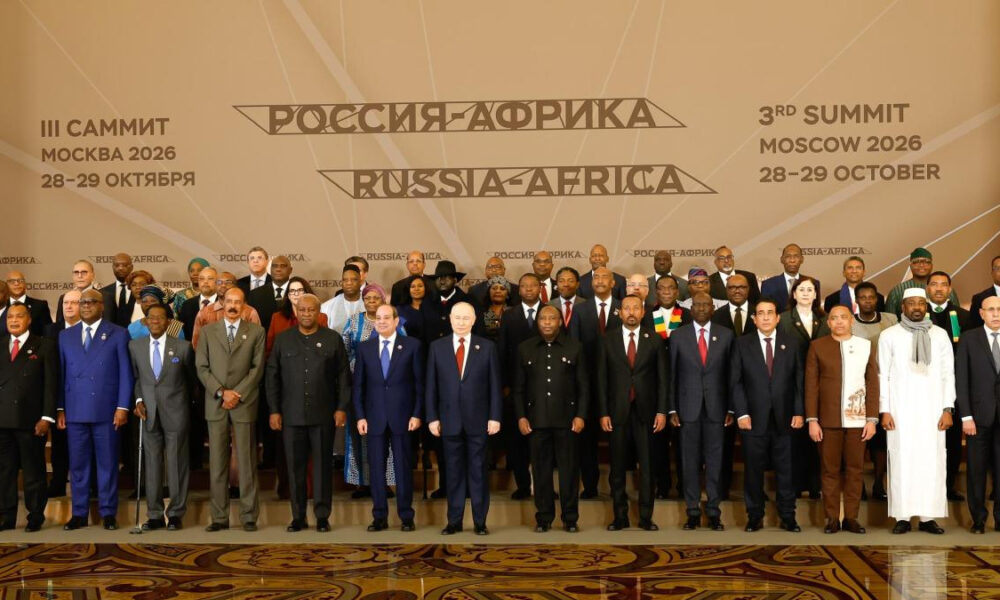
As the Germany-based consulting firm Africa Partners recently wrote, with the end of the Cold War, Russia’s influence and interest in Africa waned, and this was reflected in its trade figures with the continent. However, things have apparently changed since Russia launched its Africa summits (Sochi 2019, St. Petersburg 2023, Moscow 2026).
Russia is no longer a major player in Africa, but it is a big “risk signal” there, according to Africa Partners. Its trade boom since 2022 rests largely on sanctions-driven redirection and a cheap ruble, and both tailwinds are already fading. Its lasting leverage lies elsewhere: security for regimes in exchange for access to resources. This has evidently led Russia to play high-stakes politics on the continent, such as in East Africa.
The Eritrea-Ethiopia Balancing Act
Russia is deliberately playing both sides in its dealings with Ethiopia and Eritrea. Analysts call it a “dangerous balancing act” and a “Moscow paradox.” Moscow doesn’t want to choose because it needs both countries for different reasons, and a war between them would force it to choose.
For Russia, Eritrea is the loyal anti-West partner, offering a Red Sea coast. Eritrea is one of Russia’s most reliable votes at the UN, voting against UN resolutions calling for Russian withdrawal from Ukraine. Eritrea also provides a naval foothold. Since 2018, Russia has negotiated a logistics facility in Assab. Eritrea is the only Red Sea state still willing to host Russia after Djibouti, Yemen and Somalia said no. In April 2024, a naval delegation led by Vice Admiral Vladimir Kasatonov visited Eritrea for defense talks and joint exercises.
At the late October Russia-Africa Summit, Vladimir Putin met Eritrean President Isaias Afwerki in the Kremlin. Eritrean state media said Putin spoke of an “alignment of positions” and closer cooperation in energy, technology, mining, agriculture and food security.
Meanwhile, for Russia, Ethiopia is the big prize. Ethiopia is Africa’s second most populous country (more than 120 million people). A BRICS+ member since 2024, Ethiopia is a huge market for arms, nuclear technology and infrastructure. Some Soviet-era ties remain, in addition to a 2021 military cooperation agreement. In 2019, Russia trained about 1,000 Ethiopian naval officers for Ethiopia’s new navy, despite Ethiopia having no coastline. A March 2025 naval cooperation agreement renewed the training program.
Ethiopian Prime Minister Abiy Ahmed announced at the summit in Russia that Ethiopia had received 12 Su-35 fighter jets (Russia’s arms exporter confirmed the initial delivery of two jets, with the rest to follow) and will acquire four S-400 air-defense batteries. Putin said bilateral trade between January and September 2026 exceeded US$1.3 billion, more than double the total for all of 2025.
Talks also covered nuclear energy, health and trade.
Mediating While Arming
Russia engaged in a balancing act at the Moscow summit. Both leaders were in Moscow at the same time, shortly after Ethiopia expelled 10 Eritrean diplomats and closed its embassy in Asmara on October 1, and Eritrea severed ties.
Russia offered to mediate the core dispute: Ethiopia says sea access is “existential” and “irreversible,” while Eritrea says Assab and Massawa are sovereign Eritrean territory and Ethiopia’s demand for port access is a threat of war.
Despite the mediation offer, Russia is arming one side while offering to mediate. Delivering Su-35s and S-400s to Ethiopia changes the military balance. Benedict Manzin, a leading geopolitical and security analyst at Sibylline Ltd., says S-400s “would be best used against conventional air threats… in a war with Eritrea, they could be used against Eritrea’s limited air force and drones.” Eritrean media called the Russian offer “false mediation,” arguing that arms to Ethiopia undermine the peace offer.
As Horn Review put it, Russia maintains “two vital, non-interchangeable foreign policy assets.” A full-scale war would force Moscow into a binary choice that risks damaging both investments. Sponsoring talks is Russia’s mechanism to neutralize that dilemma, while arms sales keep both dependent.
In short, Russia wants Eritrea’s coast and UN vote, and Ethiopia’s market, BRICS vote and arms revenue. It is selling weapons to Ethiopia, courting Eritrea for a base and offering to mediate, hoping it never has to choose sides in a conflict.
Such a risky calculation is likely to fail given the longstanding enmity between Ethiopia and Eritrea, but Russia also has another matter threatening to poison its Africa relations.
Deceptive Recruitment of African Soldiers
The recruitment of Africans into Russia’s war with Ukraine under false pretenses has become one of the biggest Africa-Russia scandals of 2025-2026, and it exploded just before the October 28-29 Russia-Africa Summit.
Investigations by Journalists For Justice (JFJ) (“The Death Contract,” October 29, 2026), Amnesty International (September 10, 2026), and the UN Independent International Commission of Inquiry on Ukraine (October 26, 2026) all describe the same pattern:
- The Lure: Facebook, Telegram and WhatsApp carry ads for civilian jobs (drivers, security guards, warehouse workers, builders, firefighters and supermarket staff) promising US$2,000-US$3,000 a month, housing, Russian citizenship and no interview. JFJ found more than US$50 million in broker fees taken from recruits, with US$12,300-US$17,200 deducted from Russian bank accounts within 35 days of signing an employment contract.
- The Trap: Recruits fly on tourist visas (often via Addis Ababa, Dubai or Istanbul). Upon arrival, their passports are confiscated and they are handed a Russian-language Ministry of Defense contract. Refusal brings threats of detention, deportation and repayment of travel costs.
- Deployment: After about two weeks of training, often without any language instruction, recruits are sent to assault units in Donetsk and Luhansk. The average time from arrival to death, injury or capture is 44 days.
A second track targets migrants already in Russia (students, workers and refugees), who are pressured to enlist to maintain their visa status. A third track targets women for work at the Alabuga drone factory in Tatarstan. They are promised IT or hospitality jobs, then made to assemble Shahed drones in dangerous conditions.
The Scale of the Problem
Numbers differ because Russia publishes nothing, but all sources agree the total is in the thousands:
- JFJ (October 2026): At least 3,034 Africans from 40 countries since October 2022, with 502 killed by June 2026.
- Ukrainian intelligence (October 2026): 5,451 Africans from 43 countries identified with contracts.
- Ukraine’s Foreign Minister (February 2026): More than 1,700 from 36 countries fighting.
Top countries in the JFJ count:
- Kenya: 841 (500 via one agency, Global Face Human Resources)
- Egypt: 407
- Cameroon: 383
- Ghana: 337
- Nigeria: 214 (25 dead or missing, per StopRussianRecruiters)
- Uganda: 108
- South Africa: 69
- Gambia: at least 22 killed
- Zimbabwe: 15 killed, 66 still in Russia
How African Governments Have Responded
Despite the appalling situation regarding fraudulent recruitment, there has been no collective African Union action; responses have been bilateral and reactive.
Kenya has been the most assertive on this issue. In February 2026, the National Intelligence Service confirmed that more than 1,000 Kenyans had been duped. Parliament named officials from immigration, the Criminal Investigation Department and employment services who were allegedly involved. In March 2026, Foreign Minister Musalia Mudavadi traveled to Moscow and secured Putin’s commitment to stop Ministry of Defense recruitment of Kenyans (but not recruitment by private contractors). President Ruto raised the issue directly with Putin at the summit; families had petitioned him weeks earlier.
In February 2026, South Africa repatriated 11 men who had been lured as bodyguards. On November 9, 2026, nine foreign nationals en route to Russia were arrested at OR Tambo Airport and charged under the Regulation of Foreign Military Assistance Act, which prohibits mercenary activity.
In March 2026, four Harare men were arrested in Zimbabwe for trafficking via Facebook and Telegram, allegedly working with a Russian known as “Ivan.” By March 2025, the Government of Zimbabwe had confirmed 15 dead and was working to return 66 alive, collecting DNA from families in Bulawayo for identification. The government has been criticized for slow repatriation. One family waited months to bring a relative’s body home from a Moscow morgue.
As for other countries:
- Nigeria’s Ministry of Foreign Affairs issued a formal statement of concern just before the Russia summit. After the summit, civil society groups petitioned President Bola Tinubu following reports that 13 Nigerians had died.
- Ghana’s government raised the issue of fraudulent recruitment with the Russian Embassy in October 2026 after “I Want to Live” billboards appeared in Accra. The embassy denied the accusations, blaming Ukrainian propaganda.
- Botswana warned citizens in July 2026 about fraudulent recruitment, saying consular help in Russia is “extremely limited.”
- In Cameroon, families formed “Bring Back Our Sons and Brothers” in August 2026 after 16 confirmed deaths.
- Uganda’s Parliament raised the issue on October 15, 2026.
Amnesty directors for Africa (Nigeria, Ghana, Kenya, South Africa, Togo, Sierra Leone, Tunisia and Ivory Coast) presented an open letter to African leaders at the Russia summit, demanding a halt to fraudulent recruitment, disclosure of the whereabouts of those recruited, and consular access. On October 26, the UN Commission found “compelling evidence” of trafficking from 29 countries. European Parliament resolution B10-0166/2026 condemned it as human trafficking.
In January 2026, Russia reportedly issued a “stop-list” banning recruiters from enlisting citizens of some countries, which was seen as an admission of the problem without an admission of fault. Moscow denies illegal recruitment. At the summit, the issue was not on the official program, and no joint African declaration demanding an end was issued despite the international push.
African states are now treating the problem as trafficking, prosecuting local brokers and negotiating returns one by one, but there has not yet been coordinated continental action against Moscow.
Given the economic ties between African nations and Russia, will such coordination emerge on fraudulent recruitment?
Gregory Simpkins, a longtime specialist in African policy development, is the Principal of 21st Century Solutions. He consults with organizations on African policy issues generally, especially in relating to the U.S. Government. He is Editor-in-Chief of The Habari Network, the premier African Diaspora news website and moderates the Network’s podcast: Real Talk Habari.