A Diaspora View of Africa
Western Sahara Issue Remains Contested


By Gregory Simpkins
According to a October 3 report from Business Insider Africa, during recent sessions of the United Nations General Assembly, international backing continued to build for Morocco’s autonomy initiative regarding the Western Sahara territory. Delegations from both Burkina Faso and the United Arab Emirates confirmed their alignment with the proposal, describing it as the primary realistic path to resolve the regional dispute.
UAE Minister of State Khalifa bin Shaheen Al Marar endorsed efforts toward a “sustainable political solution to the question of the Moroccan Sahara, based on the Moroccan autonomy initiative.”
A wide coalition of other nations including Senegal, Guinea-Bissau, Armenia, Jamaica, Mauritius, Peru, Panama, Chile, and the United States also expressed support for Morocco’s position during assembly meetings and bilateral discussions.
In contrast to the growing international consensus around the autonomy plan, Algeria continues to reject the UN-backed plan and maintain its alliance with the separatist Polisario Front. Speaking at the UN General Assembly, Algerian Foreign Affairs Minister Ahmed Attaf reaffirmed his country’s backing of the Polisario Front’s demand for self-determination.
Defending Algiers’ stance, Attaf claimed, “This is based on our firm conviction that issues of decolonization cannot be resolved ever through imposing a fait accompli or following that logic.”
Western Sahara Background
Western Sahara was a Spanish colony until 1975. Spain withdrew after the “Green March” and Madrid Accords. Morocco and Mauritania moved in.
On November 6 1975, then-King Hassan II of Morocco had 350,000 unarmed Moroccan civilians bussed to the southern town of Tarfaya. They were told to walk into Spanish Sahara carrying green flags, Qurans and portraits of the King. Green represented Islam and Morocco’s Alaouite dynasty. About 25,000 Moroccan troops were positioned behind them as support. The march stopped about 12 kilometers (7½ miles) inside the territory after three days – three weeks before Spain was scheduled to formally hand over the colony.
King Hassan II and the Moroccan government gave three main arguments for the Green March:
- Morocco claimed Western Sahara was part of historic Moroccan territory before Spanish colonization. They cited ties of allegiance between Sahrawi tribes and Moroccan sultans in the 19th century. They took this claim to the International Court of Justice in 1975. The ICJ ruled there were “ties of allegiance” but also that the Sahrawi had a right to self-determination.
- Framed as reclaiming land taken by a European colonizer, the argument was that Spain had no right to give independence to a “new state” on what Morocco considered its land. The march was presented as a peaceful, popular reclamation, not an invasion.
- The year 1975 was the Cold War era. Morocco argued that if Spain left and the Polisario Front, the Sahrawi organization, took over, Algeria-backed group would create a rival state and destabilize the region. The march was a way to secure the territory quickly and peacefully.
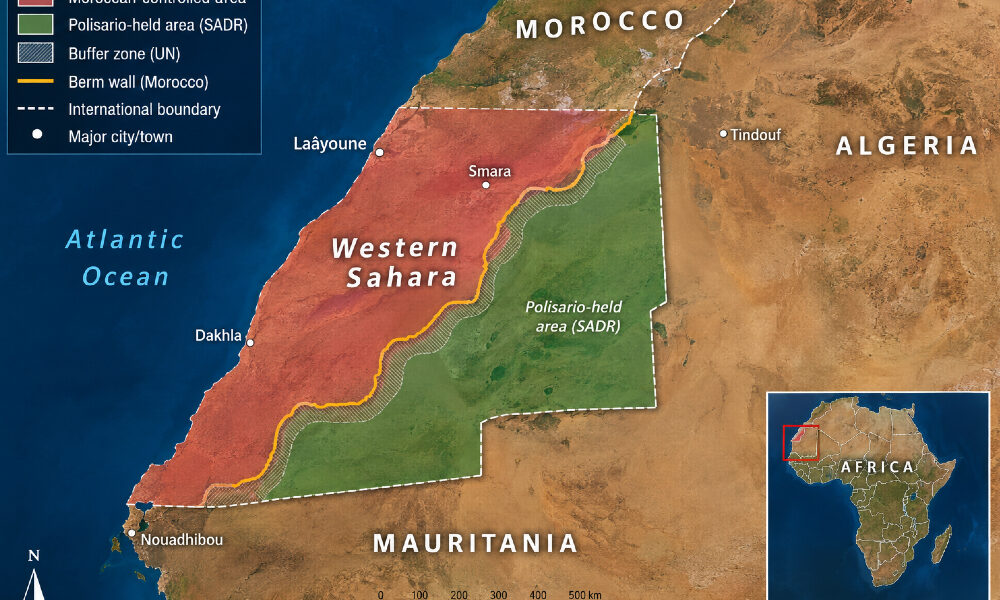
The Polisario Front was formed in 1973 to fight for Sahrawi self-determination. In 1976, it proclaimed the Sahrawi Arab Democratic Republic (SADR) in the territory with a government in exile in Tindouf, Algeria. That exile government, in addition to a northern piece of the territory occupied by the Polisario, remains in place more than 40 years later.
Mauritania withdrew in 1979. Morocco eventually took control of about 80% of the territory, including all major cities and resources. A UN ceasefire was signed September 6 1991. The United Nations Mission for the Referendum in Western Sahara (MINURSO) was established to monitor it and organize a referendum. The referendum never happened due to disputes over who could vote.
The ceasefire broke down in November 2020 after Moroccan troops entered a buffer zone. Low-intensity fighting, mostly drone strikes along the 2,700-kilometer (1,678-mile) Moroccan “Berm” wall dividing Moroccan-controlled territory from Sahrawi “liberated” land, has continued since.
The Current Situation
In 2007, Morocco presented a proposal to resolve the long stalemate. Under this plan, Western Sahara would have an elected legislative, an executive and judicial authorities. There would be local control over the economy, infrastructure, culture, etc. Meanwhile, Morocco maintains control over defense, foreign affairs and religious affairs. It does not offer independence. Sovereignty stays with Morocco.
Under UN Security Council Resolution 2797, approved on October 31 2025, MINURSO was renewed until October 31 2026 and called Morocco’s autonomy plan “potentially the most feasible solution” and a basis for negotiations. The vote was 11 in favor with three abstentions, Algeria did not participate.
Backers of the Moroccan proposal now include the United States (since 2020), Spain (since 2022), France (since 2024) and the United Kingdom (since 2025). More recently, Mauritius, Saudi Arabia and other Gulf states are backing Morocco’s plan. Supporters agree with current King Mohammed VI that the plan is a “win-win” and “face-saving” solution to end a decades-long stalemate.
The SADR continues to seek a referendum with independence as an option and rejects negotiating on the basis of the autonomy plan. Algeria – the main backer of Polisario – hosts more than 170,000 Sahrawi refugees in Tindouf camps. For Algeria, the Tindouf camps provide a buffer against a potential aggressor in Morocco. Algeria is isolated in the Security Council and accuses the resolution of violating decolonization law.
For decades, the SADR has maintained the support of powerful African allies South Africa and Nigeria, which shepherded SADR’s membership in the African Union. Morocco left the AU in 1984 to protest the SADR’s inclusion but returned in 2016 after waging a campaign to increase its economic influence on the continent partly to build its support. Today, between 40-50 African and Latin American states recognize the SADR.
On Western Sahara, China and Russia have been shifting from quiet support for self-determination to a more neutral “don’t block the process” stance. Neither recognizes Moroccan sovereignty outright, but neither vetoed the resolution backing Morocco’s autonomy plan. China, Russia and Pakistan were the three abstentions on UNSC Resolution 2797
Beijing and Moscow Explain Their Abstentions
China calls the 2025 abstention a “pragmatic decision” to “not block an ongoing peace process.” The Chinese UN representative said the resolution “does not fully reflect the latest developments” and cited lack of “an inclusive consultation process.” China presents itself as a supporter of the developing world but is cautious on self-determination issues that could set precedents for Tibet, Taiwan and Xinjiang.
As for Russia, it says the process “lacked transparency and was needlessly fast-tracked” and prevented amendments. The Russians called the resolution “unbalanced” and said it failed to provide a coherent foundation for decolonization. Russia is caught between historic military ties with Algeria versus growing economic/strategic ties with Morocco. Russia also has to balance its own positions on Kosovo, Abkhazia and South Ossetia. Russia still verbally supports self-determination as a principle but won’t use its veto to block Morocco’s plan. It frames itself as neutral and pro-dialogue.
China and Russia are not pro-independence anymore in practice, but they are also not pro-Moroccan sovereignty. They are playing the role of “neutral brokers” who abstain rather than veto, while keeping economic ties to both Morocco and Algeria.
Spain abandoned its original promise to facilitate a Western Sahara independence referendum decades ago, leaving other nations to balance strategic and economic interests when deciding their position on Western Sahara.
Recalling my service on the House Subcommittee on Africa working on the Western Sahara issue, I can say that US support for the referendum faded in favor of what was considered a more pragmatic approach supporting longtime ally Morocco – an American collaborator bolstering US positions on Israel. The current situation will hold only so long as the strategic balancing act on Morocco versus Algeria holds and those nations supporting international law and the moral position on self-determination is not eroded by Morocco’s economic campaign in Africa.
The wild card in this matter is what happens with Sahrawi youth, many of whom grew up outside the territory but have been trained in combat to defend the territory over their entire lives. I have been told that some have become involved with criminal elements in the region, while others have been influenced by extreme Islamists in the region. This situation could unexpectedly turn ugly if extreme elements convince young Sahrawis to ramp up the currently low-level conflict.
Gregory Simpkins, a longtime specialist in African policy development, is the Principal of 21st Century Solutions. He consults with organizations on African policy issues generally, especially in relating to the U.S. Government. He further acts as a consultant to the African Merchants Association, where he advises the Association in its efforts to stimulate an increase in trade between several hundred African Diaspora small and medium enterprises and their African partners.