Politics
Voting Rights Act to protect African-American and minority voters should be upheld – Obama
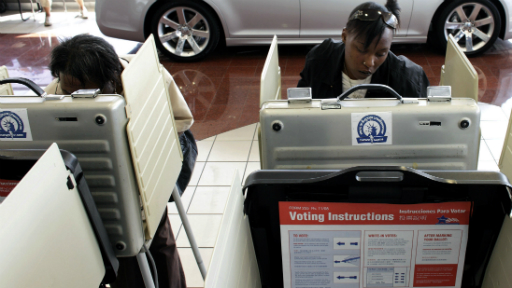
American voters. PHOTO/John Gress/Getty Images
U.S. President Barack Obama argued Friday for keeping a key provision of federal voting rights law in place, saying it will become harder but not impossible to help people who believe their rights at the polls have been violated if the Supreme Court decides to strike down that part of the law.
The court has scheduled oral arguments for Wednesday on a challenge from Shelby County, Alabama, near Birmingham, to a section of the Voting Rights Act. The provision requires all or parts of 16 states with a history of racial discrimination, mostly in the South, to get approval from the Justice Department or federal court in Washington before making any changes in the way they hold elections, such as moving a polling place.
The appeal argues that places covered by the law have made such progress that Washington oversight is unnecessary. Opponents of the provision also cite racial progress in the decades since the landmark law was enacted in 1965 that led to the election and recent re-election of Obama, the country’s first African-American president.
Defenders of the provision say it’s still needed, particularly in light of efforts in many states during the past election cycle to impose new requirements on voters, such as shortening the window for early voting or requiring voters to show photo identification before they cast a ballot, which some argue disproportionately affect African-Americans and other racial minorities – and indirectly suppress their voting rights.
Obama said removing the oversight requirement would make it a lot harder to give relief to voters who feel aggrieved. If that were to happen, he said, such voters would have to wait until potential obstacles have been put in place before they could then sue in an attempt to have them overturned.
“So generally speaking, you’d see less protection before an election with respect to voting rights,” Obama said.
In his State of the Union address, early this month, Obama revealed that he would create a commission to recommend ways to help improve the voting experience in response widespread complaints about long waits, requirements to show photo ID before voting and shortened periods for early voting.
“It’s important that we work together to make sure everybody gets a chance to vote and we clear away a lot of this nonsense and, if we have some national guidelines and rules working with states, counties to make sure that people aren’t waiting in line for six, seven hours, that there aren’t new tricks that discourage people from voting, if we’ve got those in place then obviously it’s not as good as good as if we keep Section 5 of the Voting Rights (Act) in place, which I think we should,” Obama said in the interview. “But I think it’s still possible, obviously, for us to make sure that everybody’s able to exercise their rights.”
The White House disclosed Friday that Obama and a group of black leaders, including National Association for the Advancement of Colored People (NAACP) President Ben Jealous, discussed voter access issues during a meeting Thursday in the Roosevelt Room.
The Supreme Court considered the issue of overturning Section 5 three years ago but sidestepped what Chief Justice John Roberts at the time called “a difficult constitutional question.”
The federal requirement for advance approval, or pre-clearance, was adopted to give federal officials a potent tool to defeat persistent efforts to keep African-Americans from voting. The provision has been a huge success, and Congress periodically has renewed it over the years. The most recent occasion was in 2006, when a Republican-led Congress overwhelmingly approved and President George W. Bush signed a 25-year extension.
The requirement currently applies to Alabama, Alaska, Arizona, Georgia, Louisiana, Mississippi, South Carolina, Texas and Virginia. It also covers certain counties in California, Florida, New York, North Carolina and South Dakota, and some local jurisdictions in Michigan and New Hampshire. Coverage has been triggered by past discrimination not only against African-Americans, but also against American Indians, Asian-Americans, Alaskan Natives and Hispanics.
Before these locations can change their voting rules, they must get approval either from the U.S. Justice Department’s civil rights division or from the federal district court in Washington that the new rules won’t discriminate.
Copyright 2013 The Associated Press