Business
Volkswagen’s Pan-African Playbook: A Blueprint for Building in Emerging Markets
As Volkswagen Group Africa marks 75 years on the continent, its hub-and-spoke strategy in South Africa, Ghana, Rwanda and Kenya offers a masterclass in industrial patience – and a warning about the risks still ahead.


By Des H. Rikhotso
For most global automakers, Africa is an afterthought: a continent of used-car lots and unreliable grids, better served from a warehouse in Rotterdam than a factory on the ground. Volkswagen has spent 75 years quietly betting against that consensus. The wager is now paying off, and it deserves more attention than it gets.
This year, the German carmaker folded its various African operations into a single corporate entity, Volkswagen Group Africa (VWGA) – a rebrand that is less cosmetic than it sounds. It signals that Africa has graduated, in Wolfsburg’s eyes, from a scattering of import markets into a coherent industrial region worth building for. The company now sells through licensed importers in 17 Sub-Saharan countries, runs four dedicated production facilities, and is angling for a bigger slice of trade unlocked by the African Continental Free Trade Area (AfCFTA), the pact designed to turn 54 fragmented economies into a single market of 1.3 billion people. The strategy is a hub-and-spoke model: one heavyweight manufacturing engine in South Africa, ringed by lighter assembly outposts in fast-growing markets further north.
The Engine Room: South Africa Carries the Weight
Every hub-and-spoke system needs a hub sturdy enough to bear the load, and Volkswagen’s is Kariega, its plant in South Africa’s Eastern Cape. Located in the industrial heart of Nelson Mandela Bay, Kariega is the region’s sole full-scale manufacturing facility and, by extension, the economic backbone of the surrounding metro – directly employing more than 4,000 workers.
The numbers are not trivial. Kariega has an annual production ceiling of 171,000 vehicles and, in July 2026, set a new monthly record by rolling 17,009 cars off its lines. Since June 2024, it has held a rare distinction: it is the sole global source of the Volkswagen Polo hatchback for every non-Chinese market in the world, shipping to 38 countries and sending three-quarters of its output abroad. That is not a footnote in an annual report – it is proof that a plant in the Eastern Cape can compete on cost and quality with any factory Volkswagen operates in Europe or Latin America.
Volkswagen is now doubling down. On top of a cumulative R10.28 billion (US$560 million-plus) invested since 2011, VWGA has committed a further R4 billion to retool Kariega for a new, budget-oriented compact SUV – provisionally named the Volkswagen Tengo – due to enter production in 2027. The bet is straightforward: as African incomes rise unevenly but steadily, the vehicle that wins is not the flashiest one but the cheapest one that still carries the VW badge.
The Spokes: Assembling Trust, Not Just Cars
If South Africa is where Volkswagen manufactures at scale, the rest of the continent is where it manufactures relationships. Elsewhere, VWGA relies on semi-knocked-down (SKD) assembly – shipping partially built vehicles for local final assembly – a model built explicitly to work with, rather than around, national trade policy.
In Ghana, Volkswagen took full ownership of its Accra assembly operation from a third-party partner in early 2023, a move that let it capture the full benefit of the country’s assertive Automotive Development Policy. The plant, with capacity for 5,000 units a year, assembles a broad range: the Tiguan, Teramont, Passat, Polo and Amarok.
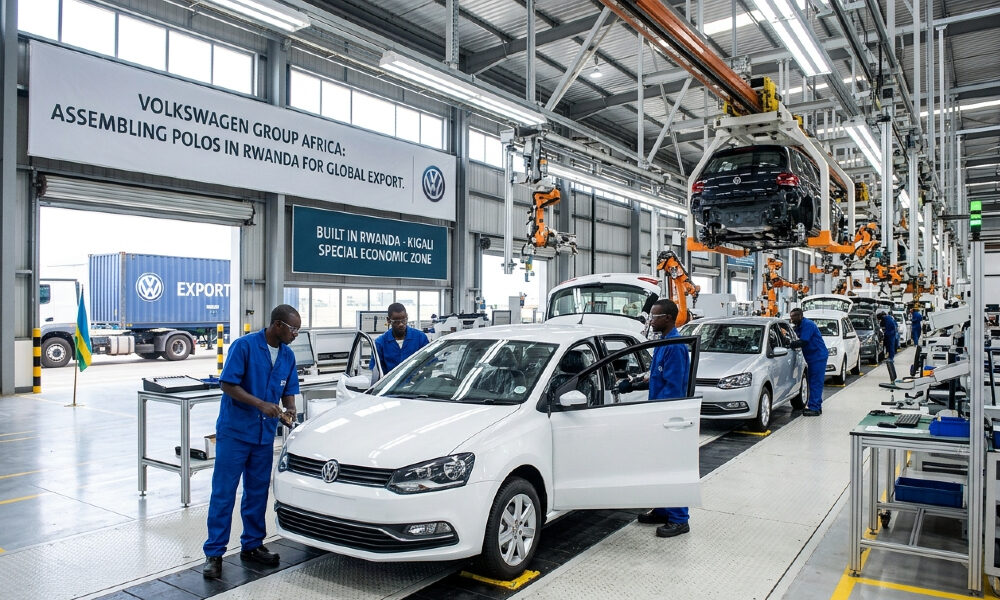
Rwanda offers a different kind of bet altogether. In Kigali, Volkswagen pairs SKD assembly with pilot programs in app-based ride-hailing and early trials of localized electric-vehicle fleets – treating the country less as a factory floor and more as a testing ground for how mobility, not just car ownership, might work across East Africa. In Kenya, a plant in Thika serves as the company’s eastern gateway, feeding demand from across the East African Community’s customs union.
And the map keeps expanding. Talks are reportedly underway with Egyptian officials over a contract-manufacturing hub in the East Port Said Industrial Zone – a move that would finally give Volkswagen a genuine foothold in North Africa and complete a continental pincer with its southern base.
The Headwinds Nobody Should Ignore
None of this comes free. Volkswagen’s African strategy faces three structural risks that could blunt its momentum if left unmanaged.
The first is a flood of cheap imports. Budget vehicles from India and China are undercutting entry-level models like the locally built Polo Vivo, squeezing the exact price segment where African demand is growing fastest.
The second is infrastructure. Energy shortages, congested logistics networks and regulatory friction – compounded by production cutbacks at ArcelorMittal South Africa’s steel mills – threaten the kind of slow-motion de-industrialization that has hollowed out manufacturing elsewhere on the continent.
The third is the electric-vehicle transition. While Europe accelerates away from the internal combustion engine, African demand remains firmly anchored to petrol and diesel – a lag Volkswagen has cleverly exploited to extend the life of its ICE export cycle, even as it quietly invests in local EV components, flexible charging infrastructure and early-stage battery production.
Why This Matters Beyond Volkswagen
The lesson here is not really about cars. It is about what serious, long-horizon industrial commitment to Africa looks like when a multinational treats the continent as infrastructure to be built rather than a market to be harvested. Volkswagen’s hub-and-spoke model – one world-class manufacturing anchor supplying a network of trade-savvy regional outposts – is a template other automakers, and other industries entirely, would do well to study.
The risks are real, and Volkswagen has not solved them so much as managed them so far. But 75 years of continuous manufacturing on a continent that most of the industry still treats as an export destination rather than a production base is not luck. It is strategy. The rest of the automotive world should be taking notes.
Des H Rikhotso (PgDip-BA, MBL) is a seasoned C-suite Multi-Industry business executive with 25+ years of Business Leadership Experience across the South, East and Western Sub-Sahara Africa Region. Based in Kampala, Uganda he serves as East Africa Region Business Executive, driving Business Strategic Growth and Operational Excellence – contributing his Leadership Voice and Clarity to the Region. Des has held Business Leadership roles at BMW Group Africa, Volkswagen Group Africa, Peugeot Motors South Africa, Toyota/Lexus South Africa, Nissan Group of Africa, G.U.D Holdings (Africa Exports Operations Division) and The HDR Group of Companies. He holds Under-Graduate and Post-Graduate business degrees from the University of the Western Cape, Wits University (Wits Business School) and the University of South Africa.