News
UWI professor warns Caribbean to heed lessons from Hurricane Maria
A senior lecturer at the St Augustine Campus of the University of the West Indies (UWI) in Trinidad & Tobago, says one of the “biggest lessons” from the Hurricane Maria experience in Dominica is that it is important for the Caribbean to now “seriously consider the impact of global warming on the level of the hurricane”.
Richard Clarke of the Department of Civil Engineering, who was in Dominica as part of the Caribbean Disaster Emergency Response Agency (CDERA), told the Caribbean Media Corporation (CMC) it was also necessary for the region to examine the wind speeds of designs for constructing buildings in the Caribbean.
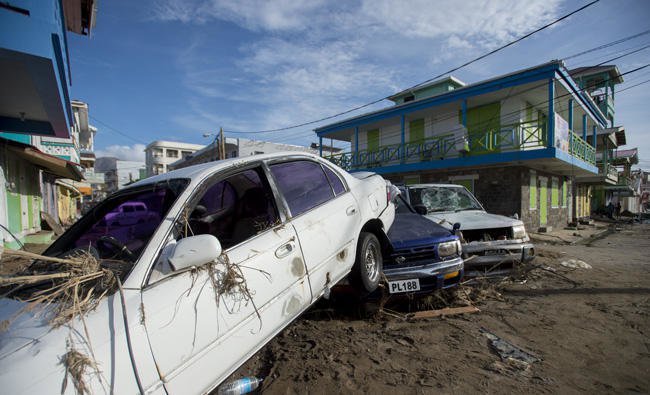
Hurricane Maria slammed into Dominica last week Monday as a Category 5 storm with winds in excess of 290 km/h (180 mph). The storm, has been blamed for more than 25 deaths officially – even though the unofficial figure is put as high as 60, and millions of dollars in damage – with more than 80 percent of the housing sector severely damaged.
“The biggest lesson that we have learnt is that it is important for us to seriously consider the impact of global warming on the level of the hurricane, on the level of the wind speed we need to be designing for. If we have to go with only historical records, meaning prior to the increase in the effect of global warming, then we will be out even if we design to the current wind speeds. when the effects of global warming kicks in, we would have under-designed the structure. So we seriously need to investigate the impact of global warming on the current design wind speeds for the Caribbean.”
Clarke said while this would be among the recommendations he would be submitting to the authorities following his early assessment of the impact of Hurricane Maria on Dominica, it is nonetheless well known to engineers worldwide.
“The issue would be to get the differing engineering organisations to form groups that would try and impact or impress upon government the need for modernizng or treating differently the effect of global warming and other natural phenomena on the design process, to mitigate the effect of this,” he said.
Clarke told CMC the other recommendation to the authorities is “a traditional one, in the sense that we know that it happens and why it happens, but it doesn’t make sense having a building code and it is sitting down on a shelf. If we want to seriously avoid the problems of the impact of the hurricane on people’s lives, we simply have to enforce the building codes,” Clarke told CMC.
Meanwhile, the authorities began the herculean task of cleaning up the debris caused by the hurricane that has made many roads impassable, restricting access to some of the outlying districts and villages. -(CMC)