A Diaspora View of Africa
US Turnaround on Eritrea Relations


By Gregory Simpkins
Major power competition often shapes how they target countries for engagement. After up and down years of US-Eritrean dealings, the US is now reportedly seeking to improve their relationship with Eritrea. An obvious motivation is the improved engagement between Eritrea and Russia in recent years.
Russian-Eritrean relations are at their strongest point since the 1991 independence of that Horn of Africa nation. Regular high-level visits, UN coordination and summit attendance continue. Russia benefits from a Red Sea partner that votes with it at the UN. Eritrea benefits from an ongoing UN Security Council ally that provides diplomatic cover and won’t pressure it on governance.
Economic ties between the pair remain modest. Eritrea’s economy is small, and sanctions constrain major projects. Neither side has announced a Russian base in Eritrea, though speculation persists due to Eritrea’s Red Sea location.
Since 2020, Russia and Eritrea have moved from polite diplomatic ties to active political alignment. The 2023 visit to Eritrea by Russian Minister of Foreign Affairs Sergey Lavrov and Eritrean President Isaias Afwerki’s Moscow trip that same year were the turning point. The relationship is driven by shared isolation from the West, UN voting cooperation and Red Sea geopolitics rather than large trade flows.
Russian President Vladimir Putin said in 2023: “We have a lot of potential in many areas” for trade/economic relations. Specific deals are limited due to Eritrea’s small economy and sanctions, but talks have covered:
- Mining & energy: Russia has shown interest in Eritrea’s mineral deposits and Red Sea port access.
- Military-technical ties: There are no public arms deals, but both sides reference defense cooperation. Eritrea refused to engage with AFRICOM and has been under Western arms embargoes, making Russia an alternative partner.
- Education/humanitarian: Several dozen students from Eritrea completed their studies in the Russian Federation, and the process continues. Agreements signed during Afwerki’s 2023 visit included intergovernmental cooperation.
But as Russia has improved its engagement with Eritrea in recent years, US-Eritrea relations have been mostly strained since Eritrea’s independence in 1993, marked by brief detente followed by long periods of sanctions, distrust and limited diplomatic ties.
As of 2026, strategic concerns in the Red Sea have pushed the Trump administration to explore a reset, but fundamental differences over governance, human rights and sovereignty remain.
A Legacy of Strain: The US-Eritrea Relationship
The US backed Eritrea’s independence from Ethiopia after the Eritrean People’s Liberation Front won in 1991. Washington established diplomatic relations in 1993 when Eritrea formally declared independence. President Afwerki was initially viewed as part of a new generation of African leaders. I was in Capitol Hill meetings during this period where Members of Congress praised Eritrea for its stand against requesting or receiving foreign aid. This was seen as a bold move to commit to self-sufficiency.
Unfortunately, Eritrea had not implemented its 1997 constitution or held national elections since independence. The 1998-2000 Eritrea-Ethiopia border war also damaged ties. The US supported a UN-backed peace process but relations cooled as Eritrea’s government became more authoritarian.
The US criticized Eritrea’s record on human rights, civil liberties, press freedom and indefinite national service. Eritrea is controlled entirely by the president and the sole political party. The US backed UN sanctions on Eritrea from 2009-2018 over alleged support for al-Shabaab in Somalia and border disputes with Djibouti.
Eritrea became the only African country to have refused engagement with AFRICOM and the IMF. It was heavily sanctioned by Washington and excluded from SWIFT, the global standard for financial information.
After Prime Minister Abiy Ahmed took power in Ethiopia, the 2018 peace agreement between Ethiopia and Eritrea raised US hopes. Sanctions at the UN were lifted in November 2018. The US reopened some channels, but Eritrea’s domestic policies didn’t change.
In 2021, the US imposed targeted sanctions against Eritrean entities and individuals, including the Eritrean Defence Forces, citing “Eritrea’s destabilizing presence in Ethiopia” and “credible accounts implicating Eritrean forces in serious human rights abuses” during the Tigray War.
At the 2022 US-Africa Leaders’ Summit, President Joe Biden acknowledged democracies like Botswana and Ghana but indicated willingness to overlook corruption/rights issues in some contexts. Eritrea was specifically mentioned as an exception due to its particularly troubling record.
Eritrean sources have described four years of “hostility” under Biden referring to their country as being “sanctioned, slandered, boxed in with wild accusations”. They attribute it to Eritrea’s refusal to be a client state, host US bases or “sell its sovereignty”.
The Pivot on Eritrea
In April 2026, the Wall Street Journal reported that the Trump administration is considering resetting relations and easing decades-long sanctions. There are several reasons:
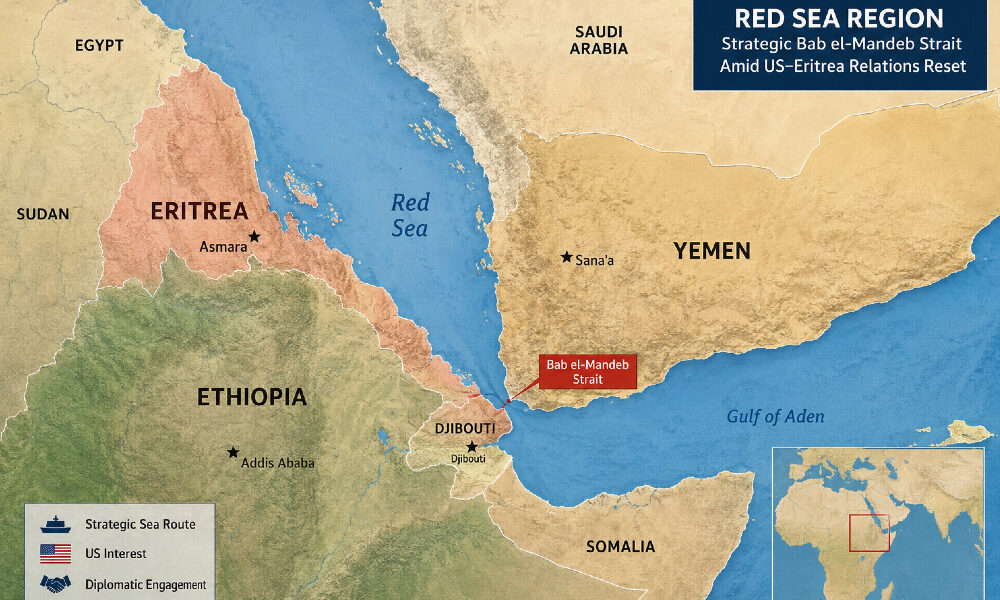
- Red Sea security: Eritrea controls 1,120 kilometers (696 miles) of Red Sea coastline next to Bab el-Mandeb. With Houthi threats and Iran restricting Hormuz, Asmara became a strategic card at the heart of the geopolitical equation.
- Regional leverage: Egyptian President Abdel Fatah el-Sisi brokered a secret Cairo meeting between Trump envoy Massad Boulos and President Afwerki covering sanctions relief and higher-level diplomatic channels.
- Russian relations with Eritrea: There is a sense that Russia should not be the impediment for the US in achieving its Red Sea goals.
President Isaias confirmed a 2026-2028 roadmap for renewed engagement. Eritrea says it wants the US to adopt “sound, rational, and regionally coherent policies” for the Nile Basin, Red Sea corridor and Horn of Africa.
That government says it is not asking for aid but urging Washington to reverse partnerships that propped up what it calls rogue regimes in Sudan, Somalia, Ethiopia and Yemen.
Analysts warn that easing sanctions could risk an armed confrontation between Eritrea and Ethiopia and that Afwerki might use the opening to consolidate his domestic authority without offering any genuine strategic concessions.
Given questions surrounding the proposed Iran-US peace accord, President Trump could ill afford another questionable agreement with a “rogue regime”.
US-Eritrea relations went from post-independence optimism to sanctions and isolation by 2009. A brief 2018 thaw was reversed with Tigray War sanctions in 2021. As of 2026, strategic concerns in the Red Sea have pushed the Trump administration to explore a reset, but fundamental differences over governance, human rights and sovereignty remain.
US reengagement at this point would be complicated. Afwerki, especially with his Russian alignment, would be a questionable partner with little incentive to put a hold on actions that would embarrass the United States or roil the situation in the Horn of Africa. Please recall that he has a long history of coming into conflict with his neighbors.
Gregory Simpkins, a longtime specialist in African policy development, is the Principal of 21st Century Solutions. He consults with organizations on African policy issues generally, especially in relating to the U.S. Government. He further acts as a consultant to the African Merchants Association, where he advises the Association in its efforts to stimulate an increase in trade between several hundred African Diaspora small and medium enterprises and their African partners.