A Diaspora View of Africa
US Tariff Policy Threatens African, Caribbean Nations


By Gregory Simpkins
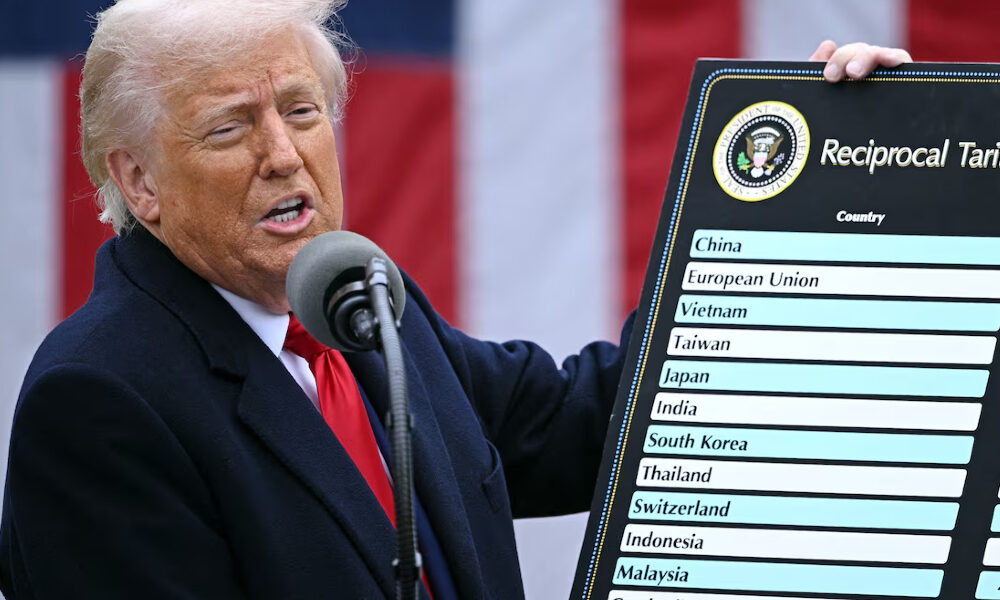
US President Donald Trump appears to be more determined than ever to pursue his international tariff policies, even through the several reversals of course seen. His position is bolstered by positive news from the Department of the Treasury, as the department’s Secretary Scott Bessent recently said more than US$98 billion in tariff revenue has flowed into the federal government as of July 8, according to a report in the July 11 edition of the Washington Times.
Bessent said tariff revenue could exceed US$300 billion by year’s end.
The Department of the Treasury announced that the government had posted a surplus for June due to the influx in tariff revenue. The Treasury’s monthly statement revealed that the government had posted US$499 billion in outlets during June while bringing in US$526 billion in revenue.
The US$27 billion surplus was also the exact value of receipts from “customs duties.” Since the beginning of the year.
That figure is sure to prove a boon to Trump’s short-term fiscal approval and possibly assuage current concerns from tariff skeptics about their impact on the broader economy. Trump himself has previously floated the prospect of tariff revenue eventually overtaking the income tax and paving the way for its elimination, though such a development appears a long way off.
In the meantime, Treasury Secretary Scott Bessent and other top administration officials continue to pursue revised trade deals with other nations in the wake of “Liberation Day.” Thus far, the U.S. has secured significant agreements with the UK and Vietnam.
Mixed Economic Impact According to The Budget Lab
The Budget Lab (TBL), a non-partisan policy research center dedicated to providing in-depth analysis of federal policy proposals for the American economy, estimated the effects all US tariffs and foreign retaliation implemented in 2025 through July 13, including the announced 30 percent tariffs on the EU and Mexico. TBL presents a more mixed view of the impact of US tariffs.
According to TBL, consumers face an overall average effective tariff rate of 20.6 percent, the highest since 1910. After consumption shifts, the average tariff rate will be 19.7 percent, the highest since 1933.
The price level from all 2025 tariffs rises by 2.1 percent in the short-run, the equivalent of an average per household income loss of US$2,800 in 2025US$. This assumes the Federal Reserve does not react to tariffs, and so the real income adjustment comes primarily through prices rather than nominal incomes; if the Federal Reserve reacted, the adjustment could in part come in the form of lower nominal incomes.
The tariffs clearly override benefits from the African Growth and Opportunity Act (AGOA), which previously allowed African countries to export goods duty-free and quota-free to the US. AGOA benefits, undermined by the tariffs, will make African exports less competitive in the US market.
Annual pre-substitution losses for households at the bottom of the income distribution are US$1,500. The post-substitution price increase settles at 1.8 percent, a US$2,300 loss per household.
The 2025 tariffs disproportionately affect clothing and textiles, with consumers facing 44 percent higher shoe prices and 40 percent higher apparel prices in the short-run. Shoes and apparel prices stay 20 percent and 18 percent higher in the long-run respectively.
In the long-run, TBL estimates that tariffs present a trade-off. US manufacturing output expands by 2.6 percent, but these gains are more than crowded out by other sectors: construction output contracts by 4.1 percent and agriculture declines by 0.8 percent.
All tariffs to date in 2025 raise US$3.0 trillion over 2026-35, with US$487 billion in negative dynamic revenue effects, bringing dynamic revenues to US$2.5 trillion.
Tariffs Hit Developing Nations in Africa and the Caribbean
Apparently not taken into account in any meaningful way in tariff impact calculations is the economic effect US tariffs will have on the developing countries in Africa and the Caribbean.
For African countries, the US tariffs could disrupt continental exports to the US, potentially leading to a decline in trade between the two regions. African countries like Lesotho, Madagascar, and Mauritius face high tariffs of 50 percent, 47 percent, and 40 percent, respectively.
The tariffs clearly override benefits from the African Growth and Opportunity Act (AGOA), which previously allowed African countries to export goods duty-free and quota-free to the US. AGOA benefits, undermined by the tariffs, will make African exports less competitive in the US market.
Countries like South Africa, which exports citrus fruits, wine and soybeans to the US, may experience economic contraction due to reduced competitiveness. The Citrus Growers’ Association of Southern Africa estimates that around 35,000 jobs are at risk in Citrusdal, South Africa, due to the tariffs, which also threaten approximately 40,000 jobs in Lesotho’s garment industry and 60,000 jobs in Madagascar’s textile sector.
Of course, the US tariffs may accelerate efforts to strengthen intra-African trade, with African countries more actively exploring alternative markets and boosting regional trade. African countries are seeking alternative markets, strengthening regional trade agreements like the African Continental Free Trade Area (AfCFTA), and investing in value-added production to build more resilient economies.
As for Caribbean countries, the region is expected to suffer nearly US$550 million in revenue losses due to the tariffs, with Trinidad & Tobago, The Bahamas, and Haiti being the hardest hit. Caribbean exporters also may experience a decline in competitiveness, particularly in industries like rum, spirits, seafood, coffee, and cocoa.
Humanitarian and Economic Fallout Beyond Trade
The tariffs could lead to higher prices for essential imports, exacerbating food insecurity challenges in the region. Furthermore, reduced American consumer spending power could also affect tourism earnings, a critical source of foreign exchange for most Caribbean economies.
The current US across-the-board tariffs negatively impact the Generalized System of Preferences (GSP), which primarily provides trade assistance to developing countries as a whole. The GSP program is not directly mentioned in the context of the current tariffs, but countries that benefit from GSP may still face challenges due to the broad nature of the tariffs.
Countries like Ghana, which faces a 10 percent tariff, may lose over US$1 billion in export revenue, while Nigeria faces a 14 percent tariff.
US and Western sanctions regimes such as the ones imposed on Russia to punish its invasion of Ukraine imposed serious collateral damage on developing countries that depended on materials such as wheat, driving up bread prices. The suspension and likely ongoing diminishing of health and other humanitarian assistance has placed a burden on developing countries that had received US aid.
Now these tariffs further creates the justifiable view that neither Africa nor the Caribbean are important for US policy.
However, such a minimized view of Africa and the Caribbean doesn’t jibe with the assessment of those who have long provided aid to these regions or those who sell or buy products from Africa and the Caribbean. In the longer run, there could be a consumer revolt over higher prices and a diminished selection of desired foreign products.
At some point, probably sooner rather than later, these elements will rise up to express their discontent with current US aid and trade policy. The Trump political advisers better hope such upheaval comes in time to make corrections before the 2026 midterm elections.
Gregory Simpkins, a longtime specialist in African policy development, is the Principal of 21st Century Solutions. He consults with organizations on African policy issues generally, especially in relating to the U.S. Government. He further acts as a consultant to the African Merchants Association, where he advises the Association in its efforts to stimulate an increase in trade between several hundred African Diaspora small and medium enterprises and their African partners.