A Diaspora View of Africa
US Culture War Affects Historical Remembrance


By Gregory Simpkins
Culture wars between various factions of the American public are not new phenomena – be it racial, ethnic, gender, sexual orientation or regional. As one might expect, each side believes its position is the correct one and discounts rival opinions.
Insofar as interpersonal relations are concerned, this of course hampers the ability to achieve understanding of one another, but in terms of establishing a historical record, the failure to achieve balance negatively affects accuracy.
This is what is happening in the United States today as regards the accounts of the country’s history contained in history books and museums. Incomplete or inaccurate history taught to children affects the body politic during their lifetimes.
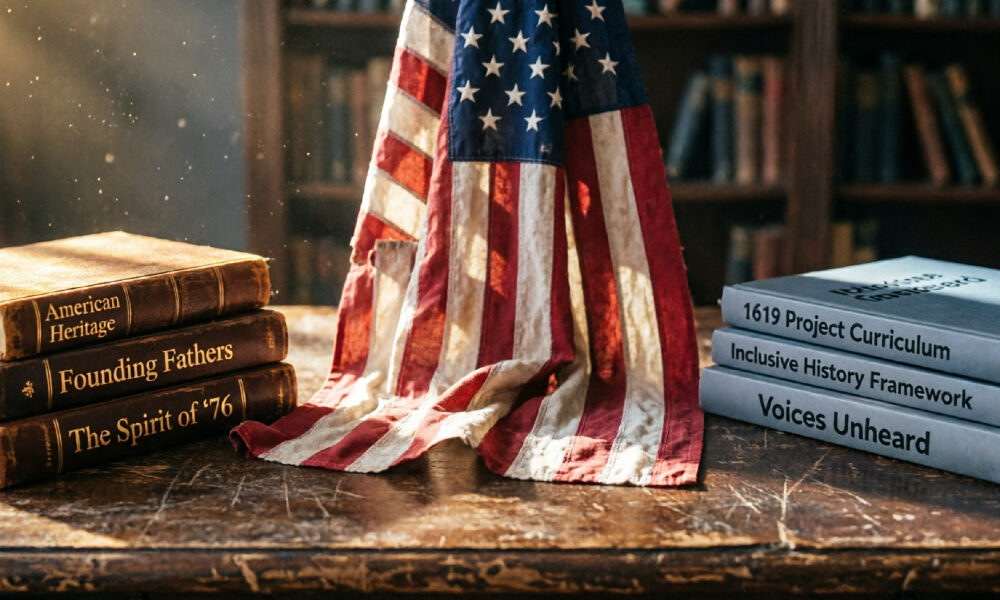
The disputes center on competing narratives of the American past: one emphasizing founding ideals of liberty, equality and exceptional progress (often tied to 1776), versus one centering on slavery, racism, Native American dispossession and systemic oppression as foundational (often tied to 1619 or critical frameworks). It is not primarily a debate over isolated facts but rather over emphasis, interpretation, purpose (civic unity vs. critique) and who controls the story in schools, museums, parks, textbooks and monuments.
This is a long-running “history war.” Earlier versions involved Confederate “Lost Cause” narratives in textbooks and monuments, progressive “new history” in the early 20th century, Howard Zinn’s book A People’s History and battles over standards. It intensified with the New York Times 1619 Project (2019), Trump’s first-term 1776 Commission (2020–2021), post-2020 monument removals, state laws on “divisive concepts” and especially under the second Trump administration around the US 250th anniversary.
Critical Race Theory and the Fight Over Curricula
In a May 24 2022 essay for the Heritage Foundation, Melissa Moschella, former Visiting Scholar at the Simon Center for American Studies, outlines how what many see as a negative view of America has infiltrated school systems. “I explain critical race theory and show how many of its ideas have made their way into public schools across the country, prompting a backlash that has led to the introduction of anti-CRT education regulations in many states,” she says.
“CRT views values like “objectivity” as tools of oppression. It’s clear that many public schools are indeed incorporating plenty of CRT-inspired ideas like these in their curricula,” she states.
President Trump has issued “Restoring Trust in the Smithsonian Institution,” an executive order that requires signs be placed outside the museum disclaiming its exhibits as “inaccurate” and anti-American. Among the contrary views on the matter is the July 29 2026 article on the Raw Story website by progressive journalist Matthew Chapman in which he states that the White House objection to including true, but negative historical events is driven by Christian nationalist and uncredentialed historian David Barton, who is promoting the Christian origin of the United States.
“Barton, along with his son Tim, head up WallBuilders, a group that promises to “teach US history and how our beginnings were overwhelmingly rooted in Christian ideology” – an easily debunked claim as Christianity and Biblical law are never mentioned anywhere in the Constitution and the document explicitly prohibits an “establishment of religion” by Congress,” he writes.
Yet this is not just a conservative-progressive issue and has been a point of contention for more than just this current period.
Core Competing Perspectives
Patriotic / 1776-oriented view (common among conservatives, some classical liberals and the Trump administrations): America’s founding principles – equality, natural rights, self-government – set in motion unique progress against the backdrop of universal human evils like slavery (practiced worldwide). The American Revolution, the Constitution, the Civil War and civil rights advances represent the implementation of those ideals.
Excessive focus on flaws, for example the so-called “original sin” of slavery/racism or settler-colonial framing, is seen as ideological distortion that fosters shame, division and anti-Americanism rather than accurate history or civic cohesion. Critics of the 1619 Project (including some professional historians) highlighted factual problems, such as claims that protecting slavery was a primary motive for the Revolution. The 1776 Commission and later executive actions have been aimed at “patriotic education” and restoring balance against what they call race-centered or “woke” revisionism.
Critical / inclusive / 1619-oriented view (common among progressives, many academic historians and activists): Traditional narratives whitewashed slavery, Native American removal, Jim Crow and ongoing racial inequities by centering on White male founders and achievements while minimizing the experiences and contributions of non-Whites. Slavery and racism are not peripheral deviations but central to the nation’s development (economy, law, culture).
Honest history requires including marginalized voices, acknowledging hypocrisy (e.g., slaveholding founders) and examining systemic legacies. The 1619 Project sought to reframe the national story around the 1619 arrival of enslaved Africans. Critics of recent federal reviews argue they sanitize or erase difficult truths about Washington’s enslaved people, Native American displacement or racism.
Complex / professional-historian middle ground: Many scholars reject both poles. American history includes profound achievements and profound failures; the Declaration’s principles were revolutionary and incomplete in practice; slavery was real and central and the Union’s victory and later reforms matter.
Polarized projects (1619’s reframing claims or 1776’s celebratory tone) can sacrifice nuance. A common narrative is eroding in schools and universities amid culture-war pressure, leaving fragmented or avoided teaching.
Current Flashpoints (as of 2025–2026)
Federal actions under a 2025 executive order (“Restoring Truth and Sanity to American History”) directed agencies, including the National Park Service and the Smithsonian Institution, to review materials for content that “inappropriately disparage[s] Americans past or living” and to emphasize American achievements and progress. This led to removals or reviews of panels on slavery at the President’s House site in Philadelphia (sparking lawsuits and partial restorations), Native American history exhibits, climate references and other interpretive materials.
Supporters frame it as correcting post-2020 ideological excesses; critics call it whitewashing or political interference with evidence-based history. Similar tensions appear in state curricula (restrictions on certain race-related concepts in multiple states), textbook content, historical markers and monument policies (removals after 2020 followed by restoration efforts).
Classroom debates often conflate academic CRT (a legal/academic framework) with broader teaching about racism or the 1619 Project. Teachers report political pressure altering discussions; professional groups warn of both over-correction toward celebration and earlier over-emphasis on grievance.
Why It Matters and Why It Persists
Control of the narrative shapes identity, citizenship, policy preferences and trust in institutions. One side sees uncritical patriotism as myth-making that ignores injustice; the other sees relentless critique as demoralizing and ahistorical (ignoring comparative global context or reforms).
Public markers and sites have long contained errors, omissions or ideological slant (e.g., language focusing on the Confederacy’s defeat in the Civil War or the so-called “Lost Cause”). Professional historians generally prioritize primary sources, complexity and evidence over either purely celebratory or purely condemnatory frameworks, but politics increasingly influences what gets taught or displayed.
The dispute continues because Americans disagree on the relative weight of ideals vs. practices, continuity vs. rupture and history’s role in fostering pride, reform or reckoning. No single “correct” portrayal exists independent of those value judgments; accurate history requires both the full record of wrongs and the distinctive features that enabled self-correction.
The United States was born through the efforts of White people who escaped what they considered persecution in Europe only to persecute non-White people in the new country. Downplaying racism in the founding of the country and in years since undercuts the tremendous progress made over the past 250 years. Celebrating the country on July 4th – Independence Day – or giving credit to the Constitution should be more about the principles embodied in the country’s establishment than in the flawed implementation of those principles.
Nevertheless, to pretend that lynchings, the destruction of Black towns, the massacres of Native Americans and the mistreatment of Hispanics and Asians never happened means that you would be celebrating achievements without acknowledging what those achievements represent. How can you measure how far we have come as a society if you leave out the low points to only honor the high points?
We should be able to tell the complete story of America – warts and all. The achievements of Black inventors, for example, are made more remarkable because of the discrimination they overcame.
Lynchings and town destructions were common in the last century and before, but they are rare in this day. I was born in a time in this country when Black people had to avoid certain areas for fear of mistreatment or worse. That is veritably nonexistent today.
The good, the bad and the ugly of American history is not only worth telling, but it is vital to preventing a return to the attitudes and behaviors we have thankfully left behind for the most part. All is not sunshine and light in this country, but if we fail to give a balanced view of where we are and where we have come from, we risk returning to the darkness from which we have climbed.
Too many people from all groups have sacrificed too much for the progress to which we cling. We must not dishonor their memories.
Gregory Simpkins, a longtime specialist in African policy development, is the Principal of 21st Century Solutions. He consults with organizations on African policy issues generally, especially in relating to the U.S. Government. He further acts as a consultant to the African Merchants Association, where he advises the Association in its efforts to stimulate an increase in trade between several hundred African Diaspora small and medium enterprises and their African partners.