Opinion
Unfair Exchange: Africa’s Costly Blind Spot in the US-China Trade War
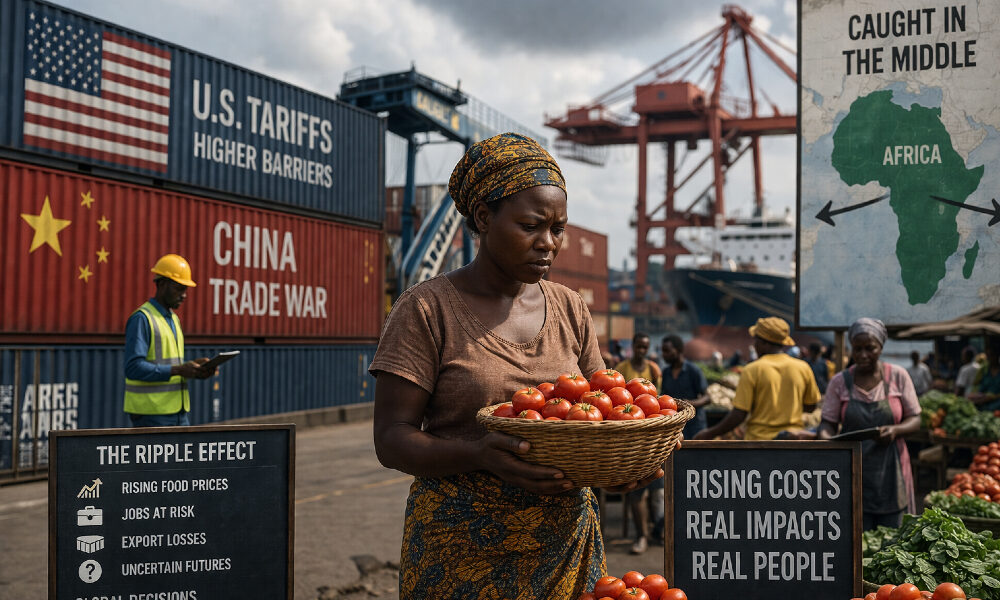
When powerful nations wage trade wars, the cost is always borne by those who had no voice in starting them.


By Juwon Akin-Olotu
When powerful countries go to war over trade, who pays the price?
The answer, almost always, is the same. It is the farmer in Ondo State who has never encountered a tariff schedule. It is the bread buyer in Lagos whose weekly food budget has been quietly recalculated by a decision made in Washington. It is the young woman in Lesotho who built her livelihood around a garment factory exporting to America, only to wake one morning and find that the terms of her survival had changed overnight.
Nobody asked them. Nobody warned them. Nobody built a buffer for them.
This is the story of the global food trade war – and Africa’s place in it. It deserves to be told plainly, without the diplomatic language that typically softens these conversations into something comfortable and useless.
What Actually Happened
On April 2, 2025, the United States announced a sweeping overhaul of its trade policy. Every country now faces a minimum 10 percent tariff on exports to America.
Countries deemed to run large trade surpluses with the US face steeper rates. Nigeria was hit with 14 percent. South Africa with 31 percent. Madagascar with 47 percent.
Simultaneously, the African Growth and Opportunity Act – AGOA – which had granted 32 sub-Saharan African countries preferential, largely duty-free access to the US market since 2000, was allowed to expire on September 30, 2025. Twenty-five years of carefully constructed trade architecture, gone. Not because it had failed. Because a new administration chose not to renew it.
African exports of agricultural goods and manufactured products now face tariffs two to three times higher than those applied to fuels and minerals. The continent’s farmers and light manufacturers are being taxed most heavily, while its oil and mineral exporters face the least disruption.
Let that sink in: the Africans who work hardest are being taxed the most.
The Numbers Behind the Disruption
Sub-Saharan Africa imports 85 percent of its wheat. Households across the continent spend more than half their income on food.
The Council on Foreign Relations estimates that the continent faces a 4 percent increase in food import spending – amounting to US$65 billion – marking a third consecutive year of growth in what African families pay simply to eat.
Nigeria alone imports US$2.1 billion worth of food from the United States annually, including rice, wheat, poultry, and dairy products. With the naira already under sustained pressure and food inflation having touched 40 percent in 2024, any additional cost transmission from global trade disruption lands squarely on the dining table.
South Africa’s citrus industry, which supports 35,000 jobs, is directly exposed to the new tariffs. Kenya’s textile and apparel sector, employing over 66,000 workers – the majority of them women – built its entire export model around AGOA access.
Lesotho, a small mountain kingdom where nearly 60 percent of apparel exports were destined for the United States, is now navigating a 15 percent tariff on goods that entered duty-free just months ago. Orders are being cancelled. Jobs are disappearing. And the people losing those jobs did not vote in the American election that changed their circumstances.
The Part That Keeps Me Up at Night
I grew up on a farm. I understand what it means to work a piece of land and have forces you cannot see or control determine what that work is worth.
But what we are watching now is different in both scale and speed. This is not a drought or a pest. It is a geopolitical realignment being conducted by large economies for their own strategic purposes – and Africa is caught in the middle of it with neither the negotiating leverage nor the structural resilience to absorb the shock.
Here is what I keep returning to.
When China and the United States go to war over trade, Africa has no seat at the table. But Africa always has a seat at the consequences.
American soybean exports to China fell 78 percent through August 2025. Corn exports collapsed by 99 percent. That disruption does not stay in Chicago. It travels through global supply chains, changes who buys from whom, shifts commodity prices, and eventually shows up as the cost of a bag of flour in Kano.
Economists estimate that the full effect of the tariff shock will reach consumers between April and October 2026. We are entering that window now.
And Africa’s governments are largely watching. Negotiating at the margins. Hoping for exemptions. Sending delegations to Washington. A meaningful structural response is almost entirely absent.
The Opportunity We Are Failing to Seize
In the middle of all this disruption, there is an opening that Africa has not yet fully recognized or grasped.
China has extended zero-tariff treatment to 100 percent of tariff lines for all 53 African countries that maintain diplomatic ties with it. China-Africa trade reached US$295.6 billion in 2024 – a record high for the fourth consecutive year. Chinese imports of African coffee grew 70.4 percent through March 2025. Cocoa bean imports rose 56.8 percent. African agricultural exports are finding new markets and growing at an average annual rate of 6 percent since 2020.
But here is the problem with this picture: replacing dependence on one external power with dependence on another is not a strategy. It is merely a relocation of vulnerability.
The African Continental Free Trade Area exists precisely for moments like this. A continental market of 1.4 billion people is the only genuine hedge Africa has against the volatility of being caught between competing superpowers.
Intra-African trade currently represents less than 15 percent of the continent’s total commerce. That number is an indictment of everything we have failed to build.
When US policy disrupts African exports, African goods should be able to find a home in African markets. When global food prices spike – whether from a war in Eastern Europe or a tariff dispute in the Pacific – Africa’s food systems should have the internal resilience to absorb the shock, rather than transmit it directly to the most vulnerable households.
That resilience is not built in a year. It is built by decisions made right now: investment in food processing, cold-chain infrastructure, regional market connectivity, and the policy frameworks that make intra-African trade cheaper and faster than importing from outside the continent.
What This Demands of Us
I run an agribusiness operation in southwestern Nigeria. I lead a youth agricultural empowerment initiative working across Africa. I run a School of Agricultural Policy, training a cohort of young Africans to read, write, and influence the policies that shape our food systems.
What I see in the current global trade environment is this: the old arguments for building sovereign, integrated African food systems are no longer theoretical. They are urgent – financially urgent, strategically urgent, urgent in the way that bread prices in Lagos are urgent.
Every African government that has not taken food sovereignty seriously is now facing the bill. Not in the form of a policy failure report, but in the form of inflation that erodes citizens’ purchasing power faster than incomes can possibly grow.
The question I want to put to every agricultural policymaker, every agribusiness leader, every young practitioner reading this is a simple one.
What are we building that does not depend on someone else’s goodwill to survive?
Because goodwill, as 2025 has demonstrated comprehensively, is not a trade strategy. Africa will feed Africa.
Juwon Akin-Olotu is the founder and CEO of Forthwith Global Limited, an agribusiness and consultancy advancing sustainable farming and modern agricultural solutions across Africa. A recognized voice in the continent’s agricultural sector, he champions technology adoption, human-capital development, and leadership grounded in service. Akin-Olotu is also a frequent speaker and moderator at international forums, where he addresses sustainable agriculture, agri-technology, and entrepreneurial education.