A Diaspora View of Africa
UN Resolution on Historic Slavery Is Incomplete


By Gregory Simpkins
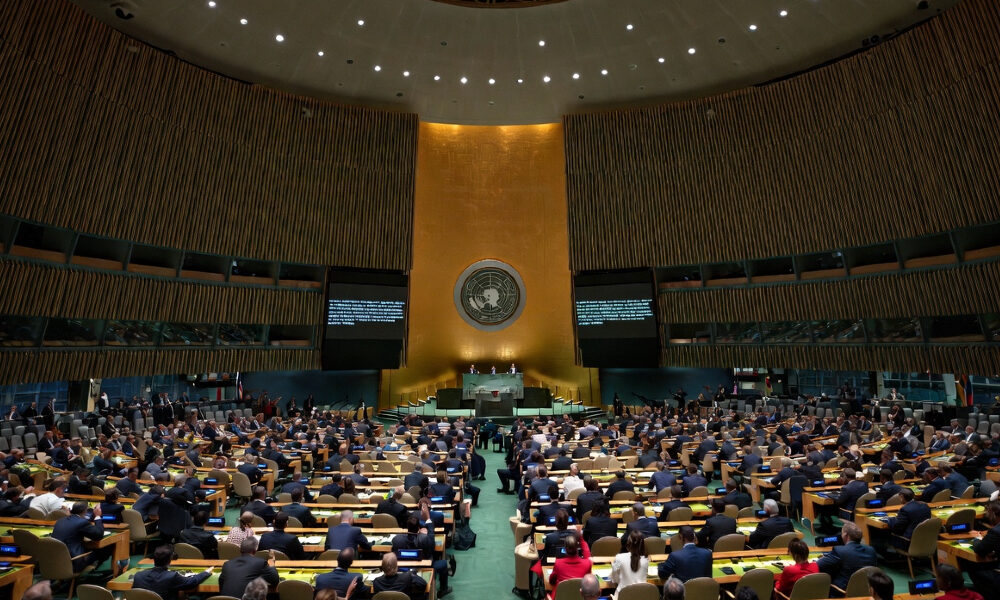
Recently, the United Nations passed a resolution labeling the trans-Atlantic slave trade as “the gravest crime against humanity.” This resolution was championed by Ghana and received 123 votes in favor. Three countries – Argentina, Israel and the United States – voted against and 52 abstained.
“Today, we come together in solemn solidarity to affirm truth and pursue a route to healing and reparative justice,” said Ghana’s President John Dramani Mahama, speaking ahead of the vote on behalf of the 54-member African Group – the largest regional bloc at the UN.
The resolution cited the definitive break in world history, scale, duration, systemic nature, brutality and enduring consequences that continue to structure the lives of all people through racialized regimes of labor, property and capital. Indeed, the trans-Atlantic slave trade definitely interrupted Africa’s history and altered the history of Europe and the Americas.
An estimated 12 million or more of Africans were sold into a form of slavery much more brutal and dehumanizing than that experienced previously in much of Africa.
The forms of slavery in Africa often were closely related to kinship structures. In many African communities, where land could not be owned, enslavement of individuals was used as a means to increase the influence a person had and expand connections.
This made slaves a permanent part of a master’s lineage and the children of slaves could become closely connected with the larger family ties. Children of slaves born into families could be integrated into the master’s kinship group and rise to prominent positions within society, even to the level of chief in some instances.
However, stigma often remained, and there could be strict separations between slave members of a kinship group and those related to the master.
How Chattel Slavery Differed From African Traditions
Chattel slavery is a specific servitude relationship where the slave is treated as the property of the owner. As such, the owner is free to sell, trade or treat the slave as he would other pieces of property, and the children of the slave often are retained as the property of the master.
There is evidence of long histories of chattel slavery in the Nile River valley, much of the Sahel and North Africa. Evidence is incomplete about the extent and practices of chattel slavery throughout much of the rest of the continent prior to written records by Arab or European traders, but it was not thought to be the dominant form of African slavery.
Justification for the resolution cites such international compacts as the Universal Declaration of Human Rights, the International Covenant on Civil and Political Rights, the International Covenant on Economic, Social and Cultural Rights, the International Convention on the Elimination of All Forms of Racial Discrimination and the Durban Declaration and Programme of Action, which acknowledged that slavery and the slave trade, including the trans-Atlantic slave trade, were appalling tragedies in the history of humanity not only because of their abhorrent barbarism but also in terms of their magnitude, organized nature and especially their negation of the essence of the victims.
All of that is undoubtedly true. Still, the UN resolution, while calling for reparations for the trans-Atlantic slave trade focuses its condemnation on those buyers of slaves sold through and to European interests but not on the indigenous sellers of slaves – even if the sellers did not have in mind the horrors that accompanied those sold abroad. Ghana and Benin previously acknowledged the role their ancestors played in the slave trade.
Moreover, the resolution ignores the selling of Africans to Middle Eastern interests – the trans-Saharan slave trade.
Trans-Saharan Slave Trade
From the 3rd century BC to the 19th century, the trans-Saharan slave trade was big business for many Arab and Northern African merchants. They relied on cheap slave labor from black Africans to develop their empires and even staff their military forces.
Although not much is known about the trans-Saharan slave trade as compared to the trans-Atlantic slave trade, it’s been estimated roughly more than 20 million black Africans were captured and enslaved. The trans-Sahara trade existing from prehistorical time, the peak of the trade extended from the 8th century until the early 17th century.
The trans-Saharan slave trade was a massive and complex system that spanned more than 1,000 years, from the 7th to the 20th century. It’s estimated that as many as 18 million Africans were forcibly taken across the Sahara Desert to be sold into slavery in North Africa, the Middle East and beyond.
Major routes included the Tripoli-Ghadames-Ghat-Gao route, connecting modern-day Libya to Nigeria and the Egypt-Sudan route. Another 4 million were taken via the Red Sea and Indian Ocean routes.
This sector of the slave trade began in the 7th century and continued until the early 20th century, with some reports suggesting it persisted in some form until the 1960s and probably beyond.
I met a freed slave held by Arabs in Sudan in 2011. He had been blinded by his “owner” with peppers rubbed into his eyes, and his case was presented at a hearing I organized in the House of Representatives Subcommittee on Africa.
Has it truly ended? Officially, yes – the trans-Saharan slave trade was abolished in the early 20th century, but Mauritania, for example, has found it necessary to abolish slavery more than once in recent decades because those who considered themselves to be Arabs continued to refuse to change their traditions because they felt black Africans were inferior.
Modern-day slavery is widely recognized as a human rights violation. However, some forms of exploitation and trafficking persist in parts of Africa and the Middle East.
Modern-Day Slavery
While focusing solely on past slavery, the resolution ignores what is considered modern-day slavery.
“Trafficking in persons” and “human trafficking” are umbrella terms – often used interchangeably – to refer to a crime whereby traffickers exploit and profit at the expense of adults or children by compelling them to perform labor or engage in commercial sex. Make no mistake, whichever term you choose, this is still slavery in modern times.
The current United States Trafficking In Persons (TIP) report, for example, recognizes two primary forms of trafficking in persons: sex trafficking (in which a commercial sex act is induced by force, fraud or coercion, or in which the person induced to perform such an act has not attained 18 years of age) and forced labor (the recruitment, harboring, transportation, provision or obtaining of a person for labor or services, through the use of force, fraud or coercion for the purpose of subjection to involuntary servitude, peonage, debt bondage or outright slavery.
Unlike centuries past, those persons forced into sexual slavery can make their enslavers much more than forcing them to engage in the physical sex act, involving those who engage prostitutes surrounding such events as the Olympics, the World Cup and the Super Bowl. In addition to such endeavors as strip clubs, in which enslaved people take off their clothes publicly, even in settings in developed countries.
Patrons of such establishments may have been watching slaves performing for their entertainment without knowing it. And technology has provided means of transmitting sexual images of enslaved persons through photos and/or videos – widening and prolonging the illicit profitmaking from their forced enslavement.
More than 180 nations have ratified or acceded to the UN Protocol to Prevent, Suppress and Punish Trafficking in Persons (the UN TIP Protocol), which defines trafficking in persons and contains obligations to prevent and combat the crime. So, international action against modern-day slavery is not confined to Western countries, some of which had been historically involved in the trans-Atlantic slave trade.
There are an estimated 50 million people (not all Africans) trapped in modern-day slavery, including in the United States and other developed countries.
This UN resolution cites one egregious example of historic slavery to be sure, but by ignoring the trans-Saharan slave trade, which lasted much longer, and modern-day slavery, which continues, it misses the mark of comprehensive justice. By curtailing its reach and focusing on a past wrong, it lets off the hook those who continued the slave trade even to this time.
The African Diaspora is quite right to call out the horrific social and economic tragedy of the trans-Atlantic slave trade; yet actually securing reparations will be more difficult than apparently is imagined for numerous reasons. Furthermore, ignoring more recent slavery, including that which endures to this day, allows those who profit from human bondage to continue their immoral and vicious business out of the limelight. Out of sight; out of mind.
Gregory Simpkins, a longtime specialist in African policy development, is the Principal of 21st Century Solutions. He consults with organizations on African policy issues generally, especially in relating to the U.S. Government. He further acts as a consultant to the African Merchants Association, where he advises the Association in its efforts to stimulate an increase in trade between several hundred African Diaspora small and medium enterprises and their African partners.