Opinion
Turning Global Disruption into Africa’s Industrial Opportunity
From Cairo’s canal to Chinese car plants, the continent is profiting from shocks it did not create. The harder task is turning luck into lasting capacity.

By Gregory September
Egypt’s finance ministry has an unlikely benefactor: a closed strait thousands of miles away.
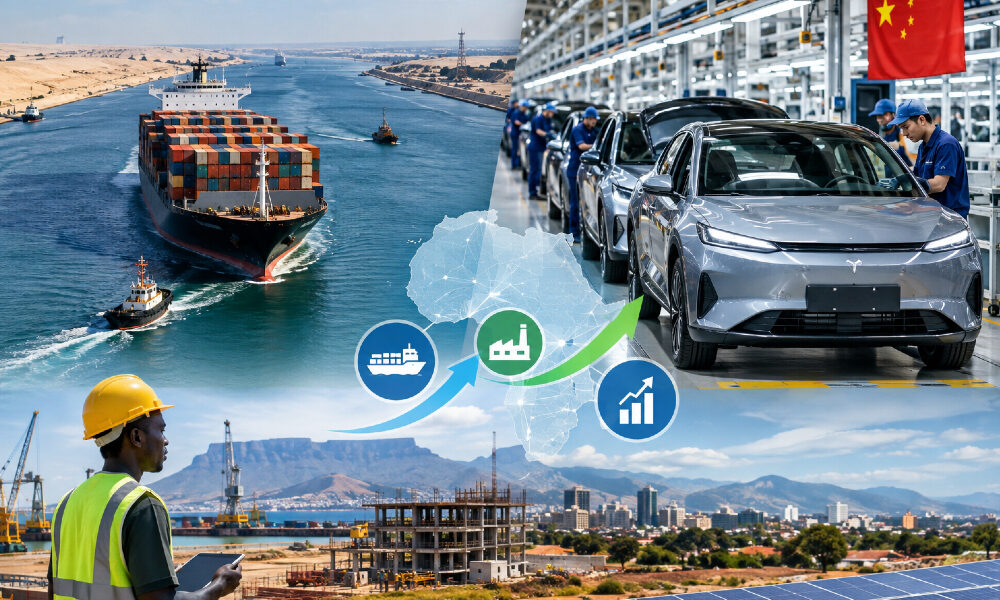
The Suez Canal collected US$505 million in July, up 42 percent from a year earlier and its best monthly haul since December 2023. Vessel traffic climbed 27 percent. Officials now expect full-year revenue of US$5.8 billion to US$6 billion. For an economy that guards its foreign-currency inflows jealously, the numbers are welcome.
Yet nobody in the shipping industry has suddenly decided that the Red Sea is safe. The disputed waters of the Bab el-Mandeb remain a place most carriers would rather avoid. The revenue is arriving because the Strait of Hormuz is shut, and ships that once had other options are being pushed toward Suez.
That is a windfall, not a recovery. The difference matters.
A Tanker-led Rebound Has Thin Foundations
Look inside the headline number. Container shipping, the highest-paying segment of canal traffic, is still down sharply, by roughly four-fifths from pre-crisis levels. The volume that has returned is dominated by other cargo, notably oil tankers rerouted by the closure.
Egypt has also cut transit fees to lure vessels. That is sensible tactically, but it trades revenue per ship for volume, and it leaves the canal’s finances hostage to conditions Cairo does not control. If Hormuz reopens, the diverted tankers will drift back to their old routes. If the Red Sea remains too risky for container lines, the most lucrative traffic stays away.
There is a quieter irony, too. A canal whose income rests on tankers is tied closely to the fossil-fuel trade at the very moment the world claims to be leaving it behind. That sits awkwardly with the climate ambitions of SDG 13, even as the cash supports SDG 8 (decent work and growth) and helps fund the infrastructure that SDG 9 demands.
So the question for Egyptian policymakers is uncomfortable but fair. Is this a Suez recovery, or merely a Suez side effect? A recovery would mean the containers return, and with them the trust of the carriers. A side effect means the money leaves when the crisis does.
The Same Story, in Steel and Lithium
Now travel from the canal to the factory floor. A very similar dynamic is unfolding in the car industry.
Western tariffs were designed to keep Chinese electric vehicles out. They may instead be pulling Chinese factories in. Between 2019 and 2025, Chinese EV makers announced US$101 billion in investment in production outside China. Some of that is about reaching foreign customers. Much of it is about sidestepping tariffs and other trade barriers. The industry is shifting from exporting cars to building factories abroad.
The lesson mirrors Suez: barriers rarely stop capital. They redirect it.
For host countries, this changes the bargaining arithmetic. A carmaker that ships vehicles from Shanghai answers to Chinese regulators and a port authority. A carmaker that builds a plant in, say, Morocco, Egypt or South Africa answers to local laws, local unions and local ministers. Beijing’s champions may have escaped the tariff wall, but they have walked into someone else’s rulebook.
Assembly is Not Industrialization
The potential prize is real: skills development, technology transfer, supplier contracts, factory jobs and tax revenue, cheaper EVs, faster electrification, and a foothold in export-oriented manufacturing networks. These are the building blocks of SDG 9.
But a factory does not automatically create an industrial base. Africa has seen plenty of plants where imported kits are bolted together, imported parts arrive in crates and the local contribution is little more than labor and a lease. Local assembly can remain local assembly for decades.
The real question, then, is not whether Chinese capital arrives. It is how much domestic value stays behind when it does. That depends on what governments negotiate: local-content rules, supplier development, training obligations, technology-sharing terms and the wider industrial ecosystem around the plant. Get those right and a car factory becomes a supplier network. Get them wrong and it becomes a warehouse with a roof.
The Trade-off Africa Cannot Dodge
African governments face a genuine tension. Cheap EVs bring cleaner transport, lower running costs and quicker electrification, all attractive to consumers and to climate-conscious finance ministers. Strict local-content requirements, by contrast, can raise costs and slow deployment, and may put off the investors Africa is trying to court.
Neither choice is free. But the continent’s experience with commodity booms suggests where the risk lies. It is easier to welcome the investment than to bargain hard for its terms, and the leverage is greatest before the ribbon is cut, not after. Governments that wait until the factory is running to ask about suppliers will find their negotiating hand much weaker.
Turning Luck into Leverage
Egypt’s canal windfall and Africa’s chance at a Chinese-built EV industry share a common structure. In both, a disruption elsewhere in the world has handed the continent an opening. In both, the danger is mistaking the opening for the outcome.
For Egypt, that means using the current surge to strengthen the canal’s fundamentals: win back container traffic, price fees for long-term revenue rather than short-term volume, and diversify income so that the treasury does not depend on someone else’s crisis. For the wider continent, it means treating each arriving factory as the start of a negotiation, not the end of one.
Shocks are unpredictable. Industrial capacity, once built, is not. The countries that prosper from this era of rerouted ships and relocated factories will be those that use borrowed momentum to build something that lasts.
Gregory September is a South African academic, author, and geopolitical analyst with extensive experience in government and Parliament. He is the founder and CEO of SAUP (Sustainability Awareness and Upliftment Projects NPC), which focuses on sustainability education and community development. He previously served as Head of Research and Development for the Parliament of South Africa. His work centers on sustainability, African geopolitics, and economic development, and he regularly contributes to analysis of global political and economic affairs.