Opinion
“Trade Fallback” and Africa’s Dual Economy: Why Informality Is Both a Symptom and a Solution


By Danilo Desiderio
In many African economies, a familiar proverb echoes through bustling markets and border towns: “When the lion does not hunt, the hyena will feed.” Today, this adage captures more than folklore – it reflects a structural reality.
As formal employment in manufacturing and services remains scarce, millions of Africans turn to informal trade not out of preference, but necessity. This phenomenon – what we might call “trade fallback” – has become a defining feature of the continent’s dual economy.
While “trade fallback” traditionally describes a nation rerouting exports after losing access to a primary market, the term takes on deeper meaning when applied domestically. In Africa, it signifies a systemic shift: when formal-sector opportunities dry up, individuals pivot to informal commerce as a lifeline.
The result? A sprawling informal economy that now accounts for over 60 percent of employment in many countries – serving as both economic shock absorber and social safety net during crises like the COVID-19 pandemic, regional conflicts, or global recessions.
Yet this resilience comes at a cost. The informal sector operates largely outside tax and regulatory frameworks, depriving governments of critical revenue.
To compensate, states often impose heavier fiscal burdens on the already-fragile formal sector – eroding its competitiveness and pushing more businesses underground. This self-reinforcing cycle entrenches a dual economy: a small, visible formal sector coexists with a vast, dynamic, yet invisible informal one.
The Hidden Engine of African Livelihoods
This duality isn’t just an economic anomaly – it’s a barrier to Africa’s broader ambitions, particularly the African Continental Free Trade Area (AfCFTA). While informal trade naturally bridges gaps left by weak industrialization, its fragmented, unregulated nature complicates efforts to harmonize standards, enforce rules of origin, and build integrated regional value chains.
Without deliberate inclusion, the promise of a single African market may remain aspirational.
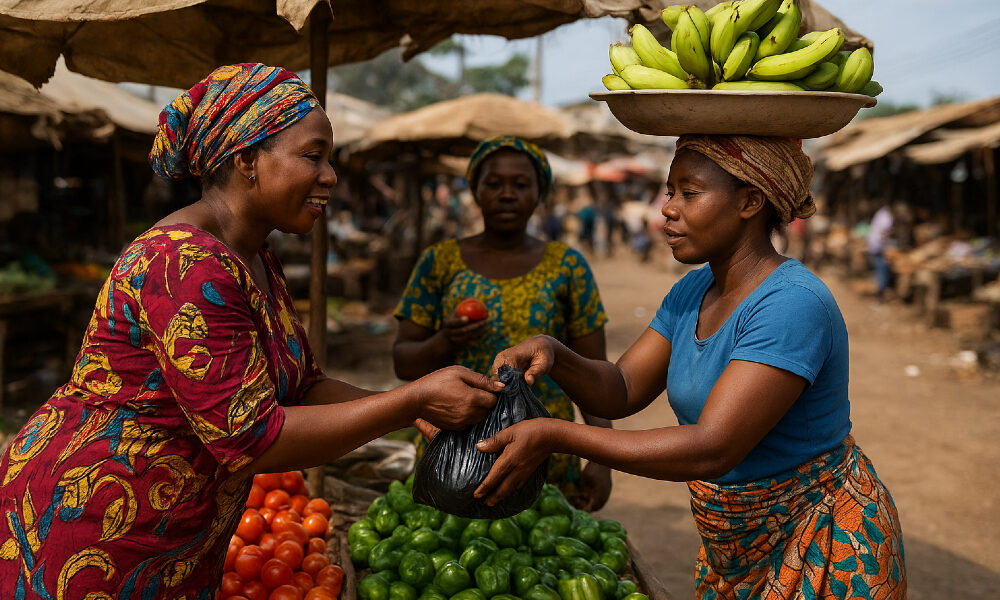
Women – who constitute the majority of cross-border informal traders – bear the brunt of this exclusion. They face disproportionate barriers: limited access to credit, unreliable market information, harassment at borders, and minimal legal protections.
Their entrepreneurial energy fuels local economies, yet they remain locked out of the very systems designed to foster growth.
From Marginalization to Integration
The solution lies not in suppressing informality, but in transforming it.
African governments and regional institutions must reframe informal trade not as a symptom of failure, but as a reservoir of untapped potential. This requires a three-pronged strategy:
- Formalization through facilitation: Simplify customs procedures for small-scale traders, digitize border processes, and establish designated corridors for informal cross-border commerce – similar to the Simplified Trade Regimes piloted in parts of East and Southern Africa.
- Financial and institutional inclusion: Expand access to microfinance, insurance, and digital payment systems tailored to informal operators. Support the formation of trader cooperatives that can aggregate supply, ensure quality control, and negotiate better terms with formal buyers.
- Progressive tax and industrial policy: Broaden the tax base by incentivizing voluntary registration – through reduced rates, simplified compliance, and visible public returns on taxation. Simultaneously, align industrial policy with trade facilitation to integrate informal traders into regional agro-processing, light manufacturing, and service value chains.
Critically, success hinges on recognizing informal traders as legitimate economic actors – not as obstacles to modernization, but as partners in structural transformation.
Rewriting the Proverb for a New Economic Era
Africa’s “trade fallback” is more than a coping mechanism; it is a testament to the continent’s enduring entrepreneurial spirit. But left unaddressed, it risks cementing economic dualism and undermining state capacity.
The goal should not be to eliminate the hyena – but to ensure it runs alongside the lion, not in its shadow.
With coherent policy, inclusive institutions, and a commitment to equitable growth, Africa can turn its informal dynamism into a powerful engine for formalization, integration, and shared prosperity. The lion may hunt – but in a truly resilient economy, no one should be left scavenging for scraps.
Danilo Desiderio serves as the CEO of Desiderio Consultants Ltd in Nairobi, Kenya, specializing in African customs, trade, and transport policies. He is a customs and trade expert at the World Bank and a senior associate to the Horn Economic and Social Policy Institute (HESPI).