A Diaspora View of Africa
Threatening Words Roil Caribbean Region


By Gregory Simpkins
The recent American incursion into Venezuela and arrest on drug and other charges of de facto leader Nicolás Maduro and wife Cilia shocked the world and has led to broad but divided reactions. Some Caribbean governments have been supportive, while others object to what they consider a violation of international law.
Trump’s Plans for Venezuelan Oil and the New Leadership
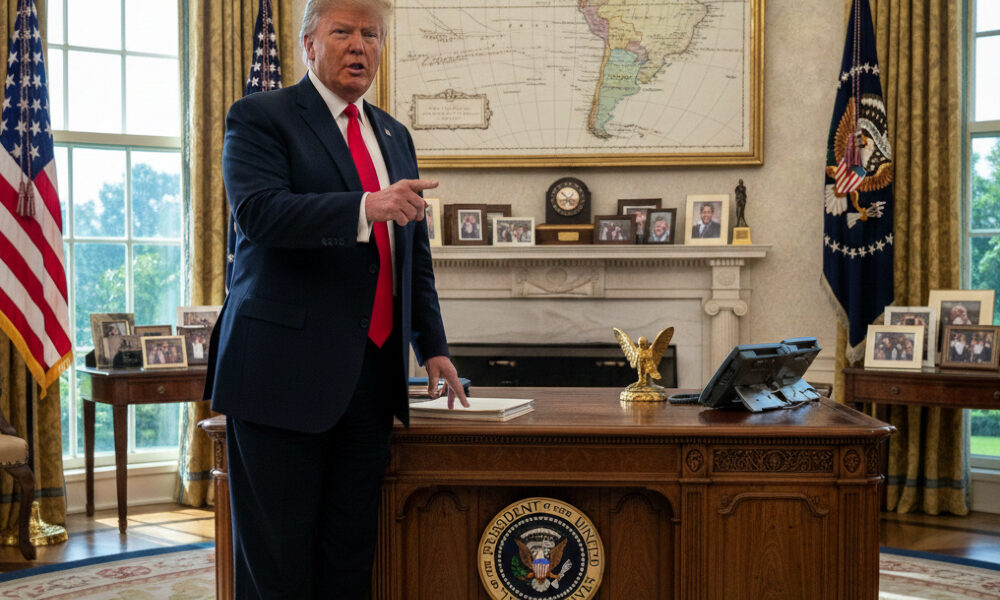
In the immediate aftermath of the Venezuela action, President Donald Trump pledged to “run” Venezuela. He subsequently said that Venezuela would export about 30-50 million barrels of crude oil to the United States, which the administration says will be sold at market prices for the benefit of Venezuelans and Americans.
No further details were provided about the mechanism for the dispersal of oil sale profits.
The decision to export Venezuelan crude was described as an agreement with the post-Maduro government, now headed by Vice President Delcy Rodriguez who has been sworn in to replace Maduro.
Rodriguez is part of a regime that is widely believed to have lost the 2024 elections, according to the opposition headed by presidential candidate Edmundo González. He claimed he had been elected with 70 percent of the vote, contrary to what the country’s election officials reported.
Polls conducted before the election indicated that González would win by a wide margin.
After the government-controlled National Electoral Council (CNE) announced summary numbers, without detailed results, representing a narrow Maduro victory on July 29, several Latin American and Western countries such as the United States and the European Union, and the opposition, expressed skepticism of the numbers or did not recognize the CNE claims; while some countries, such as Russia, China, Iran, Cuba, Bolivia, among others, recognized Maduro.
Academics, news outlets and the opposition found strong evidence, including the detailed results of the election from the tally sheets collected by poll watchers, showing that González won the election by a wide margin.
The Opposition’s Dilemma and Trump’s Strategic Choice
Opposition leader Maria Corinna Machado, who won the Nobel Peace Prize last year for her anti-regime activities, thanked President Trump for his “leadership and courage” after US forces stormed Caracas and arrested Maduro, the BBC reported on January 7. Trump has refused to endorse her assertion that her movement should manage Venezuela’s government despite the widespread agreement that Maduro did not win the 2024 election.
The Trump administration is said to have lost faith in Machado, who they consider uncooperative and who they believe has alienated too many leaders in business and civil society to be able to establish an effective government. Machado has consistently promoted a harsh sanction policy that has not only disrupted private commerce but also has interfered with foreign support for civil society.
In the meantime, Trump is supporting Rodriguez in her current role so long as she cooperates with US aims. This apparently includes kicking out the Chinese and Russians who had been providing security for the Maduro regime in exchange for off-the-books oil sales to evade international sanctions.
The US Coast Guard has seized at least two Venezuelan oil tankers and is preventing others from reaching Maduro allies in China and Russia, as well as Cuba. All three require Venezuelan oil to support their economies.
There are reports that Russia sent at least one submarine to protect fleeing Venezuelan tankers as of this writing. Will Russian naval forces engage with American naval forces to carry out their protection mission?
For that matter, what will be the Cuban response to the death of an estimated 32 Cuban security forces who had been protecting Maduro beyond rhetoric condemning the incursion?
Regional Concerns and the Venezuelan Migration Crisis
Several nations in the region have had reasons to have been concerned about the policies and actions of the Maduro regime. Venezuela’s economic collapse has led to a massive migration crisis, with more than 7.7 million Venezuelans fleeing to neighboring countries, including Colombia, Brazil, and Peru, putting a strain on their resources and infrastructure.
The large-scale migration of Venezuelans to Trinidad & Tobago and Guyana have been particularly problematic, cause strains in the delivery of services.
The point has been made that sanctions against the Venezuelan government have been at least as responsible for the massive flight of its citizens as government mismanagement, human rights abuses and corruption.
The regime’s alleged involvement in illicit activities, such as drug trafficking and gold mining, has affected regional security and stability, with groups like Columbia’s National Liberation Army (ELN) and Revolutionary Armed Forces of Columbia (FARC) operating in Venezuela and impacting neighboring countries. The regime’s authoritarian nature has led to strained diplomatic relations with several countries, including Colombia, Brazil and Peru, which have severed or reduced ties with Venezuela.
Venezuela’s energy sector has been impacted by US sanctions, affecting neighboring countries like Cuba, which relies heavily on Venezuelan oil imports.
The regime’s actions have contributed to regional instability, with concerns about the spread of authoritarianism and the influence of external actors like China and Russia.
Territorial Disputes: Trinidad & Tobago, Guyana Face Venezuelan Claims
Venezuela suspended energy agreements with Trinidad & Tobago, including joint natural gas projects, citing deteriorating bilateral relations and perceived support for US actions against Venezuela. This move affects Trinidad’s energy-dependent economy, particularly the Dragon natural gas field project.
Guyana has discovered significant oil reserves, and Venezuela’s claims over the Essequibo region, where these reserves are located, have escalated tensions. ExxonMobil, involved in Guyana’s oil exploration, has faced disputes with Venezuela over territorial claims.
Venezuela’s renewed claims over the Essequibo region have led to military buildups and diplomatic tensions. The International Court of Justice (ICJ) has ruled in favor of Guyana, but Venezuela continued to assert its claims, affecting regional stability.
Threats Beyond Venezuela: Colombia and Mexico in Trump’s Crosshairs
In addition to its threats against Rodriguez should she diverge from US policy, Trump has threatened broader action in the region ala the Venezuela operation. Al Jazeera reported on a January 7 broadcast that Trump accused the Columbian government of President Gustavo Petro of processing and selling cocaine into the United States.
In the broadcast, Trump is quoted as saying Petro had to “watch his ass.” An alleged connection between Columbia and drug smuggling is longstanding, but the Petro government is duly elected, which would make any Venezuela-style mission more problematic.
Politico reported on January 7 that Petro had responded on the X platform to the US threats by denouncing the Venezuela action and proclaiming his government’s active role in combating the international drug trade. He issued strong statements about Columbia’s readiness to face down any enemy.
Such a response may not be necessary, though, following a friendly call between Trump and Petro in which the Columbian president detailed his country’s successes in its fight against international drug smuggling. Trump promised to discuss the matter further in a White House meeting between the two leaders.
After the Venezuela action, the Mexican government and analysts discounted the likelihood of unilateral US military action against Mexican drug cartels, despite threats from Trump. Mexican President Claudia Sheinbaum’s administration has been complying with Washington’s demands, and the economic ties between the two countries are vital, they say.
Nonetheless, many expect more such threats as a way to extract more concessions from Mexico. No one dares rule out completely an unexpected move by the US president.
Sheinbaum downplayed the possibility of US military action Monday. “I don’t see risks (of that),” she said. “There is coordination, there is collaboration with the United States government.”
From Monroe to “Donroe”: A History of US Intervention
Trump appears to ignore the history of the US backing coups in the region when threatening military action to pursue his foreign policy and national security goals. In the last several decades, the United States has back a number of coups in the region:
- Cuba (1952)
- Paraguay (1954)
- Guatemala (1954)
- Haiti (1959, 2004)
- Peru (1962, 1975)
- Brazil (1964)
- Dominical Republic (1965)
- Chile (1973)
- Uruguay (1973)
- Argentina (1976)
- El Salvador (1980)
- Nicaragua (1980s)
- Bolivia (1980s)
- Panama (1989)
- Venezuela (2002)
- Honduras (2009)
US President James Monroe declared the Americas region off-limits to further European colonization in 1823, while at the same time asserting US influence in the Western Hemisphere and promising US non-interference in Europe and their existing colonies. This doctrine has been observed to one extent or another for more than 200 years.
However, there seems to be a new doctrine – the so-called “Donroe Doctrine” renamed for Donald Trump.
Unfortunately, over the past three centuries, the Monroe Doctrine has not consistently benefited regional governments, and the United States has interfered in European affairs and in their colonies. In seeking to renew and expand the Monroe Doctrine, the US must look at the matter from its neighbors eyes.
Making open or veiled threats of armed intervention – even in areas outside the Western hemisphere, such as in Greenland, make even US allies uneasy. Add to that Trump’s request to Congress for a US$600 billion increase in military spending, and this unease seems quite justified.
Secretary of State Marco Rubio says these days that we should take Trump at his word when he says he will take military action in pursuit of US policy. Indeed, he has ordered an estimated 626 air strikes in Somalia, Yemen, Iran, Iraq, Nigeria, Syria, the Caribbean Sea (against alleged drug smuggling boats) and now Venezuela.
He has thus far avoided military ground entanglements, but we shall see if that holds up in Venezuela, which he says the US now “runs.”
Gregory Simpkins, a longtime specialist in African policy development, is the Principal of 21st Century Solutions. He consults with organizations on African policy issues generally, especially in relating to the U.S. Government. He further acts as a consultant to the African Merchants Association, where he advises the Association in its efforts to stimulate an increase in trade between several hundred African Diaspora small and medium enterprises and their African partners.