Opinion
The West Got Rich, Then Sick. Africa Need Not Follow.
Economic development promised longer, healthier lives. The data tells a different story – and Africa still has time to write its own.


By Sheena Raikundalia
Since the 1960s, global GDP has expanded roughly sixfold. By almost every material measure, humanity has never been wealthier. And yet something has gone profoundly wrong along the way.
Diabetes has surged to epidemic proportions. Cancer rates have doubled in a generation. Some 1.3 billion people now live with hypertension. Depression has become the leading cause of disability worldwide.
More money. More medicine. More misery. This is the paradox at the heart of modern development – the part the growth charts never show.
The formula was not accidental. Industrial food systems stripped diets of nutritional diversity and replaced them with ultra-processed, calorie-dense products engineered for shelf life rather than human health.
Urbanization uprooted communities, lengthened commutes, and replaced social fabric with screen-mediated isolation. Stress became structural. And when the damage accumulated, trillion-dollar healthcare industries were constructed – not to prevent illness, but to manage it.
Pharma is now a US$1.6 trillion global industry. The processed food sector is thriving. Meanwhile, the United States – the richest nation in recorded history – has watched life expectancy fall in consecutive years.
This is the model the world is still being asked to admire.
Africa Didn’t Inherit This – It’s Importing It
Growing up in Kenya, cancer was a distant abstraction. It was not something that stalked dinner-table conversation or filled oncology wards with people in their forties and fifties.
That has changed within a single generation – not because of genetics or geography, but because of choices: the deliberate adoption of food systems, urban lifestyles, and definitions of “progress” that the West itself is now struggling to reverse.
This is not nostalgia. It is epidemiology.
The erosion is not limited to physical health. The United Kingdom and Japan – two of the most economically developed nations on earth – now have government ministers specifically appointed to address loneliness. Not metaphorically. As a formal public health mandate. Because the nuclear household, the open-plan office, the algorithm-driven feed, and the car-dependent suburb have together produced a crisis of human disconnection so severe that researchers now equate chronic loneliness with smoking fifteen cigarettes a day in terms of mortality risk.
The developed world built this system. Now it is selling it.
The Colonial Roots of a Nutritional Myth
Even Africa’s most beloved staples carry a complicated history. Ugali – the maize-based porridge now regarded across East Africa as a cultural cornerstone – was, in significant part, a colonial imposition.
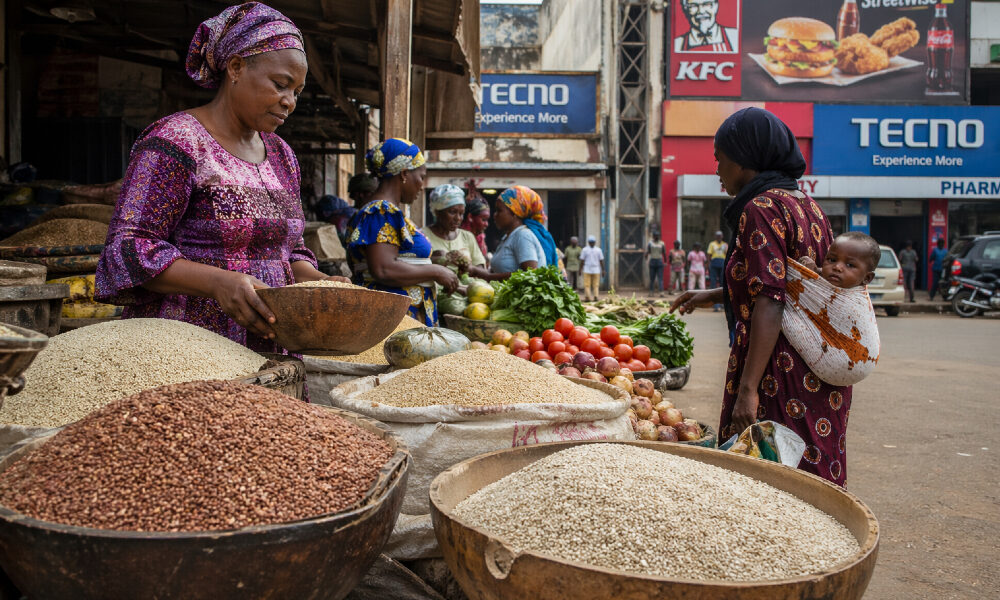
Colonial administrators promoted cheap, starchy grains because they were efficient fuel for labor, not because they were nutritionally optimal. What existed before was considerably richer: millet, sorghum, fermented grains, legume-based stews, seasonal and biodiverse diets that supported health rather than simply providing calories.
Today, elite consumers in New York and London pay premium prices for ancient grains, fermented foods, and plant-diverse diets – products that much of Africa quietly set aside in the pursuit of modernity. The West is paying to rediscover what the continent was persuaded to abandon.
The Advantage of Arriving Late
Africa’s greatest strategic asset right now is not its mineral wealth, its demographic dividend, or even its digital leapfrogging potential – though all three matter enormously. Its greatest asset is that it still has a genuine choice.
The continent has the youngest population on earth. It retains community structures – extended family networks, intergenerational households, place-based identity – that wealthier societies have largely dismantled and are now attempting to reconstruct at great expense.
It holds food traditions rooted in diversity and ecological resilience. These things still exist. But they are under pressure, and that window will not remain open indefinitely.
The central question, then, is deceptively simple: what are we actually optimizing for?
If the answer is GDP per capita, the path is well-marked and the destination is already visible – in the chronic disease wards of Chicago, the loneliness statistics of Tokyo, and the falling life expectancy figures of rural America. If the answer is something broader – health, connection, sustainability, dignity – then the path looks very different, and the models worth studying may not be in Houston or London at all.
A Different Blueprint
Development policy has long measured success in the language of industrialization: urbanization rates, formalization of labor markets, integration into global supply chains, adoption of Western consumption patterns. These metrics capture something real. But they systematically ignore the things they destroy in the process.
A genuinely prosperous Africa – prosperous in the fullest sense of the word – would look less like a replication of twentieth-century Western urbanism and more like an intelligent synthesis: modern medicine without pharmaceutical dependency; connected cities without social atomization; economic growth without nutritional collapse; technology adoption without the erasure of the community structures that make life worth living.
That vision is not utopian. Elements of it already exist, in local food movements, community health models, urban planning experiments, and a growing cohort of African policymakers and entrepreneurs who are asking exactly these questions.
It does not require rejecting development. It requires defining it better.
The West’s chronic disease burden, its loneliness epidemic, its falling life expectancy – these are not the inevitable costs of prosperity. They are the consequences of specific choices, made at specific historical moments, that can be made differently.
Africa still has the opportunity to make them differently. That opportunity is real, it is time-limited, and it is arguably the most important strategic question facing the continent’s next generation of leaders.
The grandmothers already knew the answer. The challenge now is building institutions wise enough to listen.
Sheena Raikundalia is an accomplished entrepreneur, former lawyer, government policy advisor, and angel investor with deep expertise across the legal, financial services, and impact investment sectors in Europe and Africa. She has played a pivotal role in advancing Africa’s technology and innovation ecosystems, leveraging a career that spans top-tier London law firms, leadership as Country Director of the UK-Kenya Tech Hub for the UK Foreign, Commonwealth & Development Office (FCDO), and her current position as Chief Growth Officer at agri-tech company Kuza One. Sheena is recognized for her strategic vision, commitment to fostering innovation, and strong advocacy for Africa’s growth potential in technology, entrepreneurship, and impact investment.