Opinion
The True Cost of Educating Africa’s Youth
Free schooling is a myth. The real cost of raising the world’s youngest generation is far higher than governments admit.


By Dishant Shah
Africa is young – startlingly so. More than 60 percent of its 1.4 billion people are under the age of 25, and that share is growing. By 2050, the continent’s population is projected to nearly double. This demographic wave is often described as a dividend waiting to be cashed in: a vast, energetic workforce that could power decades of economic growth.
But dividends do not pay themselves. They require investment. And that raises a question policymakers in Lagos, Nairobi, and Addis Ababa can no longer sidestep: what does it actually cost to educate a generation this large?
The official answer, in many countries, is reassuringly simple. Public primary education is free. The reality, as millions of families across Sub-Saharan Africa can attest, is anything but.
The Myth of “Free” Schooling
Tuition may not appear on the bill, but plenty else does. Uniforms, textbooks, transportation, midday meals, examination fees – these so-called indirect costs add up quickly, and for low-income households they are often the deciding factor in whether a child stays enrolled or drops out. A policy that eliminates tuition while leaving every other expense intact has not made education free. It has simply moved the cost off the government’s ledger and onto the family’s.
The math only gets harder as children get older. Secondary schools, technical colleges, and vocational institutes – precisely the pathways most likely to lead to stable employment – typically charge fees well beyond what primary schools require. Better facilities and stronger job prospects come at a price that many households cannot afford, forcing a cruel trade-off between short-term survival and long-term opportunity.
A Bottleneck at the University Gate
Higher education presents its own, quite different problem: not affordability alone, but scarcity. Public universities remain comparatively cheap, but demand vastly outstrips the number of available seats.
Millions of qualified students compete each year for a fraction of that many spots. Those who lose out face a narrowing set of choices – enroll in a costlier private university, study abroad if resources allow, or abandon higher education altogether. None of these outcomes reflects a shortage of talent. They reflect a shortage of capacity.
That shortage is a direct consequence of underinvestment. UNESCO has repeatedly noted that many African governments spend below the internationally recommended share of GDP and public expenditure on education. Meanwhile, rapid population growth means the number of school-age children keeps climbing. Simply holding enrollment rates steady – let alone improving them – requires building thousands of new classrooms, training millions of additional teachers, and extending digital infrastructure into places that have never had it. Standing still, in other words, already demands a sprint.
Technology Offers a Partial Fix
There are, however, genuine reasons for optimism. Governments and private investors alike are beginning to treat education technology as core infrastructure rather than an afterthought.
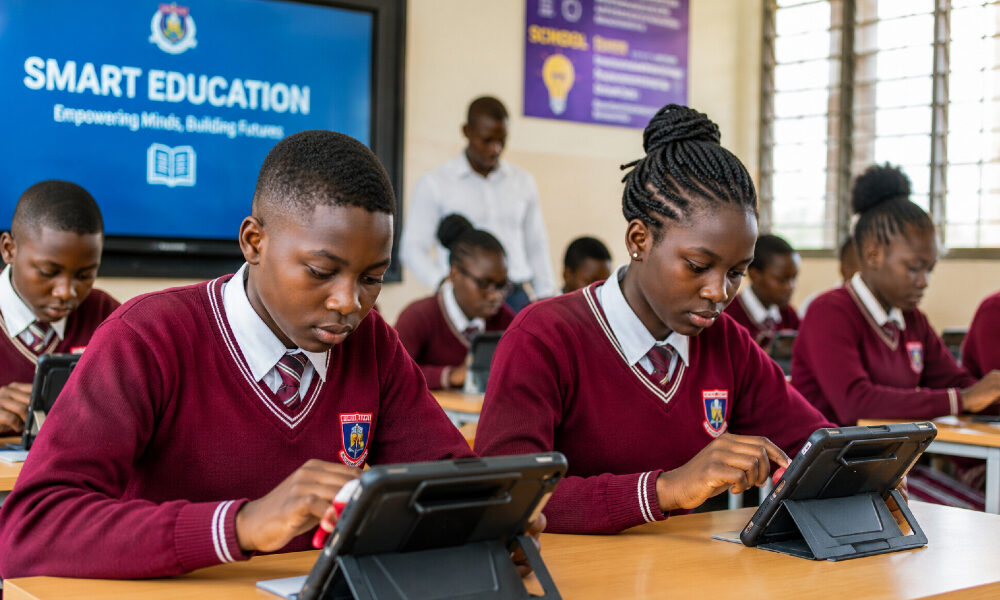
Kenya’s Digital Literacy Programme and Rwanda’s Smart Education initiatives are two prominent examples of national strategies designed to extend learning beyond the reach of traditional, brick-and-mortar schools. A growing wave of pan-African edtech startups is doing similar work from the private sector, using mobile platforms and low-bandwidth tools to chip away at geographic barriers that have long kept rural students from top-quality instruction.
Private capital is flowing in as well. Banks, philanthropic foundations, and education companies are funding universities, vocational institutes, scholarships, and digital learning platforms across the continent, filling gaps that public budgets have left open.
Progress Is Real, But So Is the gap
None of this, though, has closed the divide between urban and rural Africa. City students are more likely to attend well-equipped schools with reliable internet and qualified teachers. Their rural counterparts continue to face shortages of classrooms, electricity, teaching materials, and trained staff – the basic ingredients of a functioning education system.
The consequences show up starkly in what the World Bank calls “learning poverty”: a measure of how many children cannot read and understand a simple text by age 10, even after years in the classroom. Across much of Africa, that figure remains alarmingly high. Attendance, it turns out, is not the same as education.
Rethinking What “Cost” Means
This is the crux of the matter. Education is not a single line item – tuition, paid or waived. It is a system: infrastructure, transportation, teacher training, technology, school meals, electricity, connectivity, and sustained public investment, all working together. Strip away any one piece, and the whole structure weakens, no matter how impressive the enrollment statistics look on paper.
With Africa’s population set to nearly double within a generation, the urgency of getting this right will only intensify. The real test facing the continent’s governments is not whether they can build more schools – many are already trying. It is whether they can expand access, quality, and capacity fast enough to keep pace with a booming youth population, without pricing out the very families that population depends on.
That is the question Africa’s leaders, and the international partners who invest alongside them, can no longer afford to answer with slogans about free education. The bill, one way or another, always comes due.
Dishant Shah is a partner at Legion Exim, a company specializing in facilitating the export of high-quality engineering products directly sourced from manufacturers in India to Africa. His areas of expertise include new business development and business management.