Opinion
The Silicon Savanna: Africa’s Oral Traditions are AI’s Next Great Dataset
Long before Silicon Valley coined the term “big data,” African communities were compiling one of the richest, most under-cataloged datasets on Earth – in the form of oral tradition. As artificial intelligence learns to mine that knowledge, Africa faces a narrowing window to decide who profits from it.


By Sheena Raikundalia
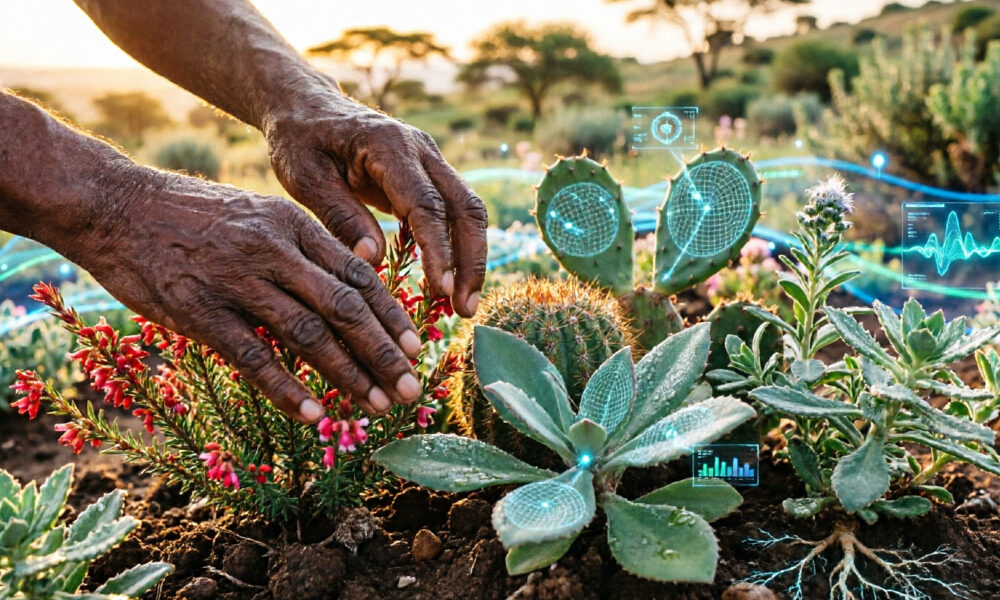
For generations, African communities have accumulated an extraordinary body of knowledge: which crops thrive in which soils, how to read an unpredictable sky, which plants heal and which poison, how ecosystems function across seasons and centuries. This knowledge is rarely written down. It lives in elders, in oral histories, in practices passed from hand to hand. Call it tradition. To an AI system, it looks like something else entirely: training data – vast, valuable, and almost entirely unclaimed.
That gap between how Africa sees this knowledge and how the world’s most powerful technology sees it is not a hypothetical problem. It is a pattern with a long and expensive track record.
A Familiar Story, Told Four Times
Consider what has already happened when African knowledge collided with systems built to extract value from it, rather than share it.
Ethiopia’s teff – a grain domesticated on the Horn of Africa thousands of years ago – was patented abroad under a benefit-sharing arrangement that eventually fell apart, leaving the country with little to show for a crop it had cultivated since antiquity. In Kenya, microorganisms drawn from the alkaline waters of Lake Bogoria were developed into industrial enzymes worth real money on global markets; it took years of negotiation before Kenya secured any share of that value.
The San people’s generations-old knowledge of the hoodia plant led to the development of an appetite-suppressing compound that was licensed internationally well before any benefit-sharing agreement reached the community that made the discovery possible in the first place. And it took the San and Khoi peoples nearly a decade of hard negotiation to win an industry-wide agreement over rooibos, a plant their ancestors had used for generations before it became a supermarket staple.
Different resources. Different countries. Different decades. But the underlying story never changes: the knowledge existed long before any system existed to recognize it, protect it, or price it fairly.
Why the AI Version of This Problem Is Harder
Those earlier disputes were fights over tangible things – plants, genetic material, physical samples that had to be collected, transported, and processed. AI changes the equation, and not in Africa’s favor. This time, the asset in question is not a plant or a molecule. It is knowledge itself. And knowledge doesn’t need a laboratory, a shipping container, or a patent office to travel. It just needs to be recorded, once, anywhere, by anyone.
Once captured, AI can do the rest – rendering that knowledge searchable, replicable, and scalable at a speed no biopiracy case of the twentieth century ever approached. A farming technique refined across generations can be repackaged overnight as a “new” climate-smart innovation. An indigenous crop can be rebranded as the next global superfood. Traditional ecological wisdom can be flattened into an AI-generated recommendation, stripped of its origin. A local language, spoken by a shrinking number of elders, can become raw training data for a model that will never credit – let alone compensate – the community that spoke it into existence.
The asset was always there. What the world lacked was the machinery to price it. AI is now building that machinery, at scale and at speed. Which leaves African governments, institutions, and communities with an urgent question they can no longer afford to defer:
What does Africa already know that AI is about to make valuable – and who gets to decide how that value is used?
A Race Against Forgetting
Much of this knowledge exists nowhere but in oral histories, community practice, endangered languages, and the memories of elders. That is precisely what makes the moment so precarious. If this knowledge isn’t documented, it risks vanishing with the generation that holds it. But documentation alone is not a solution – it may even be a trap. If this knowledge is recorded without communities having any say in how it is used, the world will simply repeat an old injustice in a new, faster format.
To be clear, this is not an argument that everything indigenous is inherently valuable simply because it is indigenous. It is an argument for recognizing a genuine asset before it disappears, and for building the legal and institutional guardrails that were missing the first four times around. This isn’t nostalgia dressed up as policy. It is a race against forgetting – and against extraction.
What an African AI Strategy Actually Requires
Too much of the current conversation about AI in Africa focuses narrowly on adoption: which foreign models to license, which cloud provider to partner with, how quickly the continent can catch up. That conversation matters, but it is incomplete.
A genuine African AI strategy cannot be only about importing other people’s models. It has to be equally about encoding what Africa already knows – documenting it, preserving it, making it visible, and, critically, building the institutions that let communities themselves decide how their knowledge is used and who benefits when it is.
Because the next great AI dataset may not be sitting in a server farm in Virginia or a research lab in Shenzhen. It may be sitting in the memory of someone who has never once been asked to write it down.
Africa has already paid the price of being late to that conversation four times. It cannot afford a fifth.
Sheena Raikundalia is an accomplished entrepreneur, former lawyer, government policy advisor, and angel investor with deep expertise across the legal, financial services, and impact investment sectors in Europe and Africa. She has played a pivotal role in advancing Africa’s technology and innovation ecosystems, leveraging a career that spans top-tier London law firms, leadership as Country Director of the UK-Kenya Tech Hub for the UK Foreign, Commonwealth & Development Office (FCDO), and her current position as Chief Growth Officer at agri-tech company Kuza One. Sheena is recognized for her strategic vision, commitment to fostering innovation, and strong advocacy for Africa’s growth potential in technology, entrepreneurship, and impact investment.