Opinion
The Sahel Gamble: A $1 Billion Bet on Self-Determination
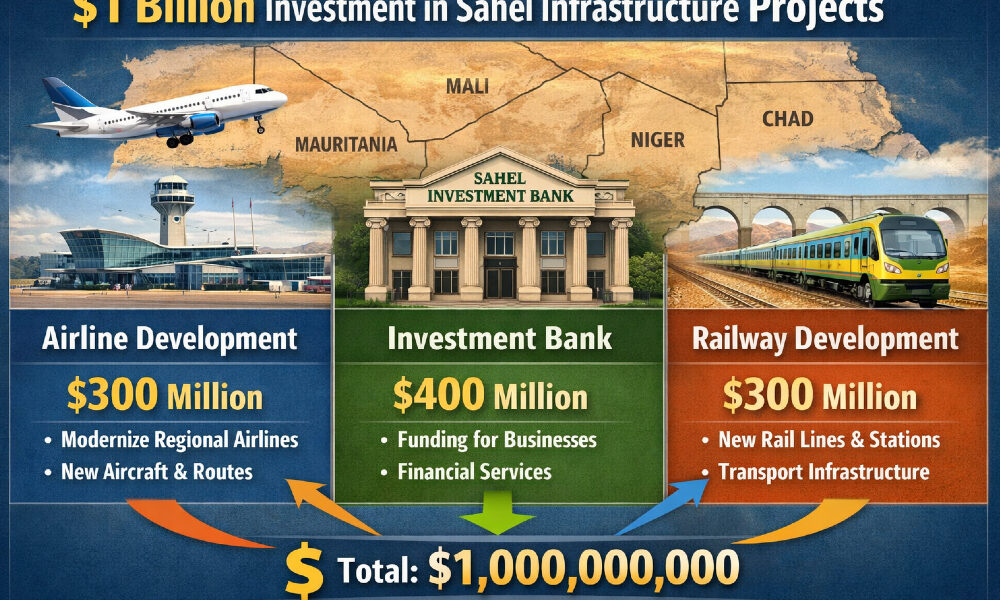
Three military-led governments have pooled a billion dollars to build an airline, a bank, and a railroad. Whether this is visionary statecraft or a costly mirage depends entirely on what comes next.


By Charles F.V. Chitekwe
There is a sentence that would have seemed implausible a decade ago: three of the world’s poorest, most landlocked, and most conflict-ridden nations just committed US$1 billion of their own capital to build shared infrastructure and financial institutions – without asking anyone’s permission.
Burkina Faso, Mali, and Niger, the trio that now forms the Alliance of Sahel States (AES), have announced plans to jointly create a regional airline, an investment bank, and a railway line connecting their territories. The announcement follows their formal withdrawal from the Economic Community of West African States (ECOWAS) in January 2025, a break that carries far more symbolic weight than bureaucratic inconvenience.
These governments – all products of military coups – have concluded that the existing architecture of African regional integration is not merely ineffective, but actively constraining. They may have a point.
The case for the wager
For generations, the dominant development paradigm in sub-Saharan Africa has operated on a specific logic: identify needs, attract external financing, attach conditions, and hope that the resulting projects serve local priorities more than donor ones.
The results have been mixed at best. Roads have been built to ports, not between cities. Rail lines have traced the geometry of colonial commodity extraction rather than the shape of African trade. Financial systems have been calibrated to satisfy creditors in Washington and Brussels rather than merchants in Bamako or Ouagadougou.
The AES initiative inverts that logic. A regional airline addresses one of the most maddening inefficiencies in African travel: flying between two neighboring Sahelian capitals frequently requires a layover in Paris.
A regional investment bank, if governed well, could finance infrastructure on terms that reflect Sahelian economic realities rather than external risk appetites. And a railway corridor in the Sahel would connect markets that have been physically isolated from one another for generations – not by geography alone, but by the deliberate neglect of intra-continental connectivity.
There is also a geopolitical dimension that the AES governments have clearly calculated. Since withdrawing from ECOWAS – and, in varying degrees, from French military cooperation – Burkina Faso, Mali, and Niger have faced sanctions, diplomatic pressure, and diminished access to traditional financing channels. Building their own financial and logistical infrastructure is not merely an economic ambition; it is a hedge.
If external partners can weaponize access to the global system, the rational response is to reduce dependence on it.
This is the logic behind the broader “African agency” conversation that has accelerated across the continent in recent years. It is not unique to the Sahel.
The case for skepticism
And yet the announcement demands scrutiny, not applause.
A billion dollars is a meaningful number in isolation. In context, it is modest.
The African Development Bank estimates that the continent faces an annual infrastructure financing gap of between US$68 billion and US$108 billion. A single railway line across the Sahel – in terrain that is challenging, in a security environment that is deteriorating – could consume the entire fund before the first locomotive runs.
Ambition and capital are not the same thing.
The governance question is equally pressing. All three member states are currently led by military juntas with limited democratic accountability. Development projects in fragile states require exactly the institutional durability, transparency, and contract enforcement that transitional military governments are least positioned to provide.
History is littered with regional integration announcements from African governments that dissolved into inertia once the press conferences ended – and those governments, at least, were civilian.
There is also the question of execution capacity. Building and operating a regional airline is genuinely complex. So is capitalizing a bank and deploying its funds effectively.
The AES countries collectively lack the deep technocratic infrastructure – civil aviation authorities, banking regulators, railway engineering expertise – that would normally underpin projects of this scale. The risk is not that these governments have bad intentions, but that ambition outpaces delivery, and that the narrative of sovereignty obscures the substance of outcomes.
Finally, there is the dependency trap that critics of existing frameworks often underestimate in reverse. Breaking from Western-aligned institutions is not the same as achieving independence. Russia and, increasingly, China have positioned themselves as the AES’s principal partners. Swapping one set of external dependencies for another does not constitute sovereignty – it merely relocates the leverage point.
What success would look like
The most honest assessment is that the AES initiative is neither a triumph of African self-determination nor a cynical distraction from governance failures. It is a hypothesis. The hypothesis – that internally driven regional integration, anchored in physical connectivity and indigenous finance, can generate better developmental outcomes than aid-dependent models – is reasonable and worth testing.
But a hypothesis is only as valuable as the evidence it generates. Success, in this context, would not be measured by the existence of an airline or a bank, but by what they produce: measurable increases in intra-Sahel trade volumes, reduced travel costs for citizens, private capital crowded in by the new bank’s concessional lending, and railway freight that reflects actual domestic commerce rather than mineral exports destined for foreign markets.
The Sahel is indeed writing its own chapter, as its advocates claim. The question is whether that chapter will be remembered as the beginning of a genuine development model – or as a cautionary lesson in the gap between sovereignty as rhetoric and sovereignty as practice.
The billion dollars is committed. The harder work has not yet begun.
Charles F.V. Chitekwe is a diplomat and global relations specialist at the Alpha Sirius Foundation, where he advises heads of state, senior policymakers, and international delegations on Africa-focused diplomacy, trade, and development strategy. He advocates for a unified African position in global negotiations, promoting innovation-driven growth, investment, and economic self-reliance over aid dependency. He writes on African development, pan-African finance, diaspora investment, and the role of AI and technology in accelerating the continent’s economic transformation.