Opinion
The Power to Stabilize: What Africa Can Become When It Negotiates as One


By Daki Nkanyane
The world is becoming less stable. Not in the dramatic register of breaking-news alerts, but in something deeper – the structural architecture of how societies relate to one another.
Alliances are shifting. Trust is thinning. Supply chains are being securitized, borders are tightening, and competition is rapidly replacing cooperation as the default posture of nations.
In such a world, stability becomes a scarce asset. And scarcity, as any economist will tell you, changes value.
This is why Africa’s next chapter is not merely about growth, development, or even global relevance. It is about something larger – something the world is quietly searching for again: stabilizers.
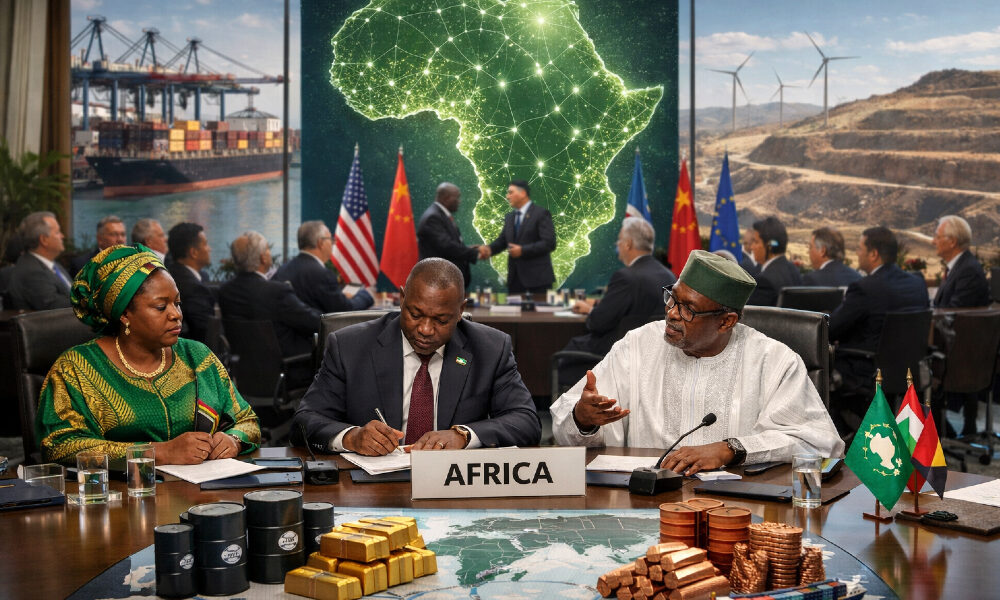
When a continent negotiates as pieces, it becomes a marketplace. When it negotiates as a bloc, it becomes a force.
Historically, stabilizers were powerful empires, dominant economies, or entrenched global institutions. But the world that produced those stabilizers is fragmenting. What replaces it will not be a single new center of gravity – it will be multiple forces holding one another in balance.
Africa has the potential to become one of those balancing forces. Not as a follower. Not as a passive “frontier market.” But as a stabilizing bloc – an organizing presence in a dangerously disorganized world.
Yet this potential rests on one decisive condition: Africa must learn to negotiate as one.
Why Africa’s Unity Is No Longer Ideological
For decades, continental unity has been spoken of in the language of aspiration – a moral desire, a Pan-African sentiment, the dream of long-departed visionaries. That era is ending.
In the emerging global order, unity is not poetry. It is leverage.
Fragmentation is expensive. It produces weak bargaining positions, inconsistent standards, and competing national priorities that external actors are all too willing to exploit.
A fragmented Africa negotiates from vulnerability. A coherent Africa negotiates from strength. Africa does not need perfect political union to act as a stabilizer – it needs strategic coherence where it matters most.
The world does not reward sentiment. It responds to structure.
Stability Is Now a Negotiated Commodity
The world is learning something uncomfortable: stability is not guaranteed. Energy security, food supply chains, trade routes, border integrity, currency confidence, and technology access – all of it is contested. All of it is fragile.
In such an environment, any region that can credibly offer predictability, resource continuity, demographic energy, and strategic geography becomes valuable – not only economically, but diplomatically. Africa holds precisely these assets:
- A demographic dividend that represents the world’s largest future labor force.
- Strategic minerals essential to industrial and clean-energy transitions.
- Vast, underutilized agricultural potential.
- Geography linking major global trade corridors.
- A bloc of nations whose collective voice carries weight in international governance.
This means Africa can stabilize – or destabilize – global systems, depending on how it chooses to position itself. That is not a problem to be managed. That is power.
Africa’s Central Weakness: Being Negotiated With in Pieces
Africa’s most consequential geopolitical vulnerability is not military or economic – it is structural. It is the fact that Africa is still routinely negotiated with in parts.
One country signs one deal. Another signs a competing deal with a rival power. Standards differ. Terms vary. Debt structures become fragmented. Digital infrastructure grows incompatible. Trade policy turns incoherent. The result is not merely administrative complexity – it is the structural reason Africa is so often managed rather than respected.
Rule-setting does not require dominance. It requires discipline.
External powers do not need to divide Africa deliberately. A fragmented Africa divides itself. And when it does, it presents the world not with a partner to engage, but a marketplace to shop.
What It Means to Negotiate as One
Negotiating as one does not mean uniformity. It means alignment on core strategic principles – agreeing that on certain matters, Africa must speak with a single bargaining posture, because the issues at stake affect collective sovereignty and long-term advantage.
These areas include:
- Critical minerals and resource governance.
- Continental infrastructure corridors.
- Digital and data sovereignty.
- Debt transparency and borrowing standards.
- Trade rules and industrial policy.
- Security frameworks and the terms of foreign military presence.
- Food, water, and energy resilience strategies
A continent that aligns on these issues increases its negotiating power exponentially. Because global powers are not interested in individual African countries in isolation – they are interested in African systems. Africa must respond at the level of systems.
The Strategic Shift: From Recipient to Rule-Setter
Africa has spent too long negotiating as a recipient. A recipient asks: “What can you offer us?” A rule-setter asks: “What must be true for access to be granted?”
The difference between those two questions is the difference between being included and being respected.
Africa is already woven into the global future. The question is whether it will help write the rules of that future – or merely comply with rules drafted elsewhere.
Rule-setting does not require dominance. It requires discipline: clear standards, shared bargaining positions, consistency across time, and the willingness to walk away from terms that fail to serve the continent’s interests.
A bloc that can walk away is a bloc that can stabilize.
Why Africa Can Become a Global Balancer
A global balancer is not a superpower. It is a stabilizing actor. Balancers reduce extremes. They create options. They prevent any single power from fully controlling the system. They negotiate space for cooperation precisely when rivalry threatens to escalate into confrontation.
Africa can become a balancer because it is not historically bound to any single geopolitical bloc; it commands multiple potential partners; it holds assets the world increasingly needs; and it represents a significant moral constituency in global forums – one that still holds genuine credibility on questions of equity and representation.
But to fulfill that role, Africa must mature beyond dependency-driven diplomacy and into strategic autonomy. Africa must stop being recruited into other nations’ agendas – and start setting terms of its own.
The Internal Condition: Institutions That Can Hold Strategy
A continent cannot negotiate as one externally if it remains fragmented internally. Negotiating strength depends on transparent institutions, coherent policy frameworks, credible governance, and leadership that is accountable beyond the next election cycle.
External powers do not need to conquer Africa if Africa negotiates against itself. This is why the strategic work of continental unity is also, at its core, an ethical project:
- Reduce corruption and the rent-seeking that makes consistent policy impossible.
- Strengthen institutions so that agreements outlast the leaders who signed them.
- Standardize transparency so that partners – and citizens – can trust the terms.
- Align national development priorities with continental bargaining goals.
Africa’s external strength is rooted in internal seriousness.
The Moral Dimension: Stability With Dignity
There is a danger in becoming a stabilizer: stability can be pursued without dignity. Some regions maintain order through repression, enforced silence, and managed inequality.
Africa must resist this path – not only because it is wrong, but because it is ultimately unsustainable.
Africa’s stabilizing power must be anchored in dignity: dignity in work, in citizenship, in migration, in governance, and in negotiation. A continent that stabilizes the world while destabilizing its own people has failed its deepest purpose.
Africa’s unique contribution to the emerging order could be a model of stability that does not require dehumanization – a proof of concept the world has rarely seen and urgently needs.
That would be rare. And that would be powerful.
What Africa Must Build to Become a Stabilizer
If Africa is serious about becoming a stabilizing bloc, it must invest in specific institutional capacities – not abstract ideals, but concrete stabilizer requirements:
- Continental negotiation institutions: technical bargaining teams, shared standards, and common frameworks designed to outlast individual leaders.
- Strategic resource governance: treating minerals and agriculture as leverage for value creation rather than commodities for raw export.
- Regional infrastructure resilience: energy grids, trade corridors, and logistics systems that connect African economies to one another before connecting them to the outside world.
- Digital sovereignty architecture: data governance frameworks, cybersecurity capacity, and technology standards that protect continental autonomy.
- Crisis resilience systems: food, water, and climate-adaptation strategies coordinated across national borders.
A Continent That the World Will Need to Reckon With
Africa is entering a century in which its relevance is no longer in question. What remains to be decided is what Africa will do with that relevance.
The continent can continue being negotiated with in pieces – absorbing deals on others’ terms, managing perpetual crises, and remaining forever “promising” without ever becoming decisive. Or it can become something far more consequential: a stabilizing bloc in an unstable world; a continent that shapes the rules rather than merely inheriting them.
Power is not what you have. Power is what you can negotiate – and what you can refuse.
All serious actors understand this. A corporation that cannot walk away from a bad deal is not negotiating – it is complying. A nation that cannot enforce its own standards is not sovereign – it is managed. A continent that cannot speak with strategic coherence is not a partner – it is a resource.
Africa’s future influence will depend, above all else, on one discipline: the discipline to negotiate as one.
And if Africa learns that discipline – if it builds the institutions, the coherence, and the resolve to act as a unified strategic bloc – then the world will not only covet Africa’s resources and consumer markets. It will need Africa’s stabilizing presence.
Daki Nkanyane is a South African – born Pan-African thought leader, entrepreneur, keynote speaker, and strategist with over 25 years of experience driving innovation, identity, and development across Africa. He is the Founder & CEO of Interflex Capital, AfrisoftLive, QonnectedAfrica, and iThinkAfrica, where he focuses on youth empowerment, entrepreneurial ecosystems, and Africa’s economic and ideological renewal. His work spans technology, digital transformation, major international events, and strategic advisory for future-ready African institutions. As a contributing writer for The Habari Network, Daki covers African innovation, leadership, human capital, economics, entrepreneurship, and Africa–Caribbean relations through cultural, philosophical, and developmental perspectives. His mission is to help shape a new African consciousness rooted in pride, possibility, and self-determination for Africans on the continent and in the diaspora. He can also be reached on Facebook and X.