Alorh’s eye on the Motherland
The Oppressor’s Greatest Weapon: The Distortion of Self-Worth


By Mary Alorh
The oppressor’s most potent tool is the manipulation of self-worth. By making individuals feel lesser, they turn personal suffering into the very foundation of control.
This psychological mechanism has long been used to justify inequality – across continents, cultures, and genders.
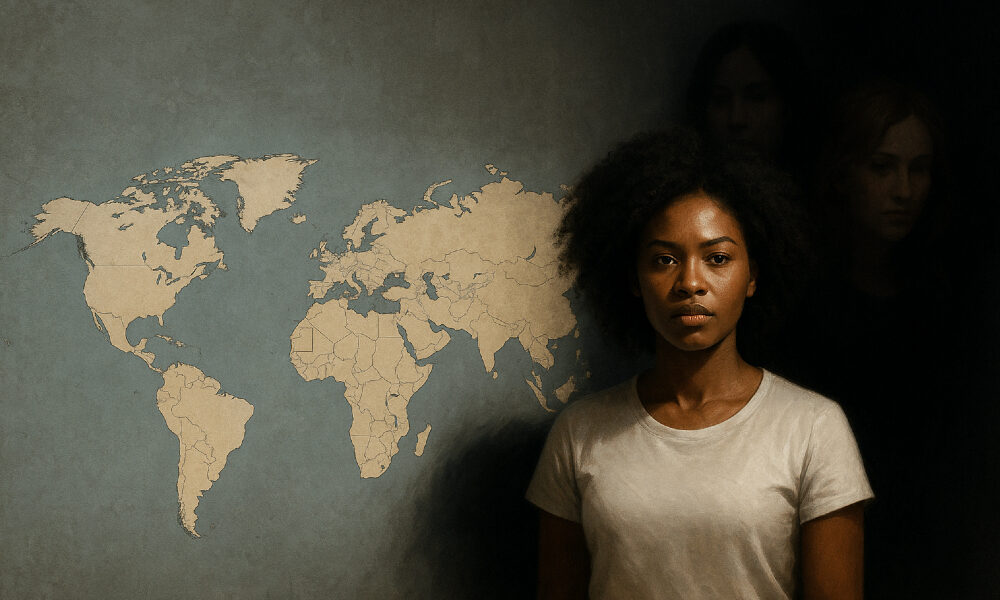
Take, for instance, the ongoing debate about how Africa is visually misrepresented on world maps. Despite being one of the largest and most geographically diverse continents, it is often depicted as smaller than it truly is.
In reality, Africa is so vast that it could comfortably fit Europe, the United States, China, India, and Japan within its borders – with room to spare.
Africa’s natural wealth – particularly in resources like lithium and cobalt, which power electric vehicles and modern technology – fuels global innovation. Yet, despite this immense contribution, the continent’s value is frequently diminished by those who benefit from its riches.
Narratives that portray Africa as underdeveloped or dependent persist, overshadowing its true potential and historical significance.
A Parallel Struggle: The Erasure of Women’s Power
This pattern mirrors a broader societal issue: the systemic conditioning of women to view themselves as inferior. Women inherently possess strength, wisdom, and leadership – qualities that should never be seen as weaknesses.
And yet, generations of cultural norms have sought to suppress these attributes, placing women in subordinate roles.
Women are the life-givers, the nurturers, and the cornerstone upon which societies are built. Through them, nations find renewal, resilience, and an enduring sense of hope.
Their existence itself is a testament to creation, continuity, and boundless possibility.
For far too long, women have been relegated to the shadows, treated as second-class citizens despite their countless contributions to history, science, politics, and culture. True gender equality remains elusive – even in the most developed nations.
Consider Katherine Johnson, the brilliant mathematician whose calculations guided NASA’s Apollo 11 mission and ensured the safe return of astronauts from the moon. Her story, once overlooked, is now celebrated as emblematic of the transformative power of women in STEM.
In precolonial Africa, women wielded extraordinary influence. Figures like Queen Amina of Zazzau in the 16th century – a formidable military strategist and ruler – expanded territories, fortified cities, and left behind legacies such as the famed Amina Walls in present-day Nigeria.
However, with the advent of colonialism and the formation of modern African states, many of these powerful matriarchal systems were dismantled. Gender inequality took root more deeply, pushing women to the margins of political, economic, and social life across much of the continent.
Even today, progress remains painfully slow. In the UK, women earn just 85.1 pence for every pound earned by men – an unambiguous reflection of the persistent 14.9 percent gender pay gap.
These figures are not just statistics; they are a call to action.
Globally, at the current rate of progress, full gender equality will not be achieved until 2155 – over 130 years from now.
- Western Europe: Estimated to close the gender gap in 67 years.
- Sub-Saharan Africa: 102 years.
- Middle East and North Africa: 152 years.
Just as the map distorts Africa’s true size, so too have centuries of bias distorted the perception of women’s power and potential. But awareness is growing.
Movements for equity, justice, and representation are gaining momentum – and with them, the promise of a future where both Africa and women are seen, valued, and empowered as they truly are.
Mary Alorh is Director of Administration at DefSEC Analytics Africa Ltd., and is an expert in Gender, Youth, and Peace & Security initiatives in West Africa.