Opinion
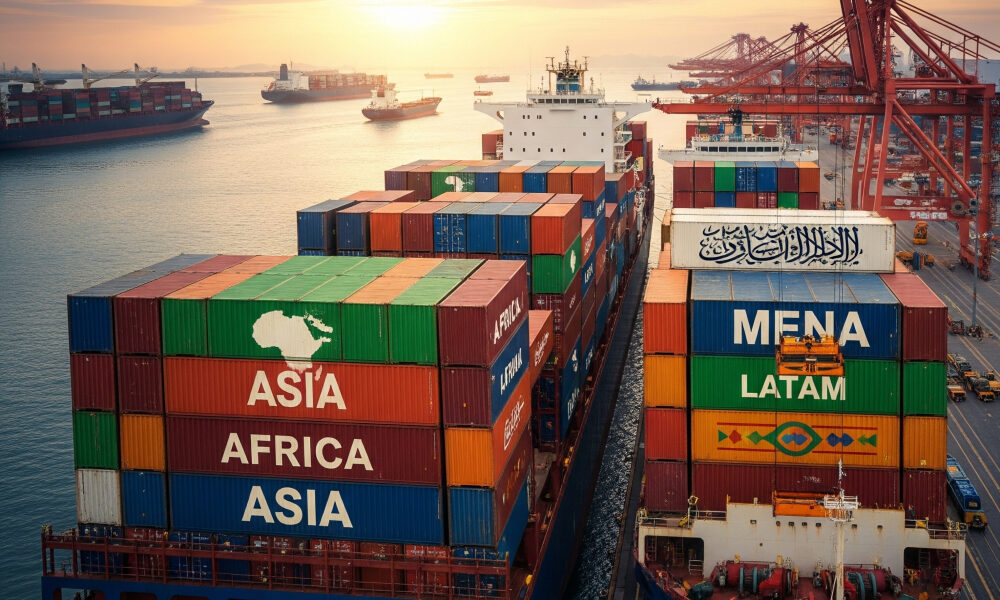
The New Axis of Global Trade: Why the Global South Is Reshaping the World Economy


By Dishant Shah
The tectonic plates of global commerce are shifting – and the epicenter is moving south.
For much of the 20th and early 21st centuries, the world economy revolved around a well-established axis: North-to-North trade. Transatlantic supply chains, Europe’s industrial might, North American consumer demand, and Japan’s export-driven growth formed the backbone of global trade.
But while that axis remains significant, it no longer stands alone.
A new force is rising – the Global South – and it is no longer just a participant in the global economy. It is becoming the stage on which the future of trade will be written.
The Rise of South-South Trade
Consider the numbers. North-to-North trade still dominates in volume, valued at approximately US$13 trillion.
But its annual growth has slowed to just 2 percent, a sign of maturity and saturation.
In contrast, South-South trade – exchanges between developing economies in Asia, Africa, Latin America, and the Middle East – is growing at nearly twice that pace, despite a smaller base of around US$ trillion. More striking is the South-to-China corridor, now worth US$3 trillion and expanding at close to 6 percent per year – the fastest-growing trade route in the world.
This isn’t a minor trend. It’s a structural transformation.
Demographics Drive Demand
At the heart of this shift is one undeniable fact: the Global South is where the world’s people are – and where its future consumers are being born.
Home to over 6 billion people, the region is projected to add nearly 2 billion new middle-class consumers by 2035. That’s 2 billion more people buying food, smartphones, vehicles, energy, and digital services.
It’s not just about population; it’s about purchasing power, urbanization, and rising aspirations.
India exemplifies this evolution. Once known primarily as a hub for IT outsourcing, the country is now emerging as a global manufacturing powerhouse.
Through initiatives like “Make in India,” and the rapid growth of domestic champions in telecom, renewable energy, and digital platforms, India is no longer just a low-cost supplier – it’s a full-spectrum economy: innovator, producer, and consumer.
Its trade narrative has shifted from cost arbitrage to scale, speed, and technological integration.
Africa: From Resource Supplier to Innovation Hub
Africa, long typecast as a supplier of raw materials, is undergoing a quiet but profound transformation.
The African Continental Free Trade Area (AfCFTA) has the potential to create a $3 trillion integrated market – the largest by number of participating countries in the world. If fully realized, AfCFTA could boost intra-African trade by over 50 percent within a decade.
Beyond trade agreements, Africa is leapfrogging traditional development stages through digital innovation. Mobile money transactions across the continent now exceed $800 billion annually – more than double the volume in 2019. From fintech startups in Lagos to agritech solutions in Nairobi, Africa is proving it’s not just a market for others’ technologies, but a creator of its own.
The continent is evolving into both a demand center and an innovation lab.
China: The Southern Connector
China’s role in this new trade order cannot be overstated. As the world’s largest trading nation, China has strategically positioned itself as the primary economic link between the Global South and the rest of the world.
Through the Belt and Road Initiative (BRI), China has financed and built infrastructure – from ports in Pakistan to railways in East Africa – that is reshaping trade logistics. Its digital platforms are expanding across Southeast Asia and Africa, while its energy partnerships with Gulf states and Latin America deepen interdependence.
China’s trade with the Global South is not just growing – it’s redefining the rules of engagement.
Rebalancing, Not Decoupling
The $5 trillion North-to-South trade corridor, growing at nearly 4 percent annually, underscores a critical truth: the future of global trade is not about disengagement, but rebalancing.
The Global North remains essential – its capital markets, technological leadership, and regulatory frameworks continue to shape global standards. But the center of gravity is shifting.
The South is no longer a periphery; it is central to supply chains, consumer markets, and innovation ecosystems.
A New Map for a New Era
If global trade is a mirror of global power, then the reflection is changing. The unipolar economic order is giving way to a multipolar reality – one with multiple axes, diverse growth engines, and interconnected regional blocs.
The question now is whether businesses, policymakers, and investors are ready to adapt.
Are supply chains being redesigned to reflect new trade corridors? Are investment strategies accounting for the rise of Southern middle classes?
Are diplomatic and trade policies aligned with this new geography?
Or are we still navigating with yesterday’s compass?
The trade winds have changed. The only question is who will sail with them – and who will be left behind.
Dishant Shah is a partner at Legion Exim, a company specializing in facilitating the export of high-quality engineering products directly sourced from manufacturers in India to Africa. His areas of expertise include new business development and business management.