Opinion
The Nana Benz: Africa’s Original Supply Chain Masters
Long before modern logistics became a boardroom obsession, a syndicate of West African women built a transnational distribution empire. Their legacy demands a radical rethinking of African business education and economic sovereignty.


By Dishant Shah
Business schools love to say that distribution is the new frontier of competitive advantage. Harvard has cases on it. Consultants bill handsomely for it. Yet in the Grand Marché of Lomé, a group of women worked out the whole idea more than half a century ago, without a single lecture. Nobody gave them a syllabus, and they ended up driving Mercedes-Benz sedans.
They were the Nana Benz, and their story deserves a better place in how Africa thinks about enterprise.
The Cloth That Conquered a Continent
The product was Dutch wax print, a fabric with a surprisingly tangled history. European manufacturers first designed it to imitate Indonesian batik. It flopped in Southeast Asia and found its real market on the coast of West Africa, where it was embraced, reinterpreted and eventually made inseparable from African identity. By the middle of the 20th century, a fabric engineered in the Netherlands had become one of the most recognizable symbols of African dress.
Here is the part that textbooks tend to skip. The factories were in Europe. The profits, or a remarkable share of them, were not.
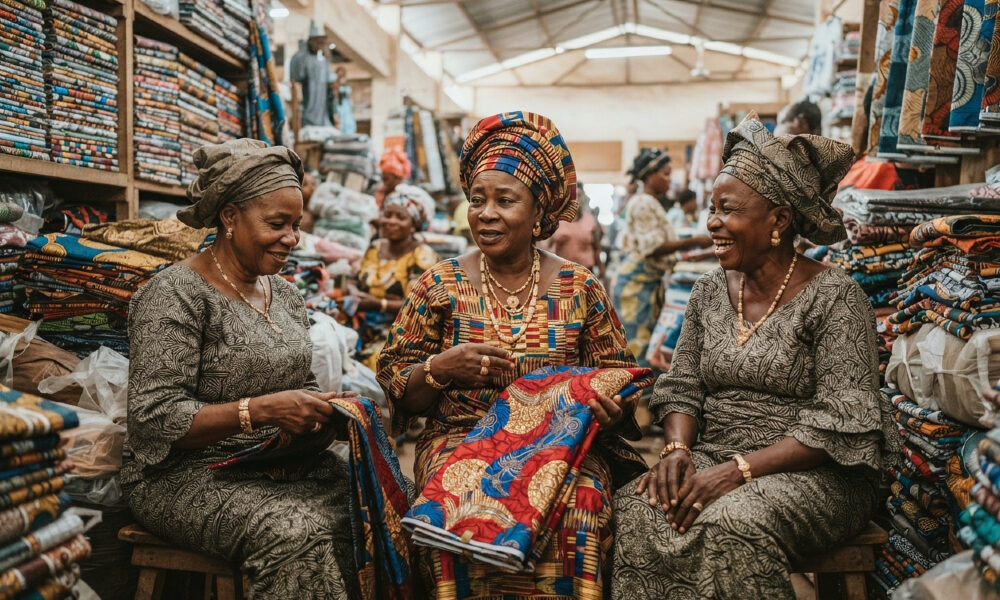
From the 1950s through the 1970s, the women traders of Lomé turned themselves into the indispensable link between European mills and West African consumers. They did not merely buy cloth and mark it up. They secured exclusive dealerships. They negotiated supply terms and imported in bulk. Then they pushed the goods through wholesale and retail channels that reached Ghana, Benin, Burkina Faso, Mali, Niger and beyond. Lomé, a small port city on the Gulf of Guinea, became a regional trading capital in textiles.
Owning the Gate, Not the Factory
The strategic insight is easy to state and hard to execute. The Nana Benz understood that the party who controls access to the customer can extract as much value as the party who controls the machinery.
They never owned a mill. Yet they shaped what European manufacturers produced, because they knew which patterns would sell in Accra and which would sit unwanted in Niamey. They christened designs with names that carried proverbs, political jokes and social commentary, turning a bolt of fabric into a conversation piece. A cloth with a good name sold itself. Demand was manufactured in the market, not in the factory.
In effect, the women ran what modern strategists would call a data business. Their market intelligence was gathered face to face, refined over decades and impossible for a foreign mill to replicate from a boardroom in Europe. Their working capital was substantial. Their supplier relationships were guarded jealously. And underneath it all lay the asset that does not appear on any balance sheet: trust.
That trust was not sentimental. In an economy with weak courts, patchy credit and thin formal banking, reputation was the contract. A trader who could be relied upon to pay, to deliver and to extend credit to the retailer further down the chain held a position no spreadsheet could capture.
Why the Benz
The nickname needs little explanation. By the 1970s and 1980s, textiles had become one of Togo’s most important commercial activities, and the women at the center of the trade were rich enough to be recognized by their cars. The Mercedes-Benz was the status symbol of choice, and “Nana Benz” entered the vocabulary of West Africa.
It was, notably, a nickname built on respect and a little awe. In a region where women traders had long been the backbone of commerce, though seldom credited as its architects, these were women whose power was impossible to ignore.
The Complications
It would be dishonest to present the Nana Benz as a pure fable of free-market genius. Their rise was entangled with politics. Close ties to Togo’s ruling circle and preferential trading arrangements helped them as much as shrewd instinct did, and critics have long noted how privilege and proximity to power shaped who got the best dealerships.
Their decline, meanwhile, shows how quickly an empire built on one product and one channel can be threatened. Currency shocks, political turmoil and shifting consumer tastes took their toll. Then came a flood of cheaper imitation prints from Asia, particularly China, which undercut the premium positioning that had sustained the trade. Younger consumers, less attached to the old brands, followed price and fashion rather than lineage. A business that had once dictated terms to European mills found itself squeezed from below.
These are not footnotes. They are the second half of the lesson. A distribution advantage is powerful, but it is not permanent, and it is most fragile when it depends on a single supplier, a single product and a single political patron.
What Africa Should Take From This
The popular narrative about African entrepreneurship tends to run one of two ways. Either it is a story of heroic survival, the informal trader scraping by against impossible odds, or it is a story of aspiration, in which the continent’s salvation lies in the next unicorn start-up and the next Silicon Valley-style incubator. The Nana Benz fit neither frame. They were neither desperate nor digital. They were strategists.
That matters now. With the African Continental Free Trade Area, the world’s largest free-trade zone by number of member countries, slowly knitting 54 markets together, the central challenge is no longer simply making things. It is moving them: across borders, through customs, past erratic power grids and into the hands of consumers who trust the seller. The continent has plenty of producers and no shortage of ambition. What it lacks, in many sectors, are the distributors, the intermediaries and the trust networks that turn production into prosperity.
This is precisely the skill the Nana Benz mastered. A continent that talks endlessly about value addition might spend more time asking who captures the value at each step, and why so often the answer is not an African firm.
There is a deeper provocation here, too. African universities and multinational graduate programs are wonderful institutions, and nothing here should be read as an argument against them. But too many young Africans are taught to treat entrepreneurship as something imported, a framework from California or London to be applied to local conditions. The Nana Benz suggest the reverse. The frameworks were being practiced in Lomé’s markets long before they were named in lecture halls abroad. The continent’s own merchants, past and present, are an under-studied archive of strategic wisdom.
The Lesson, Plainly
You do not need to own the factory to own the market. You need to know your customer better than anyone else does. You need to control the route to that customer, and you need to build the kind of trust that outlasts any single transaction. Then you need to diversify before someone cheaper arrives.
The Nana Benz understood most of this by instinct. Africa’s next generation of traders, logistics founders and wholesalers can learn the rest by studying them, and by not waiting for permission from a business school to take them seriously.
Dishant Shah is a partner at Legion Exim, a company specializing in facilitating the export of high-quality engineering products directly sourced from manufacturers in India to Africa. His areas of expertise include new business development and business management.