Opinion
The Lasting Impact of Colonial Borders on Africa’s Ethnic Landscape


By Danilo Desiderio
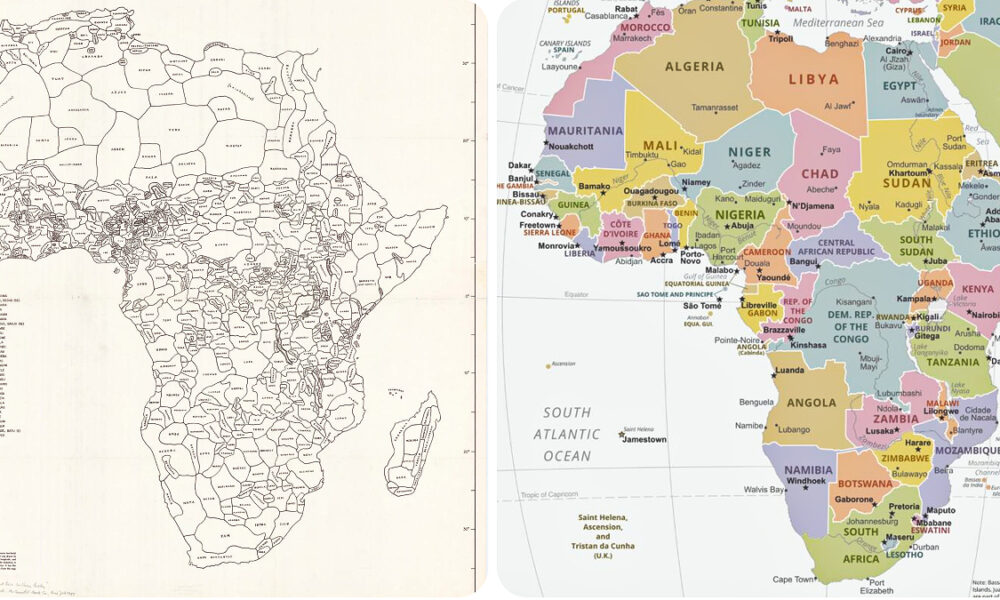
In 1959, American anthropologist George Murdock created an ethnic map of Africa, illustrating the continent’s diverse ethnic distribution based on the resources and knowledge available at the time. While not without its limitations, Murdock’s map remains a crucial reference for understanding the deep-seated ethnic tensions that continue to shape Africa today.
The contrast between Murdock’s ethnic map and modern Africa’s political boundaries – imposed by European colonial powers after the Berlin Conference of 1884–1885 – is stark. These artificial borders forced historically rival communities to coexist within newly formed states while simultaneously dividing ethnic groups across multiple countries.
For example, the Maasai people were split between Kenya and Tanzania, while the Ewe found themselves divided among Ghana, Togo, and Benin. Such arbitrary divisions disrupted traditional governance structures, economic systems, and cultural cohesion, laying the groundwork for conflicts that persist to this day.
Today, the consequences of Africa’s imposed borders remain evident in its political and social dynamics.
Sékou Touré, Guinea’s first president and a prominent Pan-Africanist, famously highlighted the fundamental difference between African and European nationhood. He argued that, unlike Europe – where nations evolved organically through centuries of conflict, alliances, and social development – Africa’s modern states were artificially imposed by external forces to serve colonial interests rather than the needs of its people.
Challenges and Opportunities for African Integration
He likened Europe’s natural formation of nations to geological shifts, where tectonic plates move, merge, and separate over time, shaping the landscape gradually.
In contrast, Africa’s borders were drawn abruptly, with little regard for cultural, historical, or ethnic realities. As a result, Touré maintained that most African countries should be viewed as states – political entities with defined governance structures – rather than nations, which traditionally share a common identity, language, and history.
A passionate advocate for African unity, Touré envisioned a future where these artificial divisions would be dismantled in favor of a unified African state. He believed that true sovereignty and progress could only be achieved by overcoming the colonial legacy of fragmentation and embracing a shared continental identity.
Today, the consequences of Africa’s imposed borders remain evident in its political and social dynamics. While Pan-Africanist ideals continue to inspire efforts toward regional integration, the challenge lies in reconciling historical grievances with modern governance structures.
Understanding this complex history is essential to forging a path toward greater unity, stability, and self-determined progress for the continent.
Danilo Desiderio serves as the CEO of Desiderio Consultants Ltd in Nairobi, Kenya, specializing in African customs, trade, and transport policies. He is a customs and trade expert at the World Bank and a senior associate to the Horn Economic and Social Policy Institute (HESPI).