Owusu on Africa
The Lake Chad Basin Cannot Afford a Sudanese Spillover
A volatile security complex at the seam of West and Central Africa now faces a new threat from the east – and the region has little margin for error.


By Fidel Amakye Owusu
Few places on Earth carry as much strategic weight while attracting as little sustained attention as the Lake Chad Basin. Straddling Nigeria, Cameroon, Chad, and Niger, with the Central African Republic on its fringes and Libya watching from the north, the basin is not a formal trade bloc or a Regional Economic Community like ECOWAS or ECCAS. It is something arguably more consequential: a regional security complex where the fates of West Africa, Central Africa, and the Sahel intertwine – and where a crisis in any one corner rarely stays contained.
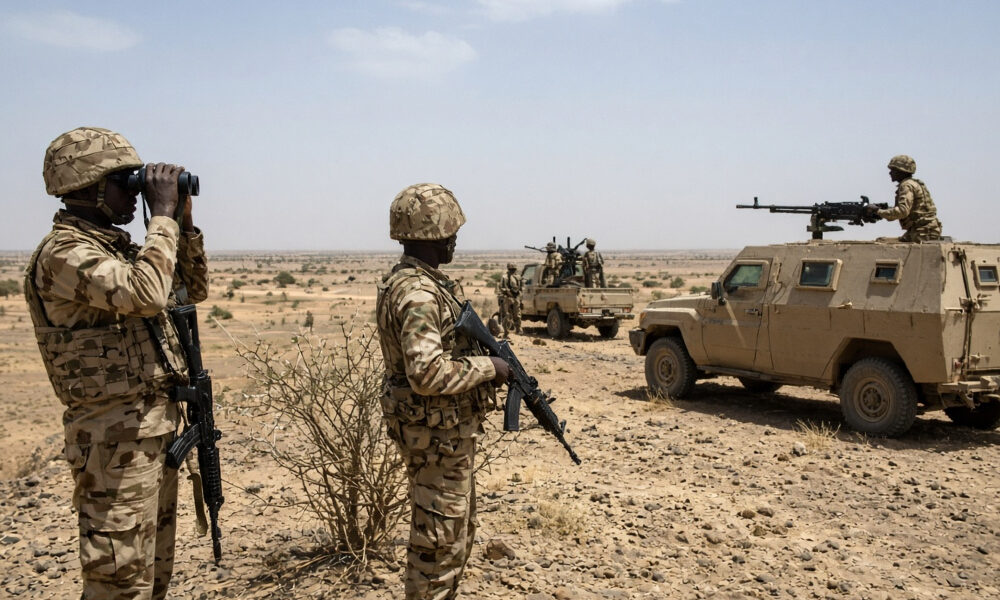
That containment is now being tested. Over the weekend, Chad’s military accused Sudan’s army of striking targets up to 100 kilometers (62 miles) inside Chadian territory, and placed its forces on high alert. It is a small, sharp signal of a much larger danger: that Sudan’s civil war is no longer a Sudanese problem alone, but one with the potential to reshape the security landscape of an entire African macro-region.
A Region Built on Both Bounty and Vulnerability
The four core states of the Lake Chad Basin sit atop some of the continent’s richest natural endowments – arable land, fisheries, oil, and mineral wealth. Yet that same geography has long made the basin irresistible to smugglers, traffickers, and, increasingly, violent extremists. The lake’s shifting shoreline, its scattering of remote islands, and its famously porous borders have for decades offered cover to those moving drugs, weapons, and people across four countries at once.
Regional governments saw this coming. In the early 1990s, alarmed by how easily bandits and traffickers were exploiting the basin’s terrain, member states deepened cooperation through the Lake Chad Basin Commission (LCBC), building a framework for joint security coordination that persists today. But the threat has metastasized. What began as a haven for organized crime became fertile ground for Boko Haram and its Islamic State-aligned offshoot, ISWAP – two of the deadliest extremist organizations on the continent. Both have thrived precisely because the basin’s ungoverned spaces make coordinated response so difficult.
The lesson of the last decade is unambiguous: no single government can secure this region alone. Stability depends on joint military operations, real-time intelligence sharing, and sustained cooperation with international partners – an architecture that took years to build and remains fragile even in calmer moments.
Sudan’s War Finds a New Front
Enter Sudan. The Rapid Support Forces (RSF) already control swaths of Darfur along the Chadian border and have drawn thousands of recruits from Chadian communities and beyond, blurring the line between Sudan’s internal conflict and its neighbors’ domestic security. In recent months, momentum on the battlefield appears to have shifted toward Sudan’s army, the SAF – and a weakening RSF is now pushing harder against that porous frontier, both into Chad and into the Central African Republic.
This is precisely the scenario regional security planners fear most: not a contained civil war, but a slow bleed of fighters, weapons, and instability westward into a basin that is already straining under the weight of Boko Haram and ISWAP. Arms proliferation is the critical variable here. Weapons displaced by Sudan’s war do not simply disappear when a front line moves; they tend to resurface in the hands of whoever controls the next ungoverned space – and few spaces are as ungoverned, or as strategically central, as the Lake Chad Basin.
The Questions That Will Define What Comes Next
Chad’s claim of Sudanese airstrikes on its soil raises the stakes considerably, and the answers to several open questions will shape the region’s trajectory over the coming months.
Will N’Djamena risk direct confrontation with Khartoum, or will this – like earlier flare-ups between the two nations – settle into a familiar pattern of proxy competition rather than open war? Do the SAF’s repeated incursions into Chadian territory suggest the RSF is heading toward a decisive defeat in the near term, or merely a prolonged and more chaotic phase of the conflict? And critically, could deeper diplomatic engagement between Sudan and its neighbors defuse tensions before they escalate into direct state-on-state hostilities?
That last question points to the most urgent unresolved issue: who, exactly, is positioned to mediate? Regional bodies like the African Union and the LCBC carry institutional legitimacy but limited enforcement power. Individual states such as Chad have skin in the game but lack leverage over Khartoum. External actors with influence over the conflict’s financiers and arms suppliers may ultimately matter more than any regional forum. Absent a credible mediator willing to act quickly, the basin risks inheriting Sudan’s war on top of its own.
Why This Matters Beyond the Region
It is tempting, from a distance, to treat the Lake Chad Basin as a peripheral concern – a patchwork of borderlands far from global capitals. That would be a mistake. This is a region where jihadist insurgency, interstate rivalry, and a spillover civil war now risk converging in the same theater at the same time. For Nigeria, Cameroon, Niger, and Chad, the cost of inaction is measured in displaced populations, disrupted trade, and emboldened extremist groups. For the wider world, it is a preview of how quickly a single civil war – in this case, Sudan’s – can radiate outward and destabilize an entire neighborhood.
The Lake Chad Basin has survived crises before by leaning on regional cooperation built the hard way, over decades of trial and error. Whether that cooperation can absorb the shock of Sudan’s war, too, may be the defining security question for this part of Africa over the next year.
Fidel Amakye Owusu is an International Relations and Security Analyst. He is an Associate at the Conflict Research Consortium for Africa and has previously hosted an International Affairs program with the Ghana Broadcasting Corporation (GBC). He is passionate about Diplomacy and realizing Africa’s global potential and how the continent should be viewed as part of the global collective.