A Diaspora View of Africa
The International Community and African Elections


By Gregory Simpkins
The aftermath of the Nigerian elections has become quite contentious, although fortunately not widely violent. There are numerous accusations of malfeasance by the Independent National Electoral Commission (INEC), recriminations about one candidate cannibalizing support from another, failure of sophisticated election equipment and the usual allegations of bribery, corruption, and intimidation.
As this is all being sorted out in court cases, the bigger question is whether the international community can find a way to help prevent botched elections in Africa or at least call out those who subvert the success of efforts to hold free, fair and transparent elections on the continent during and not just after the election process. Condemnations after the fact are virtually worthless for African voters who feel cheated out of the true impact of their vote.
There are multiple calls for the Nigerian election results to be voided, which would then lead to a rerun. The National Democratic Coalition (NADECO) wants the election results to be voided because of alleged election fraud, and the Labour Party’s candidate Peter Obi is in court. Obi is seeking an annulment of the election based on claims of widespread breaches of electoral law and 6 state governments – from the southeast to the northwest – also want the election to be canceled and rerun. The Peoples Democratic Party’s Atiku Abubakar has assembled a team of 19 senior advocates to mount an election challenge.
No such effort has ever succeeded in Nigeria. Atiku tried it and failed before, most recently after the previous election. It has happened on the continent though: the Supreme Courts in Malawi and Kenya have ordered presidential election reruns. The reasons such efforts seldom succeed are that reruns are expensive, and nullifying an election further erodes voter confidence, not to mention leads to violence.
In this case, most of the eligible voters either didn’t pick up their voter cards or didn’t cast ballots. That is how the All Progressives Congress (APC) candidate Bola Tinubu received an estimated 37 percent of the votes cast, which represents only about 10 percent of those who picked up their voter cards and an even smaller percentage of all registered voters.
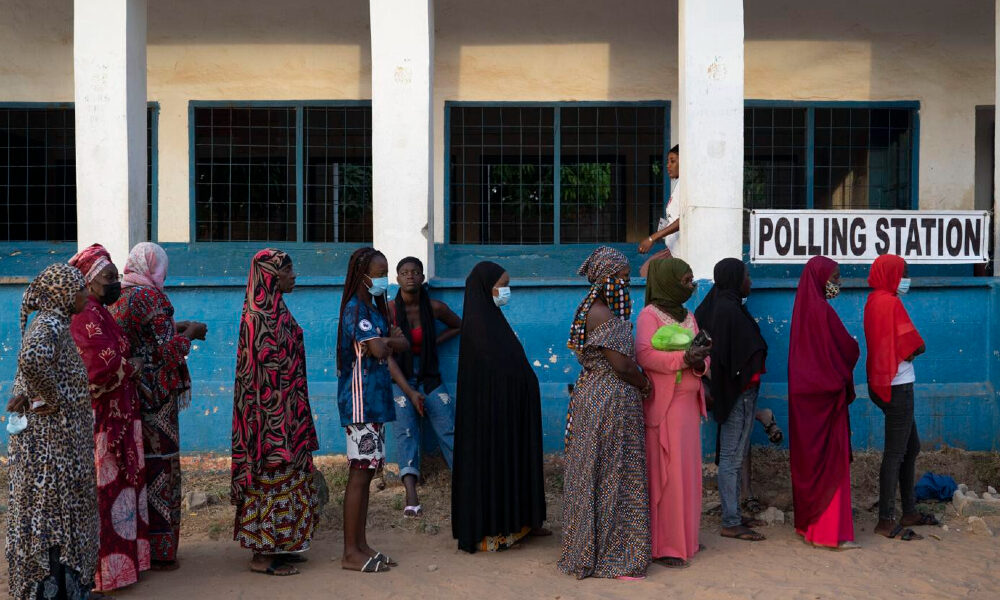
All too often, punishments like sanctions are levied after the fact, when an election has been stolen or so badly botched that there can be little confidence in who won. This leaves voters feeling that the time they spent in long lines to register to vote and then cast ballots was not worth their time and effort.
Having worked in government and participated in government-funded election observation missions in Africa, I have long seen election missions fail to monitor the entire election process. Even when American non-governmental organizations such as the International Republican Institute (IRI), the National Democratic Institute (NDI) and the International Foundation for Electoral Systems (IFES) call for more in-depth monitoring of elections or all out problems ahead of voting, the U.S. government, as well as most other governments, fail to sufficiently raise alarms and take whatever preventative actions are possible.
The appeals from these organizations likely are seen as merely justifying further grant money. But carefully worded statements apparently aimed at encouraging African governments to execute effective elections don’t carry much weight with those who are determined to manipulate them.
Criticisms
All too often, punishments like sanctions are levied after the fact, when an election has been stolen or so badly botched that there can be little confidence in who won. This leaves voters feeling that the time they spent in long lines to register to vote and then cast ballots was not worth their time and effort. When you combine that hassle with the insecurity and sometimes even voter intimidation, sitting out an election in which you have little faith is a very unattractive prospect.
Election observers have widely criticized the conduct of Nigeria’s elections. For example, Constance Berry Newman, former Assistant Secretary of State for African Affairs and a member of the IRI-NDI observation mission cited three main problems following voting:
- A lack of transparency, so voters and the general public did not understand why election data was published late, for example.
- Very late openings of polling sites because of late transportation of materials, missing materials, and late arrival of staff. This led to frustrated, often angry, voters, a limited number of whom left and a small number of whom engaged in violent activities.
- A seemingly ineffective and late tabulation announcement process that raised concerns about the announced results.
Those are useful assessments in assessing how these elections were managed, and they could well add to the evidence presented in court to challenge the results but had there been some effort to better ensure that such important glitches were prevented, there may not have been a need for court challenges.
It may seem counterintuitive to suggest that something can be done in advance of voting, but elections are not always won or lost on election day so preventative efforts against fraud and manipulation must be undertaken to ensure a just and representative process. Of course, transposing election results by polling place or wholesale switching ballots after the vote does happen on or just after election day, but much of the fraud happens long before the first ballot is cast.
Creating electoral districts to favor one party allows that party to gain more seats without actually having a majority of the voters behind them. I saw that in Kenya in 1992. Having election challenges considered by a panel consisting of representatives from the government, the ruling party, and the challenging party – as in Ethiopia in 2005 – is inherently unfair.
In the case of Nigeria’s elections this year, INEC used a sophisticated electronic system that was supposed to immediately upload results from polling places to the national database, but while some local results were uploaded quickly, the presidential results were not. INEC officials acknowledged glitches in their system but attributed them to their failure to adjust their system from reporting local results to uploading national results.
There apparently was no nationwide test of this new system. In an election with more than 93 million eligible voters, heightened voter interest, and a competitive three-candidate race, that explanation is not acceptable. Did the United States and other donor nations weigh in with INEC to strongly urge them to conduct such a test before the elections?
For some reason, the U.S. Department of State issued a statement just after the election results were released congratulating Tinubu on his victory. That was in stark contrast to the delayed reaction to Kenya’s presidential elections in 2022. William Ruto was not congratulated by the United States until a month after the elections when the Kenyan Supreme Court validated the election. Even officials inside the Biden administration have questioned the rapid acceptance of Nigeria’s elections. Why then the rush to judgment in Nigeria’s case in which there was a tightly contested race and significant flaws were found in its execution even by U.S.-funded observer missions?
International community strategies for dealing with troubled elections have ranged from quickly accepting results and refusing to go beyond mild criticisms to calling for governments of national unity as a means of quelling post-election conflict. Such solutions rarely work as well as preventative actions that would focus on funding credible local groups to look at elections processes and publicly expose obvious problems in advance of voting that are backed up by realistic international actions to warn election manipulators of the consequences of putting forward a significantly flawed election and to pressure them to do the right thing before voters go to the polls.
Let me be clear, there likely is no such thing as a perfect or near-perfect election. Certainly, we know that here in the United States. The cost of a lack of transparency and technical flaws that could have been avoided has been demonstrated to be high in terms of sapping voter confidence and stirring even violence among those who feel aggrieved. Reruns of elections are much more difficult than getting elections right – or acceptably so – in the first place.
Nigeria’s elections are the first in a series of important political contests in Africa this year, which include elections in Sierra Leone, Zimbabwe, Sudan, Gabon, Liberia, Madagascar, and the Democratic Republic of the Congo. Will the international community step up and try to help ensure effective election processes in these important contests, or will they continue to try to lock the barn door after the horse has escaped, so to speak? If Africa’s most populous nation didn’t engender sufficient pre-election attention and action, then what hope is there for effective international community support in the upcoming African elections?
Inaction or late action has been shown to be ineffective, most recently now in Nigeria. Will that lesson finally be taken seriously before the next slate of elections?
Gregory Simpkins, a longtime specialist in African policy development, is the Principal of 21st Century Solutions. He consults with organizations on African policy issues generally, especially in relating to the U.S. Government. He also serves as Managing Director for the Morganthau Stirling consulting firm, where he oversees program development and implementation. He further acts as a consultant to the African Merchants Association, where he advises the Association in its efforts to stimulate an increase in trade between several hundred African Diaspora small and medium enterprises and their African partners.