Opinion
The Indispensable Middleman: Why Agriculture Needs Aggregators, Not Apps
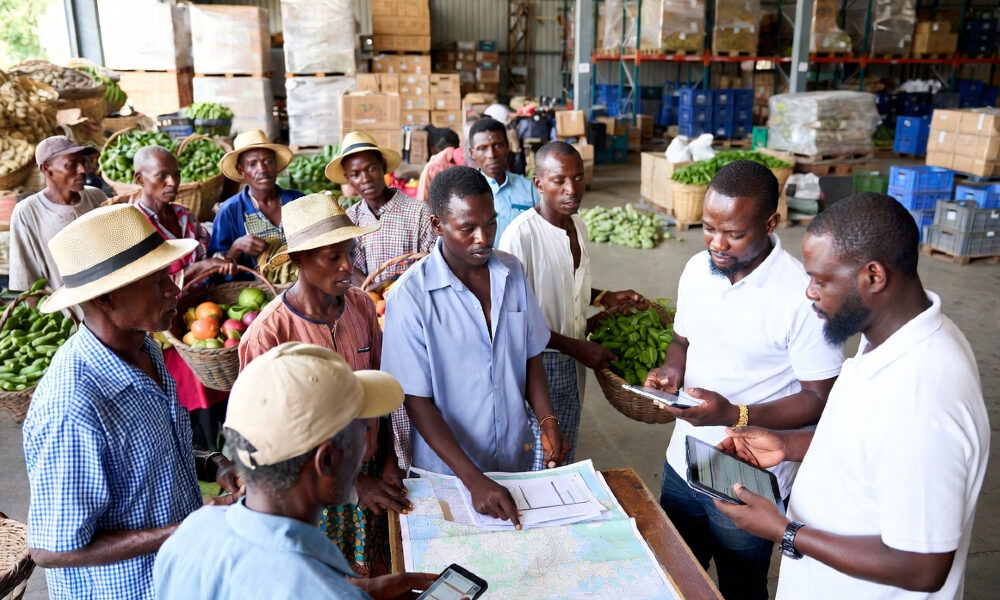


By John Dale
The promise of agricultural technology often comes wrapped in seductive rhetoric: disintermediation, direct-to-consumer models, blockchain traceability that “cuts out the middleman.” Yet this narrative fundamentally misunderstands how global food systems actually function.
The uncomfortable truth is that middlemen are not parasites to be eliminated – they are essential infrastructure supporting the 80 percent of smallholder farms that feed global markets.
The Structural Necessity of Intermediation
Every functioning agricultural system requires a robust layer of intermediaries. This is not a market failure to be corrected, but a structural imperative dictated by the nature of smallholder farming itself.
Individual farmers operating one to five-hectare plots cannot store produce at commercial scale. They cannot transport commodities across hundreds of kilometers.
They cannot aggregate sufficient volume to negotiate favorable terms with institutional buyers or processors.
These capabilities only emerge at scale – precisely the scale that smallholder farmers, by definition, lack. The middle layer connecting farmer deficiency with market requirements represents the most critical segment of the agricultural value chain.
Between the farm gate and a structured buyer, a commodity typically passes through four to six distinct handlers: local purchasing agents, village-level aggregators, bulk traders, transporters, warehouse operators, quality inspectors, and exporters.
This is not bureaucratic bloat. It is the essential bridge architecture that makes the entire system possible.
Remove these intermediaries, and the structure collapses entirely.
The Cost of Fragmentation
The consequences of poorly organized intermediation are already visible across developing agricultural economies. In Africa alone, 30-40 percent of harvested produce is lost post-harvest annually – not primarily because of inadequate cold storage or poor roads, but because coordination within the intermediary layer remains informal and fragmented.
When aggregation networks operate without standardized protocols, information systems, or quality controls, waste becomes inevitable. A tomato farmer in rural Kenya might harvest at optimal ripeness, only to watch produce rot while waiting for an aggregator who operates on informal timelines, communicates through unreliable channels, and lacks real-time market intelligence about demand fluctuations downstream.
The problem is not the existence of middlemen. The problem is that these middlemen currently operate in the shadows of the formal economy, beyond the reach of digital coordination tools that could dramatically improve their effectiveness.
What Technology Can – and Cannot – Accomplish
When entrepreneurs claim they are “removing middlemen,” what they actually mean is: “we are ignoring the work these intermediaries perform.” This represents either naïveté about agricultural supply chains or deliberate misrepresentation of technological capabilities.
Technology can absolutely reduce price opacity, providing farmers with better information about prevailing market rates. It can minimize information asymmetry between producers and buyers.
It can limit opportunities for exploitative arbitrage. These are meaningful improvements that benefit farmers and consumers alike.
But technology cannot eliminate the fundamental need for aggregation, logistics coordination, quality assurance, and risk management that intermediaries provide. No smartphone app can physically consolidate three tons of maize from forty different farmers, arrange refrigerated transport, negotiate phytosanitary certification, and manage foreign exchange risk on an export contract.
Aggregation sits at the center of agricultural value chains for good reason. It happens before processing can begin.
Pooling occurs before meaningful price negotiation becomes possible. Physical movement must be organized before commodities can reach markets. These sequential dependencies cannot be app’d away.
Organizing Reality Rather Than Flattening It
The export technology platforms currently being developed represent a fundamentally different approach – not disintermediation, but structured intermediation. Under this model, farmers remain producers, aggregators continue as coordinators, and exporters execute on international contracts.
The critical differences lie in visibility, accountability, and operational efficiency.
Digital platforms can bring informal intermediary networks into structured systems where transactions are recorded, quality standards are enforced, and participants across the chain gain real-time visibility into inventory, pricing, and logistics. A village aggregator accessing such a platform knows precisely when transport will arrive, what quality specifications must be met, and what price has been locked in with the end buyer.
The farmer supplying that aggregator can track their produce through each stage of the journey.
This is not romantic. It does not make for compelling startup pitch decks promising to “revolutionize agriculture” through magical disintermediation.
But it reflects how agricultural systems actually scale in practice – not by eliminating essential functions, but by organizing them more effectively.
Conclusion: Structure Over Slogans
The global food system depends on hundreds of millions of smallholder farmers who will never achieve the individual scale necessary to participate directly in export markets, institutional supply chains, or modern retail networks. Serving these farmers requires acknowledging rather than denying the indispensable role that intermediaries play.
Agricultural development does not advance by flattening complex realities into simplified narratives about cutting out middlemen. It advances by building the digital infrastructure, standardized protocols, and transparent markets that allow existing intermediary networks to function with greater efficiency and accountability.
The aggregators, traders, and logistics coordinators occupying the middle of agricultural value chains are not obstacles to progress. They are the foundation upon which any scalable, sustainable food system must be built. Technology should empower them, not attempt to eliminate them.
The sooner agricultural technology ventures recognize this distinction, the sooner they can begin building solutions that actually work for the 80 percent of farmers who need them most.
John Dale is an agricultural expert, procurement specialist, and export entrepreneur with 20+ years of experience in Nigeria’s agro-commodity value chain. He has deep expertise in farming, sourcing, storage, and international trade of commodities such as cashew, palm oil, ginger, and cocoa. As Co-Founder of Storgit Ltd., an agro-fintech company, he develops innovative solutions for commodity storage, trading, export, and livestock investment. Passionate about reducing post-harvest losses, strengthening procurement systems, and improving export infrastructure, John is dedicated to building a digital, efficient, and inclusive future for African agriculture.