Owusu on Africa
The Forgotten Army of Eastern DR Congo
The DR Congo’s child soldier crisis demands urgent attention – West Africa’s hard-won lessons show what is at stake if the world looks away.


By Fidel Amakye Owusu
When the guns finally fell silent in Liberia and Sierra Leone in the early 2000s, the leaders of those shattered nations confronted a challenge that no peace agreement could resolve on its own: what to do with the thousands of children who had been turned into killers.
The problem was not merely a domestic one. Regional bodies and international organizations that had labored for years to broker peace found themselves equally implicated.
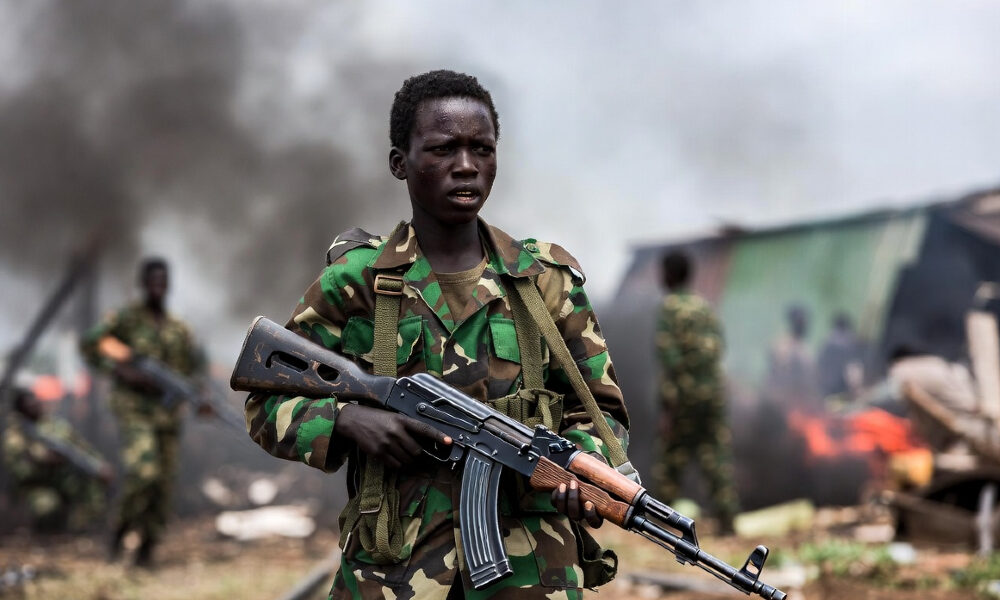
Rebel factions – often loosely organized, always ruthless – had systematically exploited children, at times keeping them compliant through drugs, deploying them to commit atrocities that adult soldiers might have hesitated to carry out. Children, after all, were more malleable. When required, they were also more ferocious.
The psychological damage was – and remains – staggering. These children were robbed of their formative years, a loss that developmental science suggests is extraordinarily difficult to repair.
Rehabilitation programs, funded by a patchwork of donor governments and national initiatives, consumed years and enormous resources. Some children recovered meaningful lives. Others carried irreversible mental illness into adulthood, permanent casualties of conflicts that the world had already declared over.
West Africa’s experience offers a sobering benchmark. Now consider what is unfolding in the Democratic Republic of Congo.
A Larger Crisis, With Fewer Guarantees
The DR Congo is home to the fourth-largest population on the African continent, with a dense concentration of people in its eastern regions – precisely where armed conflict has persisted for decades with no credible end in sight. The arithmetic of this crisis is grim.
A larger population means a larger pool of vulnerable children. A more protracted conflict means deeper and more widespread trauma. And the political and ethnic dynamics of Central Africa differ sharply from those that, however imperfectly, eventually yielded to peacemaking efforts in West Africa.
The relative success achieved along the Atlantic coast cannot simply be transplanted to the Congo Basin and expected to take root.
What made Liberia and Sierra Leone tractable – fragile states, yes, but geographically compact and eventually amenable to internationally mediated settlements – does not map neatly onto the DR Congo, a country the size of Western Europe with a dozen or more active armed groups, a weak central government, and a neighborhood that has historically complicated rather than supported stability.
The urgency, then, is not merely humanitarian in the immediate sense. Every month that fighting continues in eastern Congo is another month in which children are conscripted, drugged, and dispatched to commit violence.
Every month of delay compounds the eventual cost of rehabilitation – in funding, in skilled personnel, in years of programming – and diminishes the prospects for recovery. The international community learned this lesson in West Africa, paying a far higher price for delayed intervention than early action would have required.
The sooner peace comes to eastern Congo, the better the chances that its youngest victims can be salvaged. That is not a counsel of optimism. It is a statement of what the evidence, purchased at great human cost in Sierra Leone and Liberia, plainly demands.
Fidel Amakye Owusu is an International Relations and Security Analyst. He is an Associate at the Conflict Research Consortium for Africa and has previously hosted an International Affairs program with the Ghana Broadcasting Corporation (GBC). He is passionate about Diplomacy and realizing Africa’s global potential and how the continent should be viewed as part of the global collective.