Opinion
The Factory as the New University
For too long, developing economies have treated the university as the sole gatekeeper of technical skill. The countries that actually build productive capability know better.


By Apollo Buregyeya
Uganda is rolling out a competence-based curriculum, and it is right to do so. But the reform raises an uncomfortable question that curriculum designers cannot answer alone: where does competence actually live?
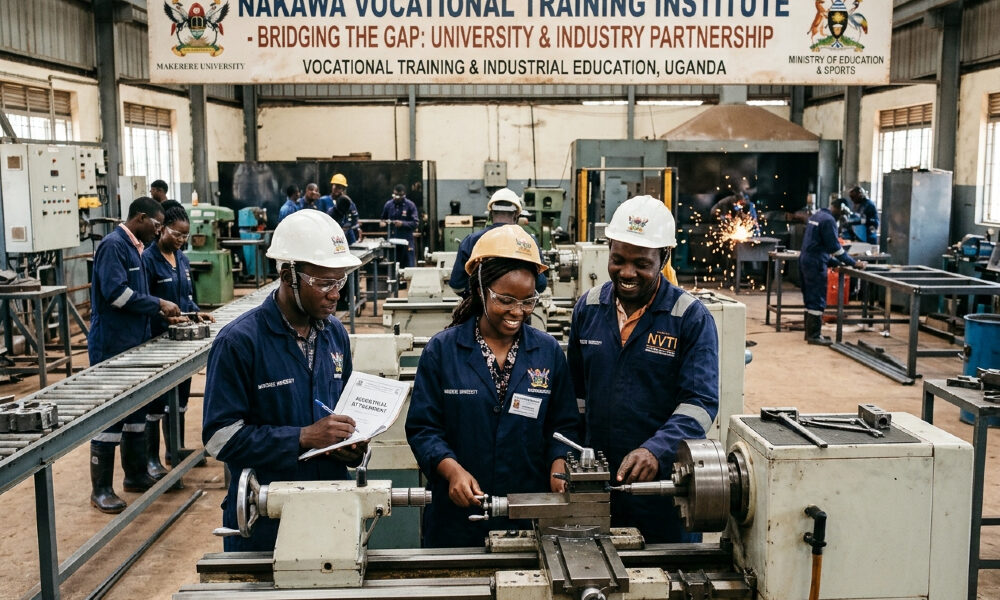
It lives in a workshop, a processing plant, a construction site, a laboratory, a mine. It lives in a maintenance system that works and in a market that pays for good work. It does not live in a rubric. No one learns to weld from a marking scheme, to assemble precision components from a whiteboard, or to maintain infrastructure from photographs of a broken road.
Lessons from 28 Million Workers
Consider the scale of what happens when production itself becomes the teacher. In his account of Apple’s rise in China, the journalist Patrick McGee reports that the company estimated its operations and supply network had trained at least 28 million workers there since 2008. These were not 28 million people sitting in lecture theaters. They learned by making products, correcting defects, running machines and holding tolerances, for customers who could reject anything that fell short.
That is an old insight. Aristotle observed that for the things we must learn to do, we learn by doing them. What is new is the scale at which modern industry can deliver that kind of learning, and the speed at which countries that harness it can climb.
Ending, not Replacing, the Monopoly
None of this means factories should replace universities. They should not. Engineering design, medical practice, scientific research and public safety demand rigorous theory and formal professional preparation. A bridge designed by someone who has only ever tightened bolts is as dangerous as one designed by someone who has never seen a bolt.
But the university has lost its monopoly on technical education. A country builds productive capability when learning moves fluidly among the classroom, the workshop, the factory floor, the building site and the laboratory. The economies that have industrialized fastest treated these as one system. Those that kept them apart produced graduates without experience and workers without credentials.
The Question Every Contract Must Answer
This is where Uganda must become more demanding as it implements the Tenfold Growth Strategy. Every large public contract, mining license, industrial-park allocation and foreign investment should be required to answer a single question: what capability will remain in Uganda when the contractor or investor leaves?
The question is not how many people were hired to sweep, load and guard. It is how many became technicians, supervisors, maintainers, process engineers and independent suppliers.
The difference is profound. A job ends when the contract ends. A skill stays in the country. A local subcontractor that has mastered quality control, equipment management, costing and on-time delivery can bid for the next project, and the one after that. That is how public spending becomes national capability, rather than a passing spectacle of foreign machinery and branded helmets.
From Consumption to Production: The Ugandan Shift
The “Build Uganda, Buy Uganda” (BUBU) policy should be judged by a more ambitious yardstick. Counting how much Uganda buys from Ugandan firms is a start. The better measure is what Uganda can now make, repair, operate and improve that it could not before.
That requires discipline. Every major investment should carry a skills and supplier-development plan, with targets that are assessed, audited and published, so that promises made at signing ceremonies are tested years later against results. And workplace learning must earn recognized qualifications, so that a capable technician can move into further training and university study without starting from zero. Without that bridge, experience remains invisible to the education system, and talent is wasted.
A New Question at the Dinner Table
Parents, too, need a new question. Good grades matter, and nothing here argues otherwise. But a grade is a record of what a child has memorized, not necessarily of what they can do. Alongside asking “What did you score?”, families should ask: What can you make? Who has seen you do it? And what should you learn next?
A society that asks those questions will, over time, produce people who can build things. A society that asks only the first will produce people who can pass things.
Two Doors, One House
The university needs a loading bay. Industry needs a classroom. Uganda needs both, and the sooner the doors between them are open, the sooner the country’s ambition can turn into things made, machines mastered and skills that stay.
Apollo Buregyeya, Ph.D., is a civil engineer and entrepreneur focused on developing sustainable African industries that leverage local mineral resources to improve living standards. He is the founder and CEO of Eco Concrete Ltd, a construction company specializing in innovative solutions tailored to the African environment. Committed to resource ownership and appropriate technology for value creation, he also teaches at Makerere University in Kampala, Uganda.