Business
The End of Corporate Empire
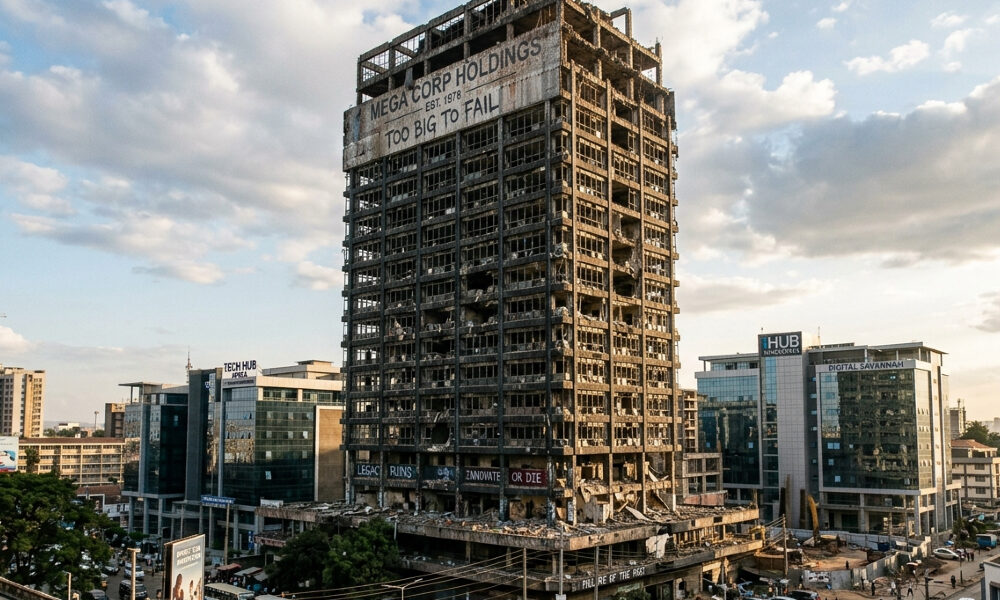
Why “Too Big to Fail” No Longer Holds


By Kei Rapodile
For much of the late twentieth century, scale was equated with stability. Large firms were treated as anchors of national economies – too embedded, too interconnected, too systemically important to be allowed to collapse.
The doctrine of “too big to fail,” popularized in the 1980s, rested on a straightforward premise: if a major company implodes, jobs disappear, supply chains fracture, and the broader economy absorbs the shock. Therefore, the company must be saved.
Four decades on, the empirical record demands a more sober assessment.
Over the past ten years, policymakers have repeatedly attempted to preserve corporate giants in the name of employment and stability, only to discover that intervention tends to postpone collapse rather than prevent it. The issue is not compassion – it never was.
The issue is structural reality. In the 2020s, longevity does not guarantee competitiveness. Innovation, not scale, determines survival.
Empires, Not Enterprises
To understand this shift, it helps to borrow from political theory. Scholars distinguish empires from modern nation-states by their structural composition. An empire is expansive, layered, and hierarchical – governing diverse territories through asymmetric power relationships and labyrinthine administrative systems.
It is large, but its very complexity generates fragility.
Many legacy corporations more closely resemble empires than adaptive enterprises. They expand across divisions and jurisdictions. They accumulate bureaucratic strata. Decision-making centralizes even as operational realities fragment. Influence grows, but agility erodes.
What made such firms formidable in one era – scope, reach, deeply embedded relationships – becomes structural drag in the next. When environments shift faster than hierarchies can respond, size stops being a shield and starts being a liability. And when these firms begin to fail, the instinct is preservation.
Yet preserving complexity does not restore competitiveness.
When environments shift faster than hierarchies can respond, size stops being a shield and starts being a liability.
The Lehman Lesson – and Its Limits
The global financial crisis illustrated this dynamic with unusual clarity. The collapse of Lehman Brothers exposed how institutional scale can mask systemic weakness.
The firm was deeply embedded in global markets; its failure was considered unthinkable – until it happened. The event was not merely a corporate bankruptcy. It demonstrated how interconnected size amplifies rather than absorbs risk.
More instructively, the federally arranged rescue of Bear Stearns months earlier did not prevent the broader collapse it was intended to forestall. Intervention deferred the reckoning; it did not dissolve it.
South Africa’s Cautionary Ledger
South Africa offers parallel case studies that merit more than cursory acknowledgment. Tongaat Hulett is perhaps the most instructive.
At 134 years old, it was a firm whose very longevity appeared to confer legitimacy. Yet that longevity had obscured compounding governance failures and debt burdens that, once exposed, required prolonged and painful restructuring.
The lesson was not that old companies fail – it was that age had been mistaken for resilience.
SA Express offers a starker arithmetic: a state-owned airline that attracted repeated bailout attempts before ultimately entering liquidation, with remaining assets reportedly sold for approximately R150,000 (US$9,300). That figure – the final price of what had once been positioned as a strategic national carrier – illustrates precisely how deferral amplifies destruction.
The longer structural failure is postponed through intervention, the less value survives to be recovered.
Group Five, once a flagship construction group, entered business rescue and eventual liquidation despite stabilization efforts. The South African Post Office has required repeated financial interventions while operational decline persisted. ArcelorMittal South Africa continues to face restructuring pressures amid global cost competition.
At Ekapa Mining, operations ceased amid financial distress, leaving workers exposed when the enterprise finally closed.
Internationally, similar trajectories unfolded. Rover Group collapsed despite repeated rescue attempts and ownership changes spanning decades.
Saab Automobile entered bankruptcy after years of struggling to compete in an industry defined by technological acceleration. In each case, the rescue logic was identical: scale justified preservation.
In each case, so was the outcome: restructuring arrived eventually, at greater cost than earlier decisive reform would have required.
Three Levels of Failure
These examples are not anomalies. They reveal a pattern that becomes visible when examined at three levels: the argument’s surface, its underlying assumptions, and the empirical evidence.
At the surface level, the case for bailouts appears humane and logical: protect jobs, prevent disruption, maintain continuity. It is a difficult argument to oppose in public.
At the level of ideas, deeper questions emerge. Does preserving a corporate shell protect productive capacity, or merely delay capital reallocation? Are governments investing in future competitiveness or subsidizing legacy inefficiency? Does size still correlate with strategic relevance in an innovation-driven economy?
At the level of evidence, the answers become difficult to ignore. Asset values collapse. Rescue plans extend timelines but not viability.
Debt burdens compound. Market share erodes. Eventually, liquidation or severe restructuring occurs – almost invariably at greater cost than earlier, decisive reform would have required.
Creative Destruction, Precisely Defined
The doctrine of “too big to fail” emerged in an era when industrial dominance equated to geopolitical strength. Steel, automotive manufacturing, banking – these sectors defined economic power.
In the 2020s, competitive advantage lies in adaptability, digital integration, and rapid iteration. Markets reward speed and innovation more than historical footprint.
Joseph Schumpeter described capitalism as a process of “creative destruction” – the continuous replacement of outdated structures by productive innovation. This framing is frequently invoked superficially, but its analytical content is precise.
Schumpeter was not simply describing failure; he was describing a mechanism by which failure enables renewal. Capital, talent, and market share released from uncompetitive enterprises flow toward those capable of deploying them more productively.
The critical distinction is between destructive episodes that clear the ground for genuine innovation and those that simply destroy capacity without enabling anything in its place. The policy question, therefore, is not whether to prevent destruction – it is whether a given intervention preserves something worth preserving, or merely delays the reallocation that productive renewal requires.
Attempts to indefinitely suspend this process tend to concentrate risk rather than eliminate it. The longer the deferral, the more violent the eventual correction.
Scale without renewal is not strength. It is deferred fragility.
Saving Workers, Not Institutions
None of this implies that workers are expendable. On the contrary, it highlights a policy misalignment that the bailout framework consistently obscures. Saving companies is not the same as saving employment.
When capital is locked inside uncompetitive enterprises, fewer resources remain for new sectors capable of generating sustainable jobs. The workers inside a failing firm are not best served by subsidizing the institutional structure around them – they are best served by frameworks that expand their options beyond it.
This requires a different kind of policy architecture. Labor mobility programs that reduce the cost of transitioning across industries. Portable retraining schemes that treat workers as agents rather than dependents of particular employers.
Active investment in entrepreneurial ecosystems in regions where legacy industries are contracting. And where intervention is genuinely warranted – where a firm has recoverable productive capacity and a credible path to restructuring – time-limited, condition-bearing support focused on transformation, not preservation.
The distinction between intervention that enables restructuring and intervention that merely defers it is not semantic. It is the difference between industrial policy and institutional subsidy.
An Ecosystem, Not a Fortress
Corporate empires, like political empires, often decline not because they are small, but because they become rigid. Overextension, administrative inertia, and resistance to transformation hollow out internal resilience.
When the external environment shifts rapidly, complexity becomes liability.
The contemporary economy behaves less like a fortress and more like an ecosystem. Ecosystems reward adaptability. Species that fail to evolve are replaced by those that can.
The uncomfortable responsibility of modern governance is to protect people without freezing the evolutionary process that ultimately serves them. The question is no longer whether a company is too big to fail. The question is whether our economic frameworks are too outdated to evolve.
Kei Rapodile is a registered Business Adviser and certified DTT Technician with a focus on Marketing, Construction, and ICT. He is the founder of Ebos Advisory, a micro advisory firm supporting enterprise growth and local economic development. Over the past 5 years, he has delivered 3,000m² of completed structures and trained over 500 students in digital literacy. With 10+ years of experience, Kei bridges strategy, infrastructure, and digital systems for practical impact. He is committed to reshaping South Africa’s built environment through innovation and inclusive enterprise.