Business
The Due Diligence Imperative: Trust as a Variable


By Naomi Mutuku
The continent’s investment landscape is defined by one core truth: risk is not merely a challenge – it is the mechanism that drives returns.
For investors willing to understand it rather than flee from it, that distinction is everything.
Africa’s risk profile is shaped by three interlocking forces: economic strength, legal and regulatory integrity, and political stability. Ignore any one of them, and even the most promising opportunity can unravel.
Master all three, and the continent’s outsized returns come into focus.
A Three-Tier Landscape
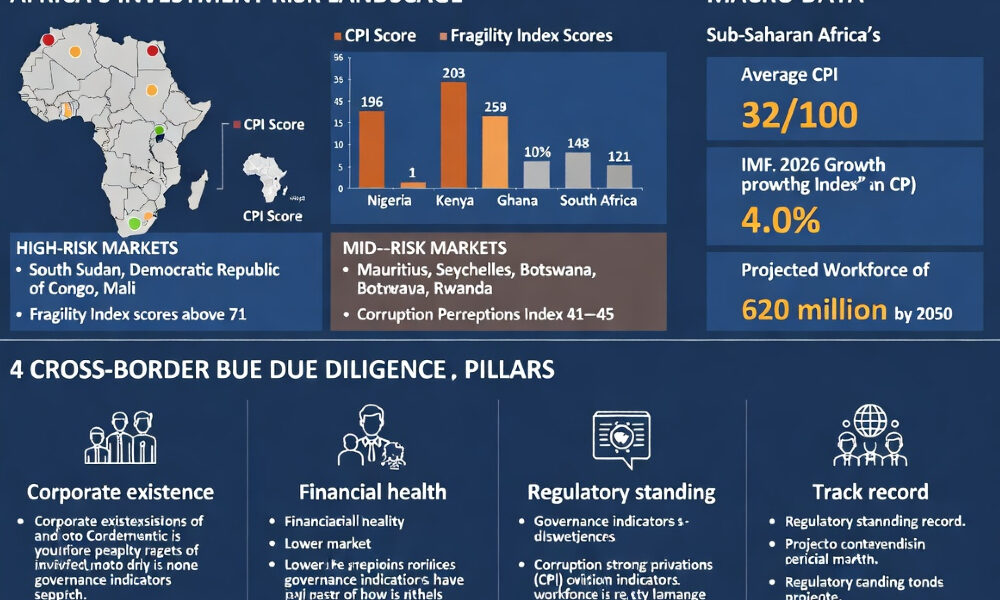
At the most volatile end of the spectrum sit markets where fragility is not a footnote – it is the operating environment. South Sudan and the Democratic Republic of Congo rank among the highest on global fragility indices, while Sudan, the Central African Republic, and the Sahel states of Mali, Burkina Faso, and Niger are defined by rising coups, armed insurgency, and institutional collapse.
Conflict is the backdrop; investor protection is largely theoretical. These are not markets for the faint-hearted or the unprepared. But they are markets, and for investors with deep local knowledge and genuine risk appetite, the mispricing of opportunity can be extraordinary.
The middle tier presents a more nuanced challenge. Nigeria, Africa’s largest economy, combines vast market scale with persistent foreign-exchange volatility and governance deficits that routinely surprise even experienced operators. Kenya functions as a regional commercial hub but carries meaningful corruption risk and a rising debt burden.
Ghana, despite a commendably resilient democratic tradition, is navigating a painful debt-restructuring process. South Africa’s Corruption Perceptions Index score – hovering between 41 and 45 – reflects deep structural tensions that constrain its considerable potential.
These are not broken markets. They are complicated ones, and the distinction matters enormously to investors who know how to structure around complexity.
Then there is the tier that rarely gets the attention it deserves. Mauritius posts a fragility score of roughly 17 – the lowest on the continent. The Seychelles leads Africa outright on corruption perception, scoring approximately 68 out of 100.
Botswana, Rwanda, and Cabo Verde have built governance frameworks that would compare favorably with many middle-income economies elsewhere in the world. Only about four African countries score above 50 on the Corruption Perceptions Index – a sobering reminder of how exceptional genuine institutional quality remains, and precisely why it commands a premium.
The Macro Case Remains Intact
None of this analysis exists in a vacuum. The International Monetary Fund projects Sub-Saharan Africa’s growth at around 4.0 percent in 2026, against a global backdrop of significantly more muted expansion.
The continent’s average CPI score of 32 out of 100 reflects real governance challenges – but it also reflects the scale of the premium available to investors who can navigate those challenges more skillfully than the market currently prices.
Most compellingly, Africa’s working-age population is forecast to exceed 620 million by 2050. No other region offers a demographic dividend of comparable magnitude.
The fundamental case for long-term capital deployment is not aspirational. It is arithmetic.
The Part No One Wants to Say Out Loud
Cross-border business is built on trust. But trust without verification is not strategy – it is exposure.
In practice, deals that appear solid on paper collapse with uncomfortable regularity the moment serious scrutiny begins. Not because the underlying opportunity was fraudulent, but because the due diligence was rushed, superficial, or dispensed with entirely in the rush to close.
Across jurisdictions, this pattern is depressingly familiar.
Operating across African borders means contending with divergent regulatory environments, opaque financial structures, inconsistent standards of corporate governance, and – in a non-trivial number of cases – counterparties whose existence beyond a well-crafted pitch deck has never been independently confirmed. Relationships and reputation matter, certainly.
Serious capital, however, demands that trust be backed by verifiable facts.
The questions that every investor should be asking before committing are deceptively straightforward: Who, precisely, is the counterparty? Do their financials withstand rigorous scrutiny? Are they compliant with local tax authorities and capital markets regulators? Do they have a demonstrable track record, or merely a compelling narrative?
The cost of skipping this process is not the due-diligence fee avoided. It is the compounded cost of financial loss, reputational damage, and strategic misdirection – losses that are rarely recovered and almost never anticipated by those who considered the shortcuts acceptable.
What Structured Verification Actually Looks Like
Effective due diligence in Africa is not a desk exercise. It requires on-the-ground verification across four dimensions: corporate existence and ownership structure, financial health under genuine scrutiny, regulatory standing with the relevant tax and capital markets authorities, and reputational history that extends beyond the names provided by the counterparty itself.
Investors entering new markets or evaluating unfamiliar partners cannot afford to rely on assumption. The information asymmetry is too great, the consequences of error too severe, and the availability of structured, local verification capability too often overlooked.
The Conclusion Smart Capital Has Already Reached
Africa’s risk is real. It is also quantifiable, navigable, and – for those who approach it with rigor – generative of returns unavailable in more efficient markets.
Smart capital does not avoid Africa’s risk. It prices it, structures around it, and captures the upside that others leave behind because they found the complexity inconvenient.
The question for serious investors is not whether to engage with Africa. It is whether they are doing so with the discipline the opportunity demands.
Naomi Mutuku is a trade and investment expert specializing in helping global companies enter Kenya and broader African markets. She focuses on reducing risk, accelerating market entry, and fostering sustainable growth. Based in Nairobi, Naomi is a regular commentator on Africa’s dynamic business landscape and is passionate about the continent’s growth potential. She can be reached via email at: mukuinaomi@gmail.com