Owusu on Africa
The DR Congo’s Plan to Disarm the FDLR: A Turning Point for Great Lakes Peace?
Kinshasa’s pledge to neutralize the Hutu rebel group is overdue – and its success is far from guaranteed.


By Fidel Amakye Owusu
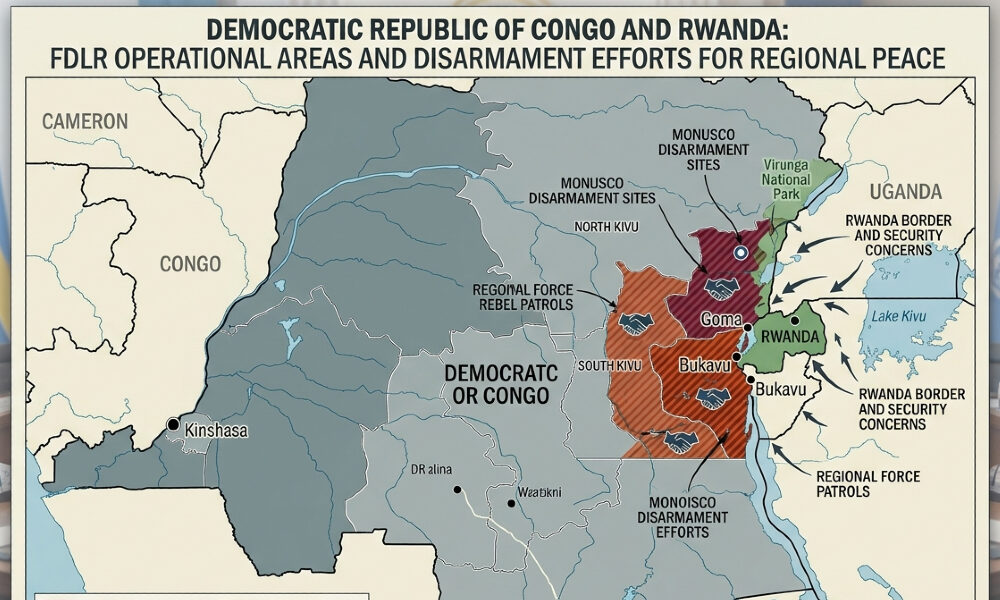
For decades, Rwanda has wielded a single argument to justify its deep and controversial entanglement in the affairs of its far larger neighbor: the Democratic Forces for the Liberation of Rwanda, better known by its French acronym, the FDLR. The rebel group – predominantly composed of ethnic Hutus and tied, at least in its origins, to the architects of the 1994 Rwandan genocide – has waged a persistent insurgency from Congolese soil against President Paul Kagame’s government in Kigali.
For Rwanda, its presence across the border has long served as both a genuine security concern and a remarkably convenient geopolitical justification.
That justification has been invoked most pointedly in relation to Rwanda’s alleged backing of the M23 rebel movement, which has destabilized eastern Congo for years, displacing millions and compounding one of the world’s most overlooked humanitarian crises. Kigali has consistently framed the neutralization of the FDLR as a non-negotiable precondition for any lasting peace.
Kinshasa, for its part, has largely resisted – until now.
A Commitment Long in Coming
The government of the Democratic Republic of Congo has now agreed to disarm the FDLR. The announcement, while short on operational detail, is being received as a potentially significant concession – one that analysts and regional diplomats have long argued is essential to any peace process with real teeth.
The timing is hardly coincidental. The pledge follows high-level talks between DR Congo and Rwandan officials in Washington, held to advance the implementation of a peace agreement signed earlier this year – an accord that has thus far produced more diplomatic momentum than measurable change on the ground.
It also comes in the wake of American sanctions on the Rwandan military and mounting pressure from several European governments, signaling that Western patience with the region’s perpetual instability is wearing thin.
Words and Their Weight
The DR Congo military’s language on the matter has been notably unambiguous. A military spokesperson declared that the FDLR will be disarmed “willingly or by force.”
On its surface, this is the rhetoric of resolve – a government projecting strength and signaling intent. But in a region where armed groups have proven themselves extraordinarily difficult to dismantle, such declarations carry a burden of proof.
History counsels caution. Eastern Congo has been the graveyard of more than a few ambitious disarmament initiatives. Armed actors in the region have repeatedly demonstrated the capacity to fragment, reconstitute, and re-emerge under new banners.
The FDLR, despite years of attrition, retains an ideological core bound by ethnicity, grievance, and fear – a combination that makes voluntary disarmament politically fraught and forced dismantlement operationally perilous.
There is also a demographic dimension that complicates the picture in ways rarely acknowledged in formal diplomatic discourse. The FDLR draws its membership overwhelmingly from Rwanda’s Hutu majority.
Any disarmament process that is perceived as ethnically targeted – or that fails to offer credible guarantees of safety and reintegration – risks deepening resentments rather than resolving them. Rwanda’s Tutsi-dominated government has cause to view the group with alarm; it also has reason to tread carefully in how that alarm is expressed and acted upon.
What Success Would Actually Require
The path to a durable outcome is narrow but navigable. A credible disarmament process would require, at minimum, international monitoring with genuine authority, transparent reintegration pathways that address the legitimate grievances of ex-combatants, and coordination between Kinshasa and Kigali that goes beyond photo opportunities.
Regional bodies – the African Union, the East African Community, and the Southern African Development Community – all have roles to play, though their track records in translating mandate into action remain uneven.
Crucially, any lasting resolution to the FDLR question must be situated within the broader M23 crisis. The two issues are not merely linked; they are, in Rwanda’s strategic calculus, explicitly conditional.
A DR Congo that follows through on FDLR disarmament removes Kigali’s most durable pretext for involvement in eastern Congo – and, in doing so, places the burden of reciprocal action squarely on Rwanda’s shoulders.
A Test of Regional Will
Kinshasa’s pledge to disarm the FDLR is, at minimum, a welcome development – a signal that the DR Congo is prepared to engage seriously with one of the central sticking points of a conflict that has claimed more lives than almost any other since World War II. Whether it represents genuine strategic commitment or a calculated diplomatic gesture remains to be seen.
The people of the Great Lakes region have endured too many false dawns to celebrate prematurely. What they deserve – and what the international community owes them – is not just a roadmap, but the sustained pressure and practical support needed to ensure that this time, the map leads somewhere worth going.
Fidel Amakye Owusu is an International Relations and Security Analyst. He is an Associate at the Conflict Research Consortium for Africa and has previously hosted an International Affairs program with the Ghana Broadcasting Corporation (GBC). He is passionate about Diplomacy and realizing Africa’s global potential and how the continent should be viewed as part of the global collective.