Opinion
The Digital Delusion: Why Africa’s Health Future Relies on Trust, Not Technology
The continent’s health crises will not be solved by technology alone – they will be solved by trust, trained workers, and communities that own the process.


By Naomi Mutuku
A few years ago, I was part of an international health initiative operating across 31 counties in Kenya. Like so many development programs before it, ours arrived with considerable excitement about technology. Dashboards gleamed. Digital tools promised efficiency. Reporting platforms were presented as the infrastructure of transformation.
And then something unexpected happened: the technology was not what moved the needle.
The most meaningful breakthroughs came from conversations held beneath trees, with community members who had been skeptical of outside programs for years. They came from rigorously trained healthcare workers and community health promoters who showed up, day after day, in places that data platforms could not reach. They came from painstaking engagement with county governments, chiefs, religious leaders, women’s groups, youth organizations, and the dense web of local institutions that actually structure daily life.
Within 12 months, measurable improvements in health outcomes began to emerge – not because anyone had downloaded an app, but because communities had come to trust the process and were invested in its success.
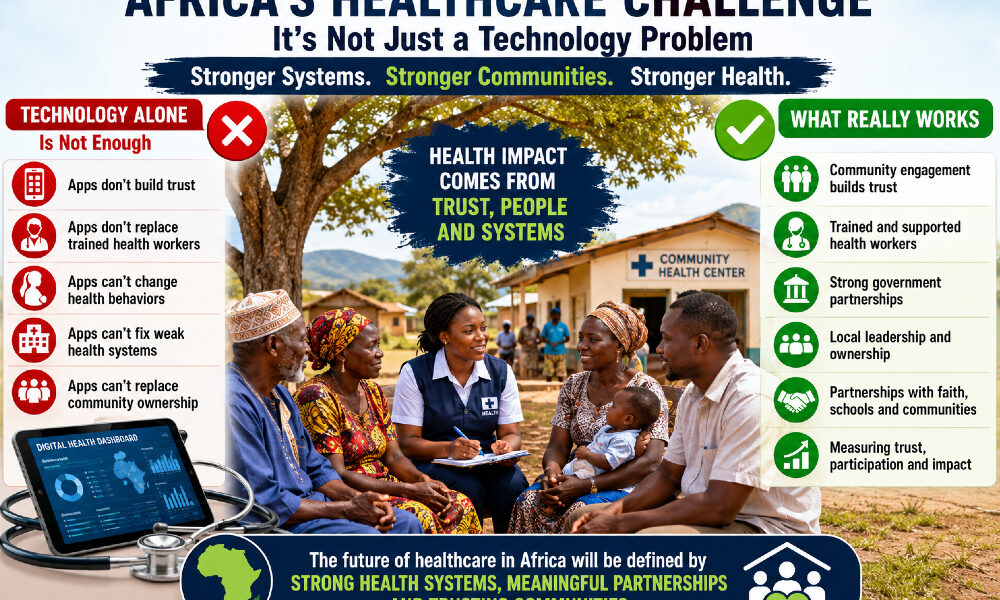
That experience crystallized a lesson that too few people working in global health are willing to say plainly: Africa does not have an app problem. It has a health systems problem, a workforce problem, a trust problem, and an implementation problem.
The Seduction of the Technological Fix
The appeal of technology as a development solution is understandable. It is visible, fundable, scalable in theory, and satisfying to announce.
A new digital health platform makes for a compelling grant proposal. A dashboard full of real-time data signals rigor and modernity. Investors and donors, many of whom made their fortunes in technology, are naturally drawn to solutions that resemble their own experience of disruption.
But health systems in sub-Saharan Africa are not waiting for disruption. They are waiting for sustained, unglamorous investment in the fundamentals that technology cannot substitute.
No application, however elegantly engineered, can replace a trained nurse who has built years of rapport in a rural community. No reporting platform can persuade a mother, wary of formal healthcare institutions, to attend her antenatal appointments.
No mobile tool can convince a hesitant parent to have a child vaccinated, nor can it repair a broken referral chain that leaves patients stranded between under-resourced facilities. And no digital system, deployed without community ownership, will outlast the funding cycle that created it.
These are not technology problems. They are human problems, and they demand human solutions.
What Actually Works
The evidence from decades of development practice – and from the experience described above – points to a consistent set of priorities that health leaders, donors, investors, and policymakers would do well to internalize.
Community engagement must precede technology deployment. Trust is not a precondition that can be assumed; it must be earned, and earning it takes time, presence, and humility. Programs that parachute in with digital tools before establishing genuine relationships with local communities tend to generate adoption metrics that mask shallow engagement and collapse once external support is withdrawn.
Healthcare worker training and retention are non-negotiable. The single greatest determinant of health system performance in low- and middle-income countries is the quality and continuity of its human workforce. Investment in training, supervision, and the conditions that make it possible for skilled workers to remain in underserved areas yields compounding returns that no platform can replicate.
Governments must be partners, not recipients. Durable health improvements require alignment with national and county governments, whose systems must ultimately carry the work forward. Programs that operate in parallel with – or in quiet circumvention of – government structures may generate short-term results, but they do not build the institutional capacity that sustains them.
Civil society is infrastructure. Faith-based organizations, schools, women’s cooperatives, and community groups are not peripheral to health systems – they are, in many contexts, the primary connective tissue between formal healthcare and the people it is meant to serve. They deserve to be treated as strategic partners, not as outreach channels.
Local ownership from day one. The question every program designer should ask is not “How do we transfer ownership at the end?” but “Why are we not building with local leaders from the beginning?” Programs that communities help design are the ones communities sustain.
Measure what matters. The development sector’s tendency to default to easily quantifiable metrics – app downloads, platform registrations, digital transactions – can systematically obscure what is actually happening on the ground. Trust levels, participation rates, community feedback, and sustained behavior change are harder to capture but far more predictive of lasting impact.
Technology as Enabler, Not Strategy
None of this is an argument against technology. Digital tools have genuine value in health systems: they can improve supply chain management, reduce reporting burden, support clinical decision-making, and connect workers in remote areas with specialist knowledge. Used well, they multiply the impact of capable, trusted, community-embedded systems.
The critical distinction is between technology as an enabler of strong health systems and technology as a substitute for them. The former is legitimate and powerful. The latter is a well-funded illusion.
The future of healthcare in Africa will not be written in app store download statistics. It will be written in the strength of health systems that can respond to crises without external scaffolding, in the quality of partnerships between governments, communities, and implementers, and in the depth of trust that makes communities active participants in their own wellbeing – rather than passive recipients of someone else’s solution.
That is a harder story to tell in a pitch deck. It is also the only story that ends well.
Naomi Mutuku is a trade and investment expert specializing in helping global companies enter Kenya and broader African markets. She focuses on reducing risk, accelerating market entry, and fostering sustainable growth. Based in Nairobi, Naomi is a regular commentator on Africa’s dynamic business landscape and is passionate about the continent’s growth potential. She can be reached via email at: mukuinaomi@gmail.com