Opinion
The Diaspora Dividend: Africa’s Most Underutilized Asset


By Charles F.V. Chitekwe
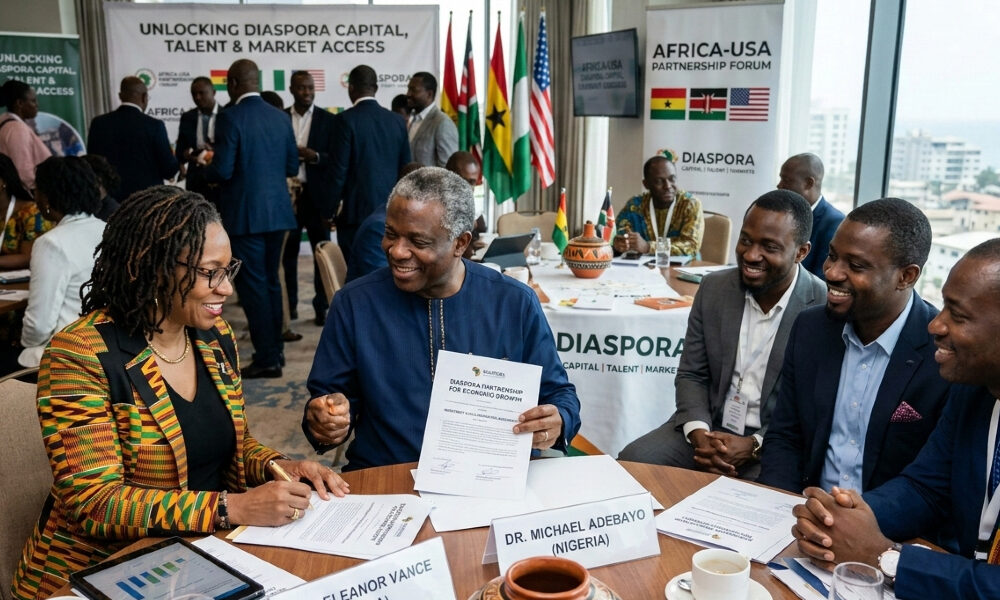
The African diaspora, and Black Americans in particular, represent one of the most powerful and untapped pools of capital, talent, and market influence on the planet. The continent’s leaders would be wise to treat them accordingly.
By any serious measure of economic potential, Africa is not short of resources. What it has historically lacked is a coherent strategy for mobilizing the ones hiding in plain sight. Chief among these is its diaspora – and within that broader community, Black Americans occupy a uniquely commanding position that the continent has yet to fully leverage.
This is not a conversation about sentiment or symbolism. It is a conversation about capital.
The Numbers Demand Attention
Consider the scale of what already flows between the diaspora and the continent, even without a formal strategy in place. According to the World Bank, remittances to Sub-Saharan Africa reached US$54 billion in 2023, with further growth projected through 2024.
Globally, remittance flows to low- and middle-income countries were expected to approach US$685 billion in 2024 – a figure that routinely dwarfs foreign direct investment and overseas development aid combined.
These are not charity transfers. They are the organic, distributed investments of people who have skin in the game.
Then consider Black American economic power specifically. The Selig Center for Economic Growth, as cited by Nielsen, projected Black American buying power at approximately US$2.1 trillion by 2026.
To put that figure in context: it would rank among the largest economies on earth if it were a country. That is not a niche market. That is a continent-scale force.
Taken together, the African diaspora – dispersed across North America, Europe, the Caribbean, and Latin America – functions less like a collection of individual households sending money home and more like a distributed sovereign wealth network. It is not controlled by any single government, it carries no IMF conditionalities, and it is capable of moving markets when organized with purpose.
What “Working With the Diaspora” Actually Means
The phrase is used frequently in pan-African discourse, but rarely with sufficient precision. To be clear about what genuine diaspora engagement entails, one must think beyond remittances.
The diaspora brings five distinct categories of strategic value to the table.
The first is capital – both direct investment and the ability to mobilize institutional finance through networks and credibility in Western financial markets.
The second is market access – Black American consumers and diaspora communities represent a global distribution channel for African-made goods and services that no trade agreement can replicate.
The third is skills and executive talent – a generation of African-descended professionals has risen to the highest levels of finance, technology, law, medicine, and policy in the United States and Europe, and their expertise remains largely untapped by the continent.
The fourth is institutional leverage – procurement networks, regulatory relationships, lobbying influence, and access to multilateral institutions that African governments often struggle to navigate alone.
The fifth, and perhaps most underappreciated, is branding and cultural distribution power – the global reach of Black American culture means that African products, companies, and narratives endorsed or adopted within that ecosystem gain an international platform that money alone cannot buy.
The Infrastructure Africa Must Build
None of this potential is self-activating. Capital without clear pathways dissipates. Talent without opportunity migrates elsewhere. Goodwill without structure collapses into frustration.
If African governments and institutions are serious about capitalizing on diaspora engagement – and they should be – they must build the rails that make it possible.
That means creating diaspora investment pathways that are genuinely simple, legally protected, and free from the bureaucratic friction that has historically driven outside investors toward more predictable markets.
It means developing bankable project pipelines: vetted small and medium-sized enterprises, credible trade opportunities, and counterparties whose due diligence has already been done. It means deepening the African Continental Free Trade Area so that diaspora investment can scale across the continent rather than being stranded within a single jurisdiction.
It means building trust infrastructure – digital identity systems, transparent compliance frameworks, reliable payment corridors, and enforceable dispute resolution mechanisms. And it means reframing the entire relationship: not “send money home,” but build enterprises together, as equal partners with aligned interests.
A Partner, Not a Patron
Africa does not need to be saved. That framing has caused enough damage. What Africa needs – and what the diaspora is uniquely positioned to help provide – is capitalization, connectivity, and scale.
The continent’s demographic trajectory, its resource endowment, and its growing consumer class already provide the foundation. What transforms a foundation into a structure is organized, strategic investment from people who have both the means and the motivation to see Africa succeed.
The future that serious pan-Africanists have long envisioned – a continental economy operating as a single ecosystem, anchored by a common currency and governed by unified institutions – is not achieved through declarations alone. It is built, transaction by transaction, institution by institution, with the full participation of every part of the African family, including the millions whose ancestors were taken from the continent by force and whose descendants have spent generations building wealth in exile.
The diaspora is not a development appendage. It is a strategic partner. Africa’s leaders should start treating it like one.
Charles F.V. Chitekwe is a diplomat and global relations specialist at the Alpha Sirius Foundation, where he advises heads of state, senior policymakers, and international delegations on Africa-focused diplomacy, trade, and development strategy. He advocates for a unified African position in global negotiations, promoting innovation-driven growth, investment, and economic self-reliance over aid dependency. He writes on African development, pan-African finance, diaspora investment, and the role of AI and technology in accelerating the continent’s economic transformation.