Business
The Demographic Reckoning: Why Europe’s Next Customer Lives in Kinshasa, Not Cologne
European boardrooms are optimizing for markets that are quietly disappearing – while the world’s fastest-growing consumer base goes uncontested.


By John Kourkoutas
The most consequential business map of the decade is not hanging in most European boardrooms. It should be.
Between now and 2050, the global population will grow by 1.4 billion people. Every one of the top ten fastest-growing nations is in sub-Saharan Africa. And virtually every market that European exporters have spent the past 30 years courting is heading in the opposite direction.
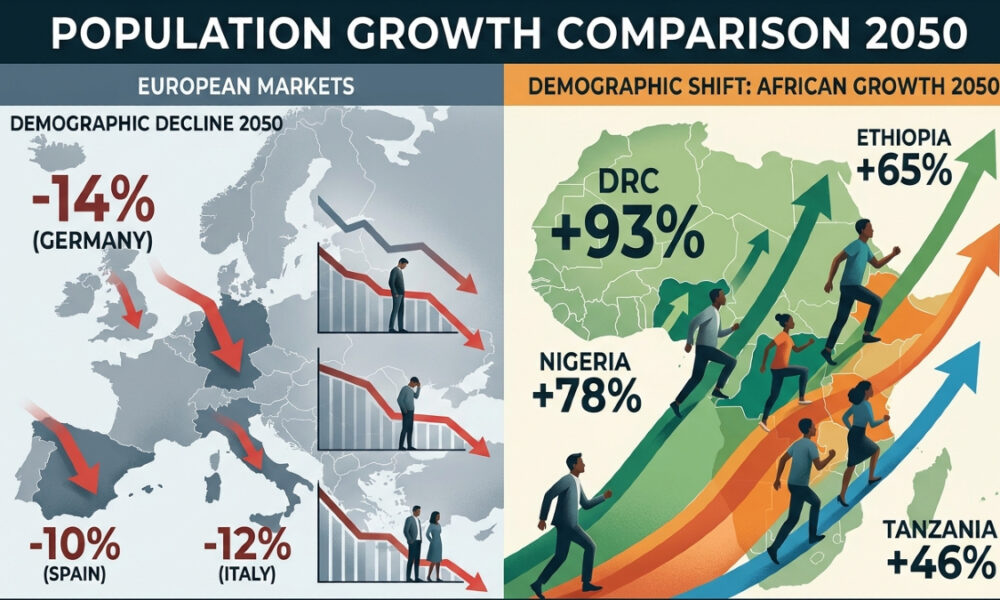
Consider the projected population changes by 2050 among the world’s most established export destinations:
- Italy: – 12.3 percent
- Germany: – 6.9 percent
- Spain: – 6.2 percent
- Poland: – 14.0 percent
- China: – 11.0 percent
- Japan: – 14.6 percent
- South Korea: – 12.6 percent
Read those figures again. These are not peripheral markets. These are the anchor economies around which entire European export strategies have been built, refined, and optimized across decades.
By mid-century, each of them will have fewer consumers, fewer workers, and lower aggregate demand than they do today. Now consider what is growing.
- DR Congo: +93 percent
- Central African Republic: +93 percent
- Angola: +90 percent
- Somalia: +89 percent
- Tanzania: +84 percent
- Mauritania: +77 percent
- Sudan: +65 percent
- Madagascar: +62 percent
- Namibia: +46 percent
The Democratic Republic of Congo alone will add more than 100 million people by 2050. That is the equivalent of an entirely new Germany – one consumer market, one country, in under 25 years.
Three Uncomfortable Truths European Executives Are Ignoring
First, most corporate growth strategies are implicitly staked on demographics that the United Nations says will not exist. The assumption that organic European market expansion can sustain a business through the next three decades is not a conservative position – it is a mathematical failure. The consumers simply will not be there.
Second, Africa’s growth story is not merely about population – it is about the composition of that population. While Europe ages steadily out of its productive workforce years, Africa is generating a young, urbanizing, economically ascending labor pool. The consumer-and-labor flywheel that powered Western economic expansion in the postwar era is now spinning, with increasing velocity, on a different continent entirely.
Third, the companies that will dominate in 2040 are building African distribution channels in 2025. Not because operating across African markets is straightforward – it is not. The infrastructure, regulatory, and logistical challenges are real and should not be romanticized. But competitive advantage is almost never earned in easy markets. It is earned by those willing to do the difficult work of establishing presence before the opportunity becomes obvious to everyone else.
The Window Is Narrowing
Most European executives will absorb this data, acknowledge it as interesting, and return to managing their German pipeline. The strategic logic of incumbency is powerful, and quarterly earnings cycles are not designed to reward 25-year bets.
But a smaller cohort of companies – the ones currently hiring Nairobi-based country managers, negotiating East African logistics partnerships, and adapting product lines for different price points and infrastructure realities – will look unremarkable today and dominant in a decade.
Category leadership in high-growth markets is not seized at maturity. It is built in the years when the market still looks too early, too complex, and too far from home.
The demographic map has already been drawn. The question is not whether Africa will be the world’s primary consumer growth engine by mid-century – the UN data makes that close to certain.
The question is which European firms will have earned the right to participate in it. Where will your customer base be in 2050?
John Kourkoutas is business development expert that specializes in helping companies, export teams, and business leaders succeed in Africa’s dynamic and emerging markets.