Opinion
The Demographic Dividend the World Cannot Afford to Ignore
Africa’s youth bulge is not a crisis in waiting – it is the most consequential growth story of the 21st century.


By Dishant Shah
Consider a map. The world, divided into four equal quarters of two billion people each.
One quarter encompasses the entirety of the Americas, Europe, the former Soviet states, and Russia combined. Another belongs solely to India and the broader South Asian subcontinent. A third to China and East Asia. The fourth to Africa and the Middle East.
Three of those quarters have spent decades navigating conflict, institutional fragility, and interrupted development. The one that did not, built the architecture of the modern global economy.
That is not an argument. It is merely a shape on a map – asking a quiet but penetrating question.
It also raises a more forward-looking proposition: a peaceful, stable Asia and Africa carries the potential to shatter every conventional growth forecast ever written.
The Number That Changes Everything
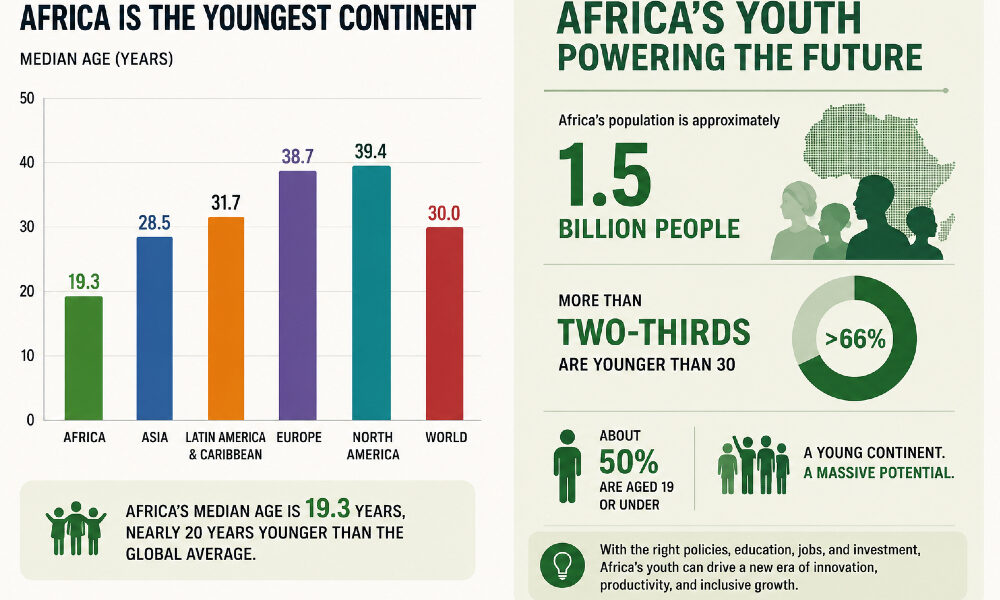
There is one figure that explains why Africa commands disproportionate attention from serious economists, demographers, and long-horizon investors: 19.3. That is Africa’s median age.
On a continent of approximately 1.5 billion people, more than two-thirds of the population is under 30. Half are 19 or younger. No other continent on earth comes close to this demographic reality – not Asia, not Latin America, certainly not an aging Europe scrambling to sustain its pension systems with declining birth rates and stagnant workforce participation.
Pause on that.
When economists speak of a “demographic dividend,” they mean the accelerant that ignites when a large, young, economically active population enters the workforce faster than dependents accumulate. It is not a theory. It is a mechanism – one with a well-documented historical record.
East Asia’s manufacturing miracle of the 1970s was powered by it. India’s services revolution in the 1990s rode it. China’s extraordinary two-decade expansion in the 2000s was inseparable from it.
In each case, a youthful, ambitious, and numerically overwhelming workforce did not merely participate in economic growth – it became the engine.
Africa is standing at precisely that threshold today. The difference is one of scale: no previous demographic dividend has ever been attempted with a population this large, this young, and with this much compounded historical growth to reclaim.
Not a Decade – a Century
This is not a once-in-a-generation opportunity. Such language undersells it. This is a structural, once-in-a-century inflection point – the kind that historians mark as the hinge between economic eras.
The African Union’s Agenda 2063 envisions a continent that has industrialized, integrated, and lifted hundreds of millions into the middle class within four decades.
McKinsey estimates that Africa’s consumer market will reach US$2.5 trillion by 2030. The African Continental Free Trade Area, now the world’s largest free trade zone by member nations, is already beginning to redirect intra-continental capital flows that previously bled outward.
The architecture of transformation is being assembled. The fuel – a young, hungry, rapidly urbanizing population – is already there.
What remains is the harder work: political environments that reward rather than punish enterprise; institutions that are functional rather than extractive; education systems that produce engineers, coders, agronomists, and entrepreneurs rather than credential-holders without markets to enter; and, critically, the infrastructure – physical, financial, and digital – that converts human potential into economic output.
None of that is simple. But none of it is novel. Every nation that has successfully executed a demographic dividend has done so through precisely this combination.
The Real Question
Africa’s trajectory is not fundamentally in doubt. The demography is not a projection – it is already here, breathing, growing, forming businesses in Lagos and Nairobi, writing code in Kigali, trading across borders in Accra.
The question that should occupy policymakers, multinational boards, and development financiers is not whether Africa will grow. It is whether the systems surrounding that growth – domestic governance, foreign investment models, international trade frameworks – will accelerate it or impede it.
For too long, the dominant model of external engagement with Africa has been extractive: remove the resource, repatriate the profit, leave behind a royalty and a road. That model is not only morally corrosive – it is economically obsolete.
A continent building a US$2.5 trillion consumer market does not need donors. It needs partners willing to build inside the continent, serve its needs at scale, and reinvest what they earn from it back into it.
The businesses and governments that grasp this shift earliest will not merely benefit from Africa’s growth. They will be constitutive of it – and the returns, financial and geopolitical, will reflect that positioning for generations.
Africa’s youth is not a burden to be managed. It is the single largest reservoir of untapped human capital on the planet. Given the right conditions, it will not simply close the gap with the developed world.
It will redefine what development looks like. The only question worth asking is whether those with the power to help will have the wisdom – and the self-interest – to get out of its way.
Dishant Shah is a partner at Legion Exim, a company specializing in facilitating the export of high-quality engineering products directly sourced from manufacturers in India to Africa. His areas of expertise include new business development and business management.