Editorial
The Curious Case of China [and Africa]
As at August 1, 2012, China has more medals than any other country at the London Olympic Games. The Chinese are probably on track to win just as many gold medals [51] as they did in 2008. Basically, since the 2004 Olympics in Athens, the U.S. has had to play second fiddle to the Middle Kingdom [although the U.S. collectively, has more medals than any other country].
Away from medals but still close to the Games, China is also ‘guilty’ of being the manufacturer of most of the clothes the athletes [including the Americans] are wearing. Granted, the Chinese did not design these clothes; however, the fact that Chinese hands were part of the value chain around the garments was provocative enough to some members of the U.S. Congress.
These honorable members of the legislature wanted to have a big ole bonfire with the Ralph Lauren designer pants, jackets, ties, [French] berets and other things. Basically, too much of a China is not a good thing!
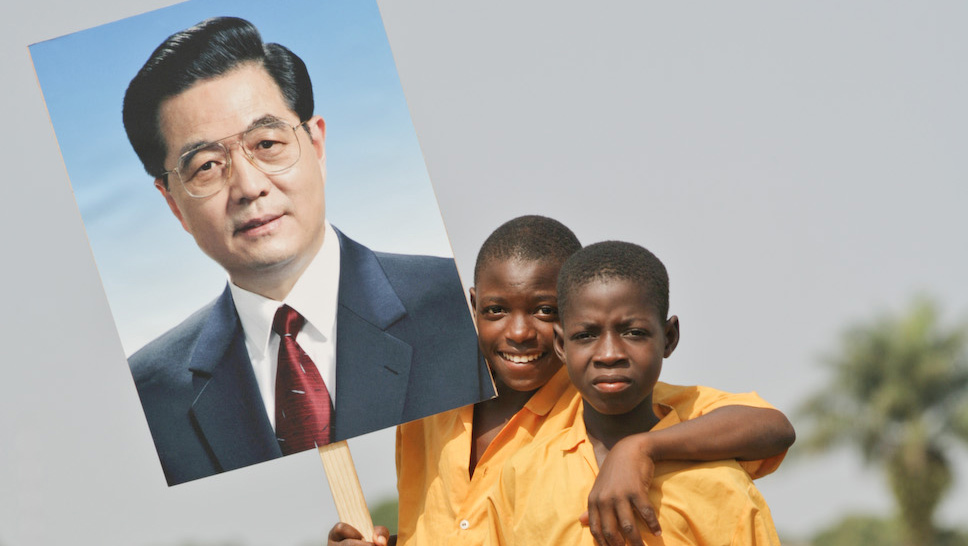
Back in the U.S. and in a great many cities across the earth especially in Africa, China is making a grant [and grand] show of its US$11 trillion dollar economy. The country is asserting itself in the infrastructure of African countries; it has even gone into the tourism trade of the Caribbean. Basically, when the Americans go to the tropics on holiday, they will be, just like they do when they go out to their malls to shop, enjoying the goods that come from the blood, sweat and tears of the Chinese.
And while this trifecta might not necessarily be an apt description of the labor or production situation in China, one cannot deny that the term ‘sweat shops’ was originated in China and exported to other aggressive countries around the world. Sweat shops produce more than sweatshirts. They produce sweat from either the young or the overexploited; they are associated with the gnashing of teeth and the working of the fingers to the bone. There is blood; there is sweat and there are tears in China; and these things are, unfortunately, going to be the norm in the tiger countries, in the emerging economies of Brazil, Russia [India already has sweat shops and a sweltering sweating people] and even South Africa. In Africa, the young people who squeeze into dark mines to dig for gold and other precious stones are already sweating, bleeding and crying for their mothers!
And that is why this paper believes that although China is now a world power, it is STILL not necessarily equitably equal to countries like Japan, Sweden, Finland, Denmark or even the U.S. These five, as an example, do not necessarily have to go to the great lengths that China currently goes to assert its national interest or sovereignty. They are, for the most part, relatively free and have a modicum of liberal democracy. Conversely, what should alarm everyone is the overall effect of internal Chinese politics.
Yes – the country has a great many people. Many of these are aggressively pushing for education – and in some cases, human rights. On the other hand, the central administration manages its people with such a heavy hand. One cannot read about everything else around the world even if they have access to the Internet. China elaborates puts a ‘protective’ ring around its people – and things like censorship bureaus pore over the fine details of movies before they come out in the cinema. Movie directors or musicians who try to criticize government or send subliminal messages of discontent in China’s media are noiselessly squashed while the country is awash with corruption.
The best allusion to China’s corruption is Nigeria on steroids!
All this notwithstanding, what is most galling about China is how it has successfully managed to infiltrate capitalism and seemingly show what a powerful entity the state can be. Call it what you may: the state acting as an arbiter, a regulator and an investor is the ultimate capitalist. Of course, one could argue that the state is not as motivated by profit as the individual businessman or corporation.
However, China is, again, profiting in more ways than one can imagine. With its state resources, China has a continuous stimulus package on hand whenever the country faces any economic strife. In this ‘downturn’ for the Chinese economy [where it is growing at about 8 percent in juxtaposition to America’s 1.5 percent], the country manipulates the Renmimbi to be more competitive against the dollar.
China has the kind of social safety net liberals go into fainting spells over. Its labor laws – with the absence of effective labor unions – can only be termed ‘ironic’: A nation founded on the Communist principals of sticking up for workers now neglects them. Reductively, American capitalists would consider China’s environment the ultimate investors/gangster’s paradise! No wonder a great many of them invest in China!
But we might miss the heart of the matter in this tale of woe: China is making a major case for itself. There are now more Asian American immigrants than Latinos and Africans. The Chinese immigrants lead the pack in terms of education, wealth and political influence. African immigrants are not even registering on the Richter scale in terms of investing or contributing to political campaigns to acquire influence. Thus, with more and more of China, expect Africa to continue to go further and further into the bottom of oblivion.
This editorial is a collation, fusion and a collaboration between the Editor and Prof. Emmanuel Musaazi of the Habari Network. For comments and responses, please write either emusaazi@thehabarinetwork.com or editor@thehabarinetwork.com