Opinion
The Coffee Paradox: Why Switzerland Profits More From Coffee Than All of Africa
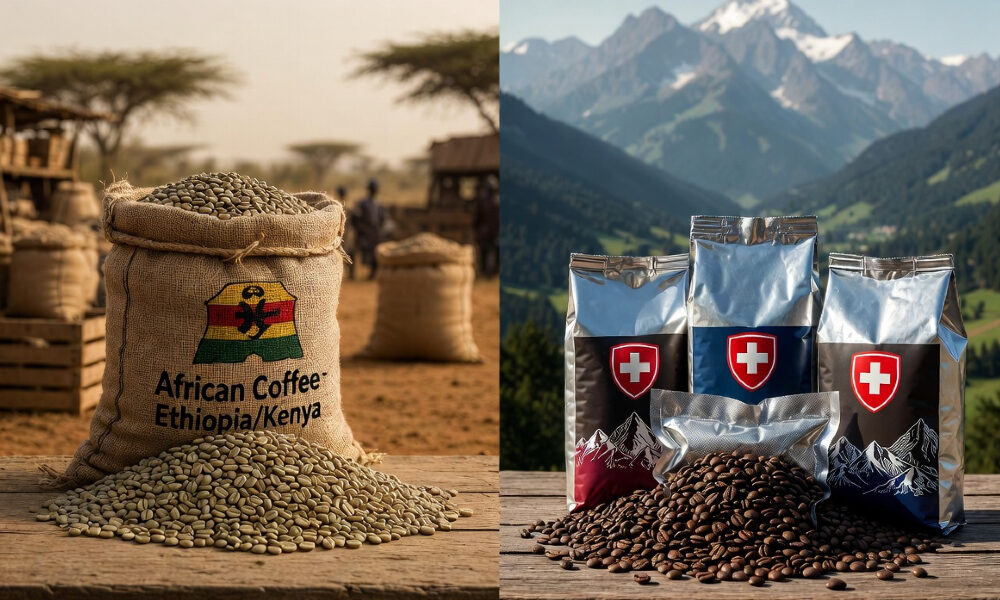
Switzerland has never grown a single coffee bean. Yet by most estimates, it earns more money from coffee each year than the entire African continent – the very birthplace of the crop. The gap explains more about global trade than any economics textbook.


By Endre Vestvik
Start with the numbers, because they do not seem to add up.
Africa is home to roughly 1.5 billion people and spans 30 million square kilometers. Switzerland has about 9 million residents tucked into 41,000 square kilometers – a landmass some 730 times smaller than Africa’s, with a population 170 times smaller. One of these places invented coffee as a global commodity. The other has no coffee farms at all.
And yet Switzerland, landlocked and bean-less, is widely considered one of the most valuable players in the global coffee trade, while Africa – the continent that gave the world coffee in the first place – captures only a sliver of the industry’s profits.
This is not a paradox. It is a business model.
A Continent of Farmers, a Nation of Financiers
Ethiopia, Uganda, Kenya, Tanzania, and Rwanda do the hard, unglamorous work of growing coffee: tending hillside farms, harvesting cherries by hand, and exporting raw green beans to the rest of the world. It is grueling, climate-exposed labor that forms the backbone of rural economies across East and Central Africa.
Switzerland, meanwhile, does almost none of that. Instead, it has built an empire around everything that happens after the harvest: roasting, instant coffee production, capsule manufacturing, global trading, branding, and the machines that brew the final cup. Some of the world’s largest coffee companies, commodity traders, and equipment makers are headquartered there. By some estimates, more than half of all globally traded coffee passes through Swiss trading houses at some point in its journey from farm to cup.
In other words, Switzerland doesn’t grow coffee – it owns the coffee industry.
The Real Value Lies Beyond the Farm Gate
This is the uncomfortable truth at the heart of global commodity trade: the people who grow raw materials are rarely the ones who get rich from them. The money is made downstream – in processing, packaging, branding, financing, and distribution – not at the farm gate.
Most African coffee leaves the continent exactly as it left the tree: unroasted, unbranded, and undervalued. African nations export raw beans and, in a strange twist of economic fate, often import the finished, branded product back at a steep markup. The continent supplies the raw material; other economies supply the meaning, the marketing, and the margin.
The prosperity gap that results is staggering. Switzerland’s GDP per capita exceeds US$115,000 a year. The African average hovers around US$2,000 – a difference of more than 50-fold. Coffee alone doesn’t explain that gap, of course. Switzerland’s wealth rests on banking, pharmaceuticals, precision manufacturing, and decades of institutional stability. But coffee is a near-perfect microcosm of a much larger structural problem: Africa has spent generations exporting raw potential and importing finished prosperity.
A Familiar Pattern, Repeated Across Industries
Coffee is hardly an outlier. The same script plays out across cocoa, cotton, gold, and a long list of other commodities that originate in Africa but accumulate their real value somewhere else. Ivory Coast and Ghana grow well over half the world’s cocoa, yet most chocolate manufacturing – and most chocolate profit – happens in Europe. The pattern is so consistent it has become a kind of economic law: whoever controls processing, branding, and distribution controls the profit, regardless of who controls the soil.
This is not a call to stop exporting raw coffee. Africa should – and will – continue to be one of the world’s most important coffee-growing regions. The real question is sharper than that: how much value is Africa leaving on the table by stopping at the farm gate?
Climbing the Value Chain Is the Real Opportunity
Imagine an Africa that roasted more of its own coffee, built its own globally recognized brands, financed its own trading houses, and exported finished, packaged products instead of raw beans. The shift would not happen overnight, and it would require investment in infrastructure, processing capacity, branding expertise, and access to capital – none of which materializes for free.
But the upside is just as real. Every step up the value chain – from grower to roaster to brand to retailer – captures a larger share of the final price paid by a consumer in London, New York, or Tokyo. Switzerland’s coffee fortune wasn’t built on owning farms. It was built on owning the parts of the supply chain that the rest of the world overlooked.
That is the real lesson buried inside this comparison. The future of African coffee shouldn’t be measured only in tons of beans exported. It should be measured in how much of the industry – the roasting, the branding, the trading, the machines – Africa eventually comes to own.
Growing coffee made Africa the foundation of a global industry. Owning more of what happens next could make it one of the industry’s biggest winners.
Endre Vestvik is an entrepreneur and founder and CEO of Kampala-based Wild Coffee, a company advancing value-added coffee production at the source in Uganda and across Africa. A self-described “coffee evangelist,” he champions fair trade, sustainability, and single-origin African coffee, working directly with farmers to eliminate middlemen, increase farmer incomes, and promote sustainable practices from farm to cup.