Opinion
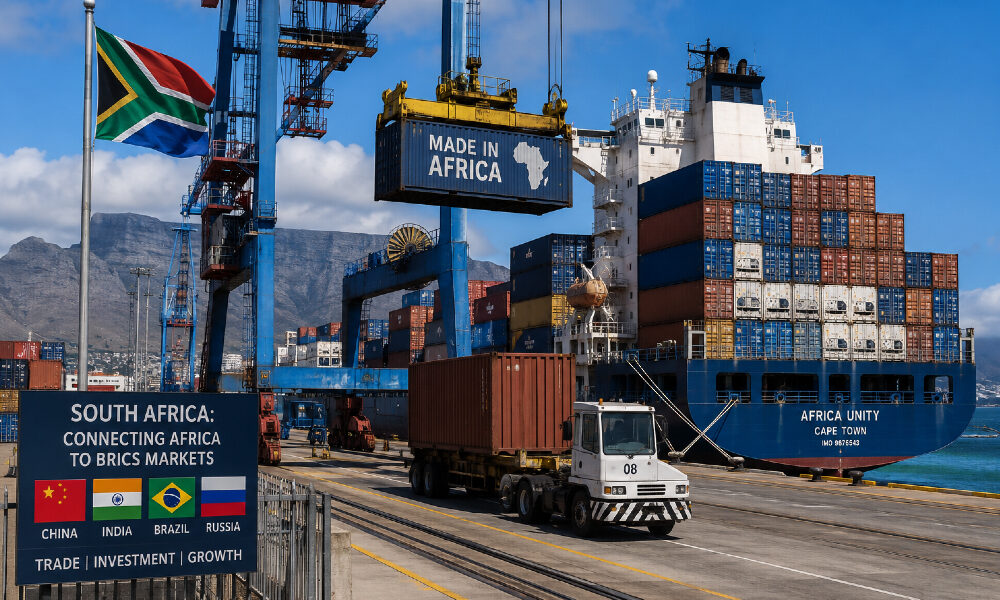
The BRICS Bridge: How South Africa Can Open Emerging Markets for the Rest of the Continent


By Jacqueléne Coetzer
South Africa occupies a particularly interesting position in the emerging architecture of global trade because it sits simultaneously inside Africa’s regional economic systems and within BRICS, the grouping that originally brought together Brazil, Russia, India, China and South Africa. South Africa joined BRIC in December 2010, becoming the 5th member and transforming the grouping into BRICS.
Since then, its position has evolved beyond symbolism. BRICS has become an important platform through which South Africa pursues South-South trade, investment, development cooperation and greater strategic diversification.
For African businesses, however, the real question is not simply whether South Africa belongs to BRICS, but how this position can be leveraged commercially. South Africa already functions as one of the continent’s major industrial, financial and logistics centere, while its membership of SACU and SADC gives it deep connections into Southern African trade architecture.
For an African company looking towards Brazil, China, India, Russia or the wider BRICS+ environment, South Africa can therefore offer something considerably more useful than another export destination – it can provide a commercial and institutional bridge into a much wider network of emerging markets.
This does not mean that South Africa provides automatic access to BRICS markets. BRICS is not a free-trade agreement, customs union or single market, and membership does not eliminate national regulations, customs requirements, currency issues or counterparty risk.
The South African National Treasury itself describes BRICS as a mechanism for dialogue and cooperation rather than a substitute for bilateral commercial relationships. That distinction is critical.
African companies should therefore use South Africa’s BRICS position as leverage, rather than as a shortcut. A company exporting processed agricultural products, minerals, manufactured goods, technology, professional services or specialist industrial products can use South Africa as part of a broader strategy involving South African distributors, manufacturers, financiers, logistics providers, trade missions, chambers and business associations, while simultaneously exploring relationships with BRICS partners.
Leverage, Not a Shortcut
The opportunity becomes particularly interesting because the BRICS relationships are already commercially substantial. South Africa’s trade with the original BRICS partners has grown significantly.
Government data show that in 2022, approximately 21.2 percent of South Africa’s total global trade was conducted with the other BRICS members, with China accounting for the largest share, followed by India, Brazil and Russia. South African exports to the other BRICS countries reached approximately US$17.6 billion in 2022, while imports lagged behind at US$32.4 billion.
China is by far the largest of these relationships. India is also a major trading partner, while Brazil and Russia provide important opportunities in agriculture, energy, minerals, industrial products and other areas.
South Africa’s latest trade data continue to demonstrate the significance of China and India within its external trade structure, with China accounting for 12.5 percent of South African exports and 22.7 percent of imports in June 2026, while India accounted for 12.2 percent of imports.
For African companies, this creates an important strategic possibility. Trade with South Africa does not have to end at South Africa. A South African relationship can become part of a wider supply chain in which African raw materials, agricultural products, manufactured goods or specialist services enter South African value chains and subsequently connect with BRICS markets.
Beyond South Africa: Tapping Into BRICS Supply Chains
The reverse is equally important. Companies from China, India, Brazil, Russia and other BRICS economies already use South Africa as an important African commercial platform because of its industrial base, financial infrastructure, logistics capability and regional positioning.
South Africa therefore has value not only as a market, but as a place from which international companies can build African operations.
This is one reason South Africa matters so much to the broader African trade architecture. For African businesses, the advantage is not simply “BRICS membership”.
The advantage lies in being able to combine African market knowledge with access to a country that already maintains substantial commercial relationships with major emerging economies.
Institutional Channels and Development Finance
There are also institutional channels that should be used far more deliberately. The BRICS Business Council, BRICS Women’s Business Alliance, embassies, trade missions, chambers and bilateral business associations can help companies identify partners, understand markets and establish relationships.
South Africa’s government has explicitly positioned BRICS as a mechanism through which it can create trade and investment opportunities and strengthen cooperation between emerging economies.
The same principle applies to development finance. The New Development Bank, headquartered in Shanghai and established by the BRICS countries, has become an additional source of financing for infrastructure and development projects in member countries, including South Africa. Its importance for Africa lies less in the idea of a “BRICS bank” and more in the practical possibility of mobilizing capital for infrastructure, transport, energy, water and other projects that can ultimately support trade.
The opportunity for African companies is therefore to think beyond selling into South Africa and start thinking about positioning within South Africa’s trade relationships. South Africa can be a market, a manufacturing partner, a logistics hub, a financial center, a regional gateway and a bridge into wider South-South commercial relationships.
But the bridge only has value if a company knows where it wants to go.
BRICS membership creates strategic leverage.It does not create commercial competence.
The companies most likely to benefit will be those that understand both sides of the equation – South Africa’s position inside Africa and South Africa’s position inside BRICS – and then deliberately structure their trade, investment and partnership strategies around both.
Jacqueléne Coetzer is a strategic trade and market analyst specialising in African and emerging markets. Her work focuses on structuring cross-border commercial relationships, connecting buyers and sellers, and facilitating trade across key sectors including commodities, diagnostics, and premium agricultural products. Her writing explores the realities behind global trade architecture, BRICS, and African economic development – not from a theoretical lens, but from active market engagement and transaction-level insight.