Opinion
The Big-Industry Myth: Why Africa’s Jobs Future Is Small
Chasing smokestacks has not solved unemployment. It may be time to bet on the workshop instead of the factory.


By Balbir Singh
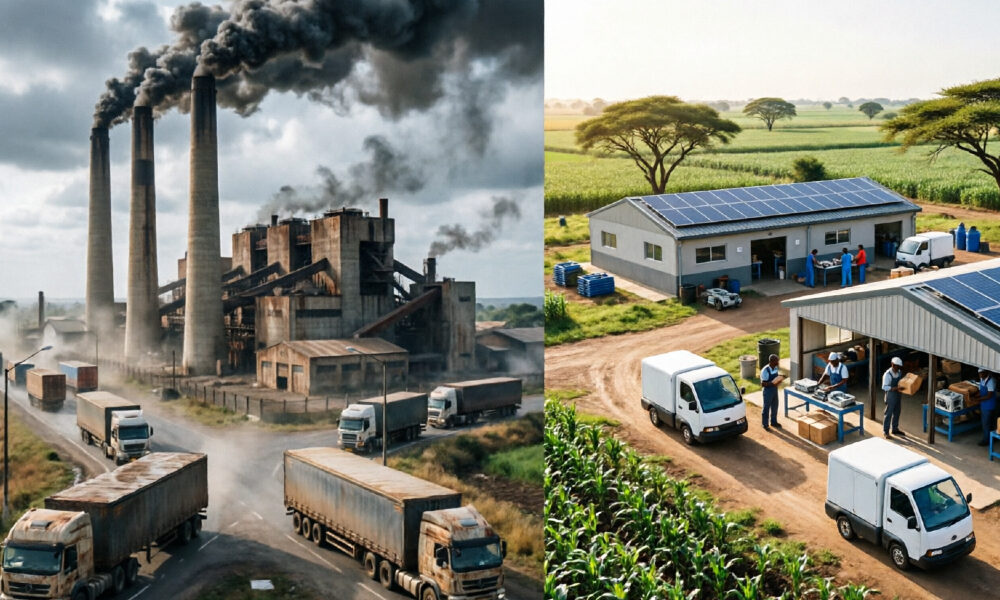
For decades, the promise has been the same: attract a big industrial plant, and jobs and prosperity will follow. Governments across Africa have staked their development strategies on this idea, courting steel mills, refineries, and assembly plants with tax holidays and industrial parks. Yet the results tell a more complicated story.
South Africa, Mexico, Venezuela, and Egypt are all home to large, capital-intensive industries. All four also struggle with unemployment rates near or above 30 percent. Even wealthy economies with vast industrial bases, such as the United Kingdom and the United States, have watched manufacturing jobs stagnate or vanish even as output has climbed. The pattern is hard to ignore: big industry does not reliably mean big employment.
Compare that with countries built on small and home-based enterprises. In India, China, Vietnam, Rwanda, Kenya, Indonesia, and Japan, small-scale and household industries account for a large share of jobs – by some estimates, employing roughly 80 to 90 percent of the workforce in these economies. These businesses have proven remarkably durable, adapting to downturns in ways that massive, single-site plants often cannot.
Why Bigger Isn’t Always Better
Large industrial facilities tend to cluster in major cities, for reasons of infrastructure, financing, and access to ports. That concentration comes at a cost. Raw materials must be hauled in from distant regions, and finished goods are often shipped right back out to the same rural markets that supplied the inputs in the first place. Every mile of that round trip adds to logistics costs, carbon emissions, and the final price tag for consumers.
The pull of the big city also draws workers away from rural areas, straining urban housing, sanitation, and health systems while hollowing out the communities left behind. And even where big industry does generate jobs, labor conditions on assembly lines and in mega-factories are not always the humane, dignified work that development planners promise.
The Case for Small and Circular
A more resilient model already exists – it simply needs more attention from policymakers. Consider a small soybean oil mill built in the district where the soybeans are actually grown. Only the finished oil needs to travel to distant consumers. The soybean cake left over becomes feed for local livestock and poultry, and the remaining byproducts return to the same fields as fertilizer, helping grow next season’s soybean crop.
This is a circular economy in miniature: raw materials, processing, and even waste all stay close to home. Transport costs fall. Local skills and technical know-how grow. Rural communities gain steady income without being pushed to migrate to overcrowded cities. And because the entire cycle happens within a small radius, the environmental footprint shrinks dramatically compared with a supply chain stretching across a country or a continent.
Rethinking Africa’s Industrial Playbook
None of this is an argument against large-scale industry altogether. Steel, energy, and heavy manufacturing will always have a role to play in national economies, including in Africa’s. But policymakers who treat mega-projects as the primary route to mass employment are backing the wrong horse. The evidence from small-industry economies suggests that durable job creation, rural stability, and environmental sustainability are more often built from thousands of small workshops than from a handful of giant factories.
For African governments looking to industrialize without hollowing out their rural economies, the lesson is straightforward: invest in small-scale and home-based industry, keep processing close to the source of raw materials, and let the jobs – and the sustainability – follow.
Balbir (Shekhawat) Singh, PhD, is a results-driven agribusiness techno-commercial professional with over 18 years of experience in sales, marketing, agronomy, product management, farming, commodity trading, and agri-inputs (fertilizers, seeds, agrochemicals). Passionate about advancing sustainable farming, he currently serves as Director General/CEO of Sodesep SA-Fertilizer Abuja, Nigeria. He has worked across emerging markets including India, Uganda, Kenya, Cameroon, Tanzania, Indonesia, and Nigeria.